
- Salvaging materials during demolition starts with identifying what’s actually worth saving before any wall comes down.
- Lumber, doors, fixtures, brick, and hardware are the most commonly salvaged items in residential demolition projects.
- Sorting materials on-site as you go is far more efficient than trying to separate a mixed debris pile afterward.
- OSHA’s engineering survey requirement applies before demolition begins, even on projects planning heavy salvage work.[1]
- What you don’t salvage still needs a plan for disposal — dumpster sizing should reflect what’s actually left over.
Why Salvaging Materials During Demolition Pays Off
Every demolition project has some material worth saving, even if it doesn’t look that way at first glance. Salvaging materials during demolition means taking the time, before or during teardown, to remove items that still have value — whether that value is financial, through resale, or practical, through reuse in another project. For Peoria homeowners tackling a renovation or a full teardown, this step can meaningfully reduce disposal costs while keeping usable material out of the waste stream entirely.
The EPA’s research on construction and demolition materials makes the case clearly: recovering valuable materials for further use protects natural resources and can save money compared to sending everything straight to a landfill.[2] That said, salvage work does take planning. Materials have to be identified early, removed carefully, and stored somewhere safe until they’re reused or sold — none of which happens automatically once demolition starts.
Zap Dumpsters Peoria works as your local sourcing partner throughout this process, connecting you with the right dumpster size for whatever debris remains once the salvageable material has been set aside.
What’s Actually Worth Salvaging
| Material | Salvage Value | Notes |
|---|---|---|
| Framing lumber | High, especially older growth wood | Denser and often stronger than new lumber |
| Doors and trim | Medium to high | Vintage styles are in demand at salvage yards |
| Cabinetry | Medium | Solid wood cabinets salvage better than particleboard |
| Brick | Medium | Requires careful, slow removal to avoid breakage |
| Fixtures and hardware | Medium to high | Light fixtures, doorknobs, and hinges often resell well |
| Drywall, damaged material | Low to none | Usually goes straight to the dumpster |
Structural Lumber
Framing lumber is usually the single biggest salvage opportunity in a residential demolition. Buildings constructed decades ago often used old-growth wood that’s simply denser and stronger than what’s commercially available today. The EPA specifically notes that wood-framed buildings, particularly those with heavy timbers, beams, or unique species like Douglas fir or old-growth southern yellow pine, tend to be the easiest and most valuable to deconstruct for material recovery.[2]
Fixtures, Hardware, and Architectural Details
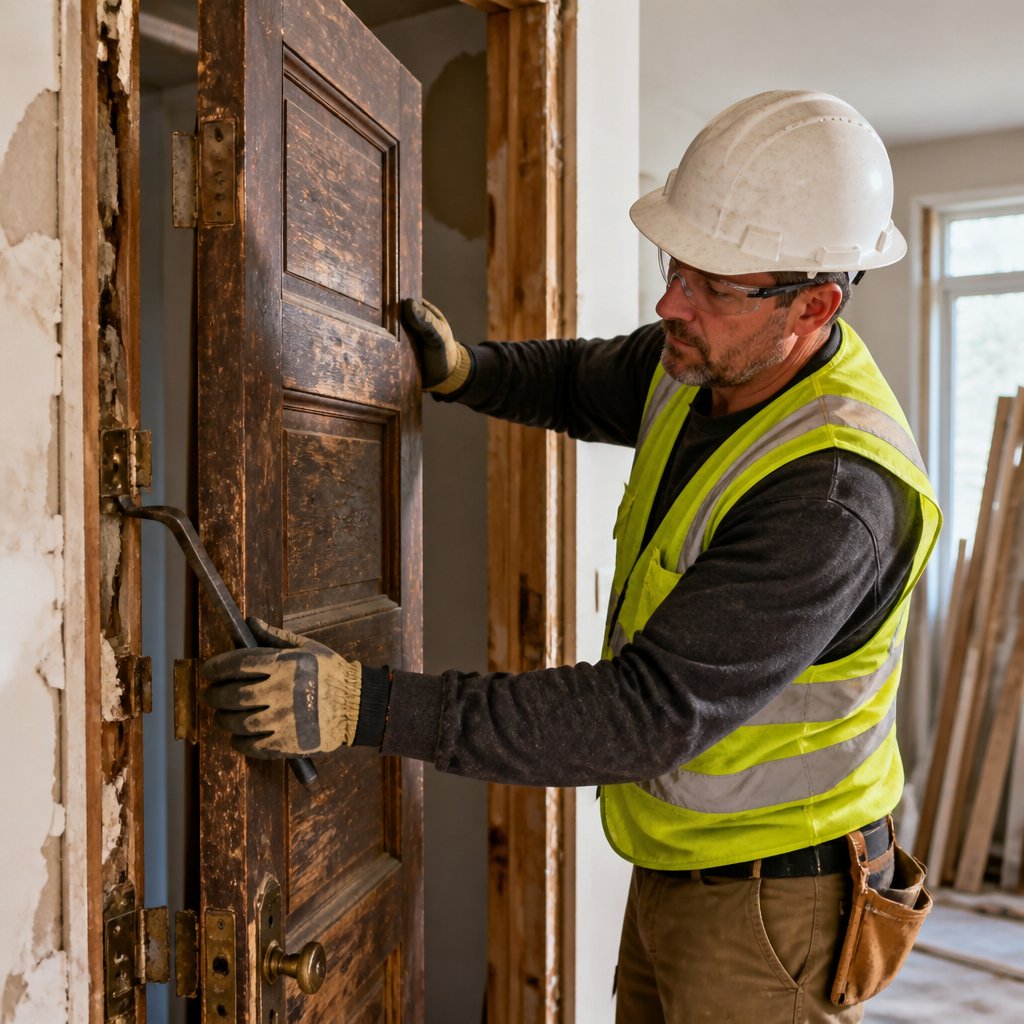
Doors, trim, doorknobs, hinges, and light fixtures from older homes often have a style and build quality that’s hard to find in newer construction. These smaller items are also the easiest to remove without specialized equipment, making them a good starting point for any salvage effort, even on a project that will otherwise be handled through standard demolition. A single afternoon spent pulling doors, hardware, and light fixtures before the crew arrives can be enough to fill a truck bed’s worth of resalable material, even on a home headed for full teardown the next day.
How to Plan a Salvage Effort Before Demolition Starts
Salvaging materials during demolition works best when it’s planned before the project begins, not improvised partway through. Walk the structure first and make a list of items worth saving — lumber, fixtures, cabinetry, brick — and decide where each one will go once it’s removed: reuse in another project, sale to a salvage yard, or donation to a reuse organization like a Habitat for Humanity ReStore.
Materials removed carefully and set aside before heavy demolition begins are far more likely to survive the process intact than anything pulled from a mixed debris pile afterward. Once framing lumber, brick, or fixtures get crushed together with drywall and shingles, their salvage value drops dramatically or disappears entirely.
Safety Still Comes First
Even a salvage-focused project needs to follow the same safety groundwork as standard demolition. OSHA requires a written engineering survey by a competent person before demolition operations begin, assessing the structure’s framing, floors, and walls for the risk of unplanned collapse.[1] This matters just as much — arguably more — when workers will be spending extra time inside a structure carefully removing materials rather than knocking walls down quickly from a distance with equipment.
Quick Decision Table: Salvage or Skip?
| Material Condition | Recommendation |
|---|---|
| Solid, undamaged lumber or trim | Salvage |
| Fixtures in working condition | Salvage |
| Water-damaged or rotted wood | Dispose |
| Cracked or broken brick | Dispose (unless repurposed for fill) |
| Drywall, insulation, damaged flooring | Dispose |
Tools and Techniques for Careful Removal
Salvaging materials during demolition is as much about technique as it is about planning. Pulling nails straight through instead of prying boards apart at odd angles helps keep lumber intact and usable. A flat bar and a hammer go a long way for trim and molding, while a reciprocating saw can cut through nails cleanly when a board is too stubborn to pry loose without cracking. Working from the top of a structure down, rather than bottom-up, also tends to keep more material intact, since it avoids destabilizing pieces you still need to remove.
Cabinetry and fixtures usually come out easiest when unscrewed rather than pried, so having the right screwdriver bits and a cordless drill on hand before the project starts saves a surprising amount of time. For brick, patience matters more than tools — brick laid with low-quality or degraded mortar tends to break apart cleanly with hand tools, while high-strength modern mortar often means the brick cracks before the joint gives way. Testing a small section early tells you quickly whether brick salvage is realistic for a given structure or better left to standard demolition.
Where the Rest of the Debris Goes
Once salvageable material is set aside, whatever’s left still needs proper disposal. Mixed demolition debris — broken drywall, damaged wood, old flooring, and general construction waste — should go straight into your dumpster rather than piling up around the salvage area. Keeping the two piles physically separate throughout the project makes it much easier to track what’s being saved versus what’s being hauled away, and helps avoid accidentally tossing something with resale value into the debris pile.
Salvaging Materials During Demolition Near You
Salvaging materials during demolition takes a little extra planning, but the payoff — lower disposal costs, resale opportunities, and less material headed to the landfill — is usually worth it for projects with real salvage potential. Even a modest effort, focused on the highest-value items like lumber and fixtures rather than trying to save everything, can meaningfully shrink the volume of true waste your project produces and, in turn, the dumpster size you need to handle it. For a closer look at how demolition compares to a full deconstruction approach, our guide on demolition vs deconstruction waste management differences breaks down when each method makes the most sense.
Whatever’s left after your salvage work is done, Zap Dumpsters Peoria works as your sourcing partner for demolition debris removal, helping connect you with the right container size near you.
Salvaging Materials During Demolition FAQs
What materials are most worth salvaging during demolition?
Framing lumber, doors, trim, cabinetry, brick, and fixtures like light fittings and hardware are typically the most valuable items worth salvaging during demolition.
Does salvaging materials during demolition slow down the project?
Yes, salvaging materials during demolition generally adds time compared to standard teardown, since items need to be removed carefully rather than knocked down with equipment.
Can I sell salvaged materials from my demolition project?
Many salvage yards and reuse organizations purchase or accept usable lumber, fixtures, and architectural details, which can help offset the extra labor time involved in careful removal.
Do I still need a dumpster if I’m salvaging most materials?
Yes, even projects with significant salvage work generate leftover debris like drywall, damaged wood, and general waste that still needs proper disposal.
Is an engineering survey required before salvage-focused demolition?
Yes, OSHA’s demolition standard requires a written engineering survey before operations begin, regardless of whether the project emphasizes salvage or standard teardown.