
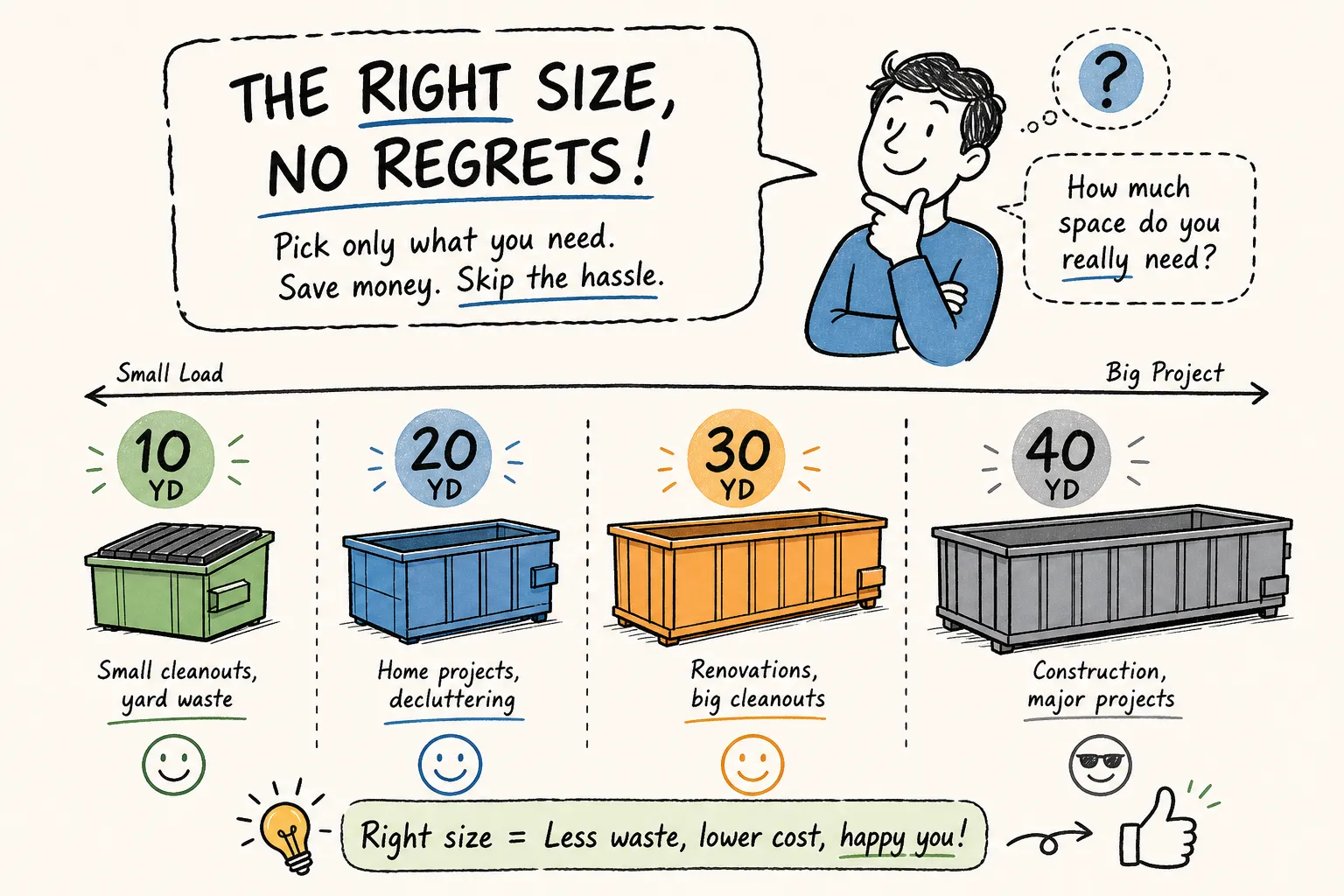
Choosing the right dumpster rental sizes is the most common question our team at Zap Dumpsters Peoria IL fields on nearly every call. Amongst all the calls for roll-off containers for Central Illinois, we’ve seen the same two mistakes repeat: renting too small and paying for a second pickup, or renting a container so large it sits half-empty while you pay for capacity you never touched. In our experience, both mistakes cost real money and both are easy to avoid.
This guide covers the four most common roll-off sizes we can get you, what actually fits inside each one, weight limits that catch people off guard, and the placement basics you need to know before booking. Read through it once and you’ll have a clear answer before you ever pick up the phone.
How roll-off dumpster sizes work
Dumpster capacity is measured in cubic yards. One cubic yard is a cube that measures three feet on every side. Picture a standard washing machine: that’s roughly one cubic yard. A 10-yard dumpster holds ten of those cubes. That mental image makes the numbers concrete before you start comparing dumpster rental sizes.
Use this table as your reference point. Dimensions vary slightly between manufacturers, but these are the industry-standard benchmarks for the four most common roll-off sizes we carry. For a helpful size chart that mirrors these industry standards, see Budget Dumpster’s size guide.
| Size | Dimensions (L × W × H) | Contractor Bags | Pickup Truck Loads | Typical Weight Limit |
|---|---|---|---|---|
| 10 yard | 14′ × 7.5′ × 3.5′ | ~60 bags | 4 loads | 1, 2 tons |
| 20 yard | 22′ × 7.5′ × 4.5′ | ~120 bags | 8 loads | 3 tons |
| 30 yard | 22′ × 7.5′ × 6′ | ~180 bags | 12 loads | 4, 5 tons |
| 40 yard | 22′ × 7.5′ × 8′ | ~240 bags | 16 loads | 5, 6 tons |
The sections below map each of these four dumpster rental sizes to real projects so you can match your job to the right container without second-guessing yourself.
Choosing dumpster rental sizes for your project
The 10-yard dumpster: the right tool for small, contained jobs
At 14 feet long, 7.5 feet wide, and 3.5 feet tall, a 10-yard container has a compact footprint that fits most residential driveways without drama. It holds about 60 contractor bags or the equivalent of four full pickup-truck loads. The weight limit typically runs between one and two tons, which matters as soon as tile, old fixtures, or drywall enter the picture.
This size is the right call for a single bathroom remodel, a garage cleanout clearing out old furniture and boxes, a small deck tear-down, or a seasonal yard debris haul. The 10-yard isn’t a “starter” dumpster, it’s the right container for genuinely small projects, provided there’s no heavy masonry or dense debris involved. If your job stays within one or two rooms and doesn’t involve heavy masonry, a 10-yard covers it. Renting larger than you need wastes money every time. For practical packing and loading strategies specific to this size, check our 10-Yard Dumpster Loading Tips & Contractors Planning Tool.
The 20-yard dumpster: the most-rented size, and for good reason
The 20-yard rolls in at 22 feet long, 7.5 feet wide, and 4.5 feet tall. That translates to roughly 120 contractor bags or eight pickup-truck loads. Weight limits usually land around three tons. This is the most frequently rented roll-off size in the country, and the reason is simple: it hits the practical sweet spot between residential volume and a manageable footprint.
A 20-yard makes sense for a full kitchen remodel with cabinet and appliance removal, whole-house flooring replacement across hardwood, tile, and carpet, a basement cleanout, or a single-story estate cleanout. It also handles roofing jobs on a standard ranch home. If your project spans multiple rooms or produces debris from several material types, the 20-yard is your default. A second delivery fee almost always costs more than just booking the right size upfront.
The 30 and 40-yard containers: built for large-scale work
The 30-yard: major renovations and multi-room demolitions
The 30-yard shares the same length and width as the 20 but stands six feet tall instead of 4.5. That extra height adds significant volume: around 180 contractor bags and 12 pickup-truck loads. Weight limits sit in the four-to-five-ton range. The footprint stays manageable, but the capacity jumps considerably.
This size fits full roofing tear-offs on larger homes, multi-room renovation projects combining kitchen, bathrooms, and flooring, large estate cleanouts across a two-story home, or storm debris removal after a major weather event. Small to mid-size construction crews doing remodels in the Peoria area often reach for a 30-yard as their standard job-site container. It handles volume without the logistics of a full 40-yard unit.
The 40-yard: new construction, demolitions, and commercial sites
The largest standard roll-off runs 22 feet long, 7.5 feet wide, and eight feet tall. It holds up to 240 contractor bags and 16 pickup-truck loads, with weight limits reaching five to six tons. This container is designed for new home construction, full structure demolitions, large commercial cleanouts, and ongoing job sites generating high-volume debris day after day.
For job sites in the Peoria area running with a full crew, a 40-yard is often the right starting point, though it’s worth confirming site constraints like permit requirements, driveway access, and weight limits with your provider before loading begins. In many cases, the price difference between a 30 and a 40 is smaller than the cost of a second haul once you’ve run out of room mid-project. At construction scale, start with the 40 and confirm capacity with your waste provider before loading begins.
Weight limits, heavy materials, and what catches people off guard
Volume and weight are two separate things, and most people only think about one of them. Dense materials like concrete, dirt, asphalt, and brick reach weight limits long before the bin looks full. One cubic yard of solid concrete weighs approximately 4,050 pounds. Even a partially filled 10-yard dumpster can hit its weight cap quickly when loaded with concrete. Overage fees typically run $25 to $100 per ton above the stated limit, and those charges add up fast. For more on how dumpster capacity and weight interact, review this dumpster weight guide.
The materials that catch people off guard most often:
- Concrete and asphalt: Dense enough to max out a weight limit with just a few yards of material. Standard 10-yard containers carry a 1, 2 ton weight allowance; if you’re disposing of significant concrete volume, ask your provider specifically about heavy-debris configurations and their associated weight allowances before booking.
- Roofing shingles: Can weigh anywhere from 2,500 to 9,500 pounds per cubic yard depending on material type and moisture content, with heavier figures applying to slate or waterlogged material.
- Dirt and excavated earth: Wet soil runs 2,100 to 3,000 pounds per cubic yard and fills weight limits quickly on landscaping and grading jobs.
The fix is straightforward. Tell your rental company what materials you’re disposing of, not just the volume. Ask about weight limits before booking, not after the container is loaded. If concrete, shingles, or dirt are part of the job, ask specifically about heavy-debris pricing. A reputable local provider sizes the container and weight allowance together based on what you tell them. If they don’t ask about materials when you call, that’s a sign to ask the questions yourself.
Getting the right container delivered in Central Illinois
Placement, permits, and driveway logistics
For most residential jobs in Peoria, driveway placement requires no permit. Once the container moves to a public street, that changes. Placing a roll-off in the city’s right-of-way requires a permit through the Peoria Public Works Department, currently priced at $20 per 30-day period. Confirm current permit details with the city’s official guidance at the Peoria Public Works site: Peoria dumpster and portable storage container rules. If you’re working outside Peoria or want a general overview of local placement laws, this dumpster placement laws guide is a useful reference.
The standard placement rules apply here: keep the container at least 15 feet from a fire hydrant, 20 feet from a corner, and clear of any driveways, emergency access points, or overhead obstructions for the delivery truck. HOAs add another layer, with some neighborhoods restricting visible container placement regardless of permit status. Check all three before you book: the city, your HOA, and your driveway’s surface stability for larger units.
Why working with a local provider matters
Zap Dumpsters Peoria IL can get you the full range of roll-off sizes from 10 to 40 yards; the team has direct, on-the-ground knowledge of Peoria city codes and Central Illinois regulations. That means you get specific answers on permit requirements, not generic advice from a national call center that has never been to your street. Local knowledge removes the guesswork on placement, sizing, and what debris your project actually generates.
Pricing in Central Illinois for weekly roll-off rentals, at the time of writing, currently runs roughly $350, $582 for a 10-yard, $450, $672 for a 20-yard, $500, $801 for a 30-yard, and $550, $891 for a 40-yard. Those ranges reflect local market rates, not national averages padded with fees you’ll only see on the final invoice. Ask any provider you’re considering to confirm exactly what’s included in the quoted price, weight allowance, rental period, and any applicable overage rates, before you commit. For protecting yourself on the fine print, read our Dumpster Rental Contracts Guide: Save Money, Avoid Surprises.
The short version, before you call
Small single-room projects belong in a 10-yard. Most residential renovations and cleanouts fit a 20-yard. Large multi-room or full-property projects need a 30-yard. Anything at construction scale starts at 40. The most expensive mistake is guessing wrong, because a second delivery or an overweight fee consistently costs more than booking the right container from the start.
If you’re not sure which dumpster rental sizes fit your job, describe the project to the team at Zap Dumpsters Peoria IL and get a straight answer on what to rent. The full size range is available, pricing is transparent, and local knowledge of Central Illinois permits and placement requirements comes standard. For a deeper look at matching projects to sizes around Peoria, see our article on Peoria Construction: Selecting the Right Roll-Off Dumpster. That’s the whole process.
Frequently asked questions about dumpster rental sizes
What dumpster rental size do I need for a kitchen remodel?
Most kitchen remodels, including cabinet removal, appliance disposal, and flooring tear-out, fit comfortably in a 20-yard dumpster. If you’re also tackling adjacent rooms or removing heavy tile throughout the house, step up to a 30-yard to avoid a second haul.
How do I compare dumpster rental sizes and weight limits?
Start with the volume your project generates (use the contractor bags or pickup-truck-load equivalents in the table above), then factor in material density. Light debris like drywall, wood, and cardboard rarely approaches weight limits. Dense materials like concrete, brick, and roofing shingles can hit weight caps well before the container looks full. Always tell your provider what you’re disposing of so they can match both the dumpster rental capacity and the weight allowance to your job.
Do I need a permit for a dumpster in Peoria, IL?
Driveway placement on private property typically requires no permit. If the container needs to sit in a public right-of-way or on the street, a permit through the Peoria Public Works Department is required, currently $20 per 30-day period. Confirm size restrictions and clearance requirements for your specific street before delivery.
What is the most common dumpster rental size for residential projects?
The 20-yard is the most frequently rented size for residential work. It handles most whole-home cleanouts, multi-room remodels, and standard roofing jobs without requiring the larger footprint of a 30- or 40-yard container.