
Key Takeaways
- A room-by-room plan keeps you moving and prevents overwhelm during your spring clean.
- Sorting items into clear categories — keep, donate, recycle, and trash — before you remove anything saves time and money.
- Some items you uncover, like old paint, pesticides, and certain electronics, require special disposal under Illinois law.
- A roll-off dumpster rental can handle the heavy volume that a single cleanout produces far faster than curbside pickup.
- Knowing your costs upfront helps you choose between a dumpster rental and a full-service junk removal option.
The most effective spring cleaning junk removal strategies start with a room-by-room sorting plan before anything leaves your home. Once you know what you are removing and how much of it there is, matching the right disposal method — donation, recycling, hazardous waste drop-off, or a roll-off dumpster — keeps your Peoria cleanout on track and out of the landfill whenever possible.
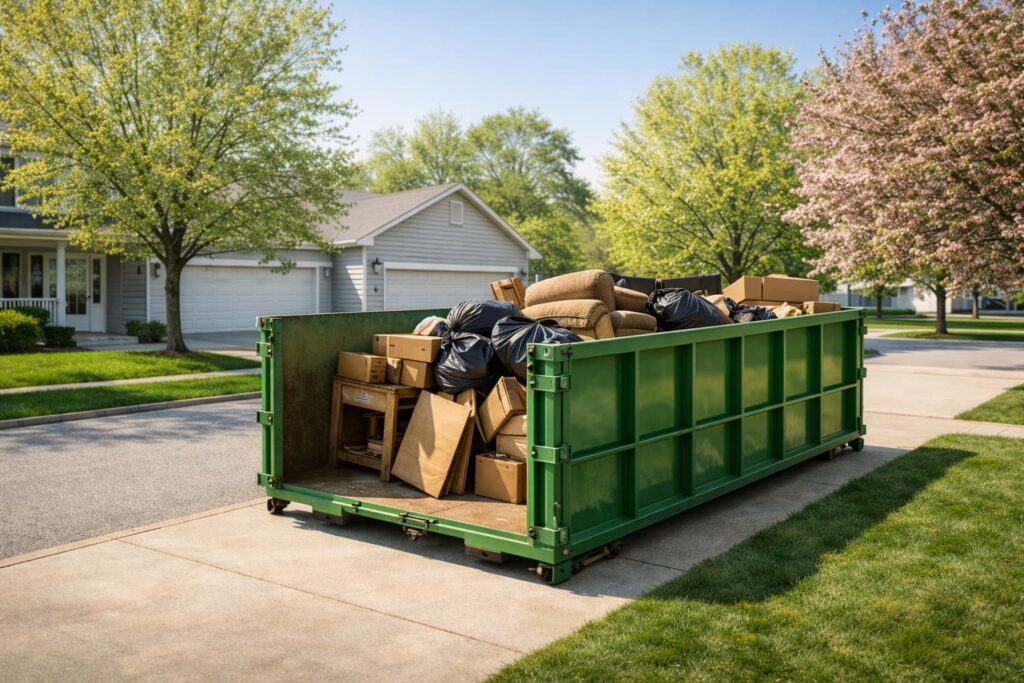
Why Spring Cleaning Junk Removal Strategies Matter More Than Ever in Peoria, IL
Spring in Peoria arrives with warmer temperatures, open windows, and the sudden awareness that your home has quietly collected a winter’s worth of clutter. According to a 2025 survey by the American Cleaning Institute, 80% of Americans plan to spring clean each year, and among those, 57% say decluttering and organizing is their top motivation.[1] That motivation is real, but without a clear disposal plan, most of that junk simply moves from one room to another.
Peoria homeowners face a specific challenge that other guides overlook: Illinois has strict rules about how certain household waste must be handled. Old paint, pesticides, and many electronics cannot just go in your regular trash bin. Knowing this before you start — not after your garage is already half-empty — is what separates a clean home from a compliance headache.
The good news is that a solid plan turns what feels like an overwhelming project into a manageable series of small wins. A room-by-room approach, combined with smart sorting before a single bag leaves the house, is how Peoria residents get the most out of their spring cleaning effort. When the volume of what you are removing outgrows curbside pickup, a roll-off dumpster sourced through a local service like Zap Dumpsters Peoria’s residential junk removal dumpster rental service gives you a single, convenient container for bulky items, debris, and general household waste — all at your own pace.
Most homeowners significantly underestimate how much material a thorough cleanout produces — often far more than several weeks of regular curbside pickup combined.
Quick Decision Guide: Which Disposal Method Is Right for Your Junk?
| Item Type | Best Disposal Method | Why |
|---|---|---|
| General household clutter | Roll-off dumpster rental | High volume, flexible schedule |
| Clothing, furniture (good condition) | Donate locally | Keeps usable items out of landfill |
| Oil-based paint, pesticides, chemicals | Illinois EPA HHW collection event | Required by Illinois law |
| Computers, TVs, phones | Certified e-waste recycler or HHW event | Electronics banned from Illinois landfills |
| Renovation debris (drywall, lumber, flooring) | Roll-off dumpster rental | Mixed materials, high weight |
| Medications (expired or unused) | DEA take-back program or HHW event | Prevents water contamination |
| Appliances (refrigerator, washer) | Roll-off dumpster or appliance hauler | Bulky, may need Freon removal first |
Room-by-Room Spring Cleaning Junk Removal Strategies That Actually Work
The room-by-room method works because it gives you a defined start, a defined finish, and visible progress throughout. Trying to tackle an entire house at once leads to half-sorted piles in every hallway and no room actually finished. Instead, pick one space, clear it completely, and move to the next. Here is how to approach each area of your Peoria home.
Kitchen: Expired Food, Broken Appliances, and Drawer Clutter
The kitchen produces more low-grade clutter than almost any other room. Start with your pantry shelves and pull everything forward. Check expiration dates and set aside anything past its use-by date. Next, open every drawer and cabinet. Mystery gadgets, duplicate tools, and cracked storage containers all qualify as junk. Small appliances that have been sitting unused for more than a year — toaster ovens, blenders with broken lids, single-use gadgets — can go into a donation box if they still work or into your trash bag if they do not.
The key habit for the kitchen is the “flat surface rule”: nothing stays on a counter, table, or shelf unless it is used at least once a week. This rule alone eliminates the creeping piles that accumulate between deep cleans. When your kitchen junk fills a bag or two, that goes straight into your dumpster or designated trash — do not let it sit out as a staging area.
Bathrooms: Medications, Cosmetics, and Expired Products
Bathrooms are small rooms that collect a surprising amount of waste. Old cosmetics, half-used bottles of shampoo, expired over-the-counter medications, and worn-out accessories like cracked soap dishes all add up. Pull everything out from under the sink and from shelves before you start sorting — seeing it all at once helps you make faster decisions.
Medications deserve special attention in Peoria. Flushing pills or pouring liquid medications down the drain can introduce pharmaceutical compounds into the water supply. The better option is a DEA-authorized drug take-back location or the Illinois EPA’s Household Hazardous Waste (HHW) collection events, which accept pharmaceuticals along with chemicals and other hazardous materials.[2] Illinois EPA coordinates these free HHW collection events each spring and fall, and pre-registration is required for 2026 spring events — so check the schedule early.
Bedrooms and Closets: Clothing, Furniture, and Forgotten Storage
Clothing is where most people stall. A useful rule of thumb: if you have not worn it in 12 months, it goes. Pull everything out of your closet before making keep or donate decisions — sorting in place means you never see the full picture. For items in good condition, Peoria has several local donation centers and thrift shops that accept clothing, shoes, and bedding.
Furniture is a different story. Broken bed frames, wobbly dressers, and outdated pieces that have been stored “just in case” all take up valuable space. These bulky items are exactly where a roll-off dumpster earns its keep. Trying to break down a particleboard dresser for curbside pickup is tedious — dropping it whole into a rented container takes seconds.
Living Room: Electronics, Media, and Décor
The living room often hides a decade’s worth of obsolete technology: DVD collections, old gaming consoles, tangled cable boxes, and televisions that have been replaced but never removed. In Illinois, most electronics are banned from landfill disposal, which means they cannot simply go in a standard dumpster either. Look for certified e-waste recyclers in Peoria County or bring them to an Illinois EPA HHW collection event, which accepts many consumer electronics alongside household chemicals.[2]
Decorative items — excess picture frames, knick-knacks, outdated artwork — are easy to over-keep. Ask honestly: does this item have a permanent home and a purpose, or is it just filling space? If you find yourself justifying its presence rather than genuinely wanting it displayed, it belongs in the donation box or trash.
Home Office: Paper Shredding, Old Tech, and Outdated Supplies
Home offices accumulate paper faster than almost any other surface in the house. Financial records older than seven years, outdated instruction manuals, old printer cartridges, and broken office equipment all qualify as spring cleaning targets. For sensitive documents, a cross-cut shredder handles the job safely — shred into bags and the paper can go into standard recycling.
Old printer cartridges cannot go in the general trash due to chemical residue. Most office supply retailers in Peoria accept cartridge recycling for free. Broken printers, scanners, and computers count as e-waste under Illinois law and must be diverted from landfills through proper channels.
Garage and Basement: The Biggest Spring Cleaning Junk Removal Challenge
Garages and basements are where Peoria homeowners discover the true scope of their spring cleaning project. These spaces collect everything that does not have a clear home elsewhere: old paint cans, broken tools, seasonal items that were stored “temporarily” three years ago, and boxes that have been moved from house to house without ever being opened.
Paint and chemical products require particular care. Oil-based paints, solvents, thinners, pesticides, and antifreeze are all classified as household hazardous waste under Illinois regulations. They cannot go in your roll-off dumpster or standard trash. The Illinois EPA runs free, pre-registered HHW collection events where Peoria-area residents can drop off these materials safely and at no charge.[2] Latex paint is handled differently — it does not qualify for HHW events but can be dried out and disposed of with regular trash once fully solidified.
For everything else in the garage and basement — broken power tools, old lumber, worn-out sporting equipment, discarded appliances, and general debris — a roll-off dumpster placed in your driveway is the most efficient solution. The sheer volume that comes out of a typical Peoria basement or garage during a serious cleanout will quickly overwhelm curbside pickup limits.
Ready to Clear the Clutter This Spring?
Zap Dumpsters Peoria helps you source the right roll-off container for your home cleanout — no guessing, no oversized bins.
The Sort-First Method: A Smarter Spring Cleaning Junk Removal Strategy
The single biggest mistake in residential cleanouts is skipping the sort. Moving items out of a room before you have decided what happens to each one creates secondary piles throughout the house and often means good donations end up in the trash simply because there was nowhere else to put them. The sort-first method fixes this.
Four Categories That Keep Your Cleanout Moving
Before anything leaves a room, set up four clearly labeled boxes or areas: Keep, Donate, Recycle, and Remove. Every item you touch gets placed into one of these four spots — no “maybe” pile allowed. The absence of a maybe pile is what makes this method work. If you cannot decide in 30 seconds, it goes in the Remove category. Indecision is the enemy of progress in a cleanout.
Keep only what has a specific, designated home in your space. If you are keeping something but cannot identify exactly where it will live once the room is clean, put it back in the Remove category. Clutter is almost always the result of keeping items without a permanent place for them.
Deciding What Qualifies as Junk
Professional organizers often use time-based tests to cut through the indecision. Have you used this item in the past year? Would you buy it again today at full price? If the answer to both questions is no, it is junk regardless of how much it originally cost. Sunk cost is one of the strongest emotional forces keeping clutter in Peoria homes, and recognizing it for what it is helps you let things go more cleanly.
For items with sentimental value that you genuinely cannot use, consider digitizing photos of them before discarding. This approach preserves the memory without consuming physical space — particularly useful for inherited items, children’s artwork, and old hobby equipment.
Dumpster Rental vs. Full-Service Junk Removal: Which Spring Cleaning Strategy Fits You?
| Factor | Roll-Off Dumpster Rental | Full-Service Junk Removal |
|---|---|---|
| Typical Peoria cost | $250 – $650 depending on size | $75 – $523 depending on load size[3] |
| Physical labor required | Yes — you load it yourself | No — crew handles everything |
| Timing flexibility | High — fill over days or weeks | Low — one appointment, done fast |
| Best for large volumes | Yes — whole-house cleanouts | Better for single rooms or items |
| Best if mobility is limited | Not ideal | Yes — crew does all heavy lifting |
| Renovation debris accepted | Yes — drywall, lumber, tile | Varies by company |
For most whole-house spring cleanouts in Peoria, a dumpster rental tends to offer better value per pound removed. For an informed breakdown of what you can expect to pay, the average junk removal cost guide for Peoria, IL walks through typical load sizes, pricing tiers, and the factors that affect your final bill.
Handling Hazardous Waste During Spring Cleaning in Illinois
Spring cleaning in a Peoria garage or basement almost always turns up materials that fall under the Illinois EPA’s household hazardous waste rules. This is the part of the cleanout most guides skip, yet it is the one that creates real environmental and legal risk when handled incorrectly.
What Counts as Household Hazardous Waste in Illinois
The Illinois EPA defines household hazardous waste as residentially generated materials that are potentially dangerous when no longer used for their intended purpose.[2] Common examples found in Peoria homes during spring cleaning include oil-based paints and stains, paint thinners and solvents, antifreeze, motor oil, weed killers, insecticides, pesticides, and fluorescent light bulbs. All of these items must go to a designated HHW collection event — not in your regular trash and not in a roll-off dumpster.
Illinois EPA has coordinated free one-day HHW collection events since 1989, and over 401,000 Illinois households have used these events to dispose of hazardous materials safely. Pre-registration is required for all 2026 spring events. Check the Illinois EPA’s HHW collection schedule at epa.illinois.gov to find the nearest event date.[2]
What You Can Put in a Dumpster vs. What You Cannot
A roll-off dumpster is an excellent tool for general household junk — furniture, clothing, general debris, non-hazardous construction materials, broken appliances without refrigerants, and yard waste. It is not the right container for anything on the hazardous materials list above, for electronics subject to Illinois e-waste laws, or for liquids of any kind. When you call to source a container, the team at Zap Dumpsters can walk you through which items are acceptable and which need to be separated for special handling — saving you from potential additional charges or violations.
Electronics Disposal Rules in Peoria
Illinois has banned most consumer electronics from landfills under the Illinois E-Waste Recycling Act. Televisions, computers, monitors, printers, and many other devices must be recycled through registered collectors. Peoria County has certified e-waste collection locations, and these items are also accepted at qualifying Illinois EPA HHW collection events. Do not put them in your dumpster — keep them staged separately and plan their drop-off before or after your main cleanout day.
Spring Cleaning Junk Removal Strategies for Renovation Debris and Remodeling Waste
Many Peoria homeowners use spring as a natural trigger not just to declutter, but to finally finish that renovation project that produced leftover materials — or to clear out the debris from a project that happened last fall. Renovation debris is a different animal from household clutter and it needs a different disposal approach.
Why Mixed Renovation Waste Needs a Dedicated Container
Renovation projects produce mixed loads that are heavy, bulky, and often unpredictable in volume. Drywall, flooring, cabinets, insulation, roofing shingles, ceramic tile, and lumber all behave differently in terms of weight and density. A dedicated roll-off container keeps this material organized, prevents it from mixing with household waste that has different disposal streams, and removes the need for multiple trips to a transfer station.
For spring renovation cleanouts in Peoria, a 10-yard or 15-yard container works well for single-room projects, while larger remodeling jobs often call for a 20-yard or 30-yard unit. Getting the size right matters — an undersized container means a second delivery fee; an oversized one means paying for space you did not use. If you are not sure what size fits your project, a quick call to (309) 650-8954 connects you with the Zap Dumpsters sourcing team, who can match you with the right container based on your specific scope.
Expert Insight on Cleanout Volume
Home organization professionals consistently note that most homeowners underestimate what a true deep clean produces. “The volume that comes out of a home during a thorough spring cleanout almost always surprises people,” notes the National Association of Productivity and Organizing Professionals. “Planning for more capacity than you think you need — both in time and disposal — is what separates a finished project from one that stalls halfway.” Having the right container in place before you start, rather than scrambling once the pile grows, is the strategy that turns a spring cleaning plan into a completed spring cleaning project.
Need a Dumpster for Your Spring Cleanout in Peoria?
Zap Dumpsters helps source the right-sized container for residential junk removal across Peoria and surrounding communities.
Start Your Spring Cleaning Junk Removal Strategy Today — Expert Help Near You
Spring cleaning junk removal strategies come down to three things: a room-by-room plan, a sort-before-you-remove habit, and matching each category of waste to the right disposal method. In Peoria, that means knowing the Illinois EPA’s HHW collection schedule for your hazardous materials, understanding e-waste rules for your old electronics, and having a reliable container in place for the high-volume general junk that every serious cleanout produces.
The most common reason a Peoria spring clean stalls is not a lack of motivation — it is a lack of a plan for where everything goes. Start by walking through your home with the room-by-room guide above and an honest eye. Then build your disposal plan around the categories you find. For the bulk of your household junk, renovation debris, and general clutter, a roll-off dumpster placed conveniently in your driveway lets you work at your own pace without 10 trips to the transfer station.
Zap Dumpsters Peoria helps homeowners source the right roll-off container for cleanouts of every size — from single-room declutters to whole-property clear-outs. Whether you need a 10-yard bin for a garage cleanout or a 30-yard container for a full home renovation, the team is ready to help you find the right fit. You can also read the detailed junk removal cost guide for Peoria, IL to understand what a full-service junk removal option would cost in comparison, so you can make the choice that fits your budget and your timeline.
Spring in Peoria is short. Get started now, and call a dumpster sourcing partner near you to make this the year your cleanout actually gets finished.
Spring Cleaning Junk Removal Strategies FAQs
What are the best spring cleaning junk removal strategies for a whole-house cleanout in Peoria?
The best spring cleaning junk removal strategies for a whole-house cleanout combine a room-by-room order with a strict four-category sort — keep, donate, recycle, and remove — before anything leaves each space. In Peoria, pairing this method with a roll-off dumpster rental gives you the capacity to remove high volumes without multiple trips, making the project far more manageable from start to finish.
Can I put old paint and chemicals in a rental dumpster during my spring cleaning junk removal?
No — oil-based paints, thinners, pesticides, and most household chemicals are classified as household hazardous waste under Illinois law and cannot go in a roll-off dumpster or regular trash. The Illinois EPA runs free, pre-registered HHW collection events in the spring and fall where Peoria-area residents can dispose of these materials safely and legally.
How do I decide between a dumpster rental and full-service junk removal for spring cleaning?
A dumpster rental is usually better value for large, flexible-timeline projects where you can do the loading yourself. Full-service junk removal works better for smaller loads, single-item pickups, or situations where mobility is limited. For typical Peoria spring cleanouts involving multiple rooms, a dumpster rental is often the more cost-effective choice.
What spring cleaning junk removal strategies work best for a garage or basement cleanout?
Start by separating hazardous materials — paint, chemicals, and electronics — into their own staged area before you begin removing anything. Everything else that is broken, unused, or unwanted can go directly into a roll-off dumpster. Working in zones within the garage or basement, rather than pulling everything out at once, keeps the process organized and avoids creating a bigger mess than you started with.
How many cubic yards of junk does a typical Peoria home spring cleanout produce?
Most single-room cleanouts generate enough for a 10-yard dumpster, while a full home or combined garage-and-basement project typically fills a 15- to 20-yard container. Renovation debris can add significantly more volume depending on the materials involved, which is why it helps to consult with a local dumpster sourcing service before committing to a container size.
Spring Cleaning Junk Removal Strategies Citations
- American Cleaning Institute — 2025 Spring Cleaning Survey Results. Accessed March 2026.
- Illinois Environmental Protection Agency — Household Hazardous Waste. Accessed March 2026.
- Zap Dumpsters Peoria — Average Junk Removal Cost Peoria IL Guide. Accessed March 2026.