
- An N95 respirator is the minimum for mold cleanup — upgrade to P100 filters for jobs over 10 square feet.
- Non-vented goggles are required — safety glasses with side vents let spores in.
- Gloves must reach mid-forearm and be made from nitrile, neoprene, or natural rubber — not standard household latex.
- Disposable coveralls seal your clothing from contamination and prevent spores from spreading to other rooms.
- How you remove your gear matters just as much as what you wear — improper doffing spreads spores to clean areas.
The right protective gear for mold cleanup keeps mold spores out of your lungs, eyes, and skin — and stops you from tracking contamination into clean parts of your home or job site. The specific equipment you need depends on how large the affected area is and what cleaning agents you plan to use.
Why Protective Gear for Mold Cleanup Is Not Optional
Mold spores are microscopic. Most common species — including Cladosporium, Penicillium, and Aspergillus — produce spores that measure roughly 2 to 10 micrometers in diameter.[1] You cannot see them floating in the air, and you cannot feel them landing on your skin. That is exactly what makes mold remediation dangerous when done without the right protection.
When you disturb a moldy surface — by scrubbing, cutting drywall, or pulling up wet flooring — you release a cloud of spores into the air. Without a respirator, those spores go straight into your airway. Without goggles, they settle on your eyes. Without gloves and a coverall, they cling to your skin and clothing, then travel with you to every room you walk through afterward.
The U.S. Environmental Protection Agency states clearly that the minimum personal protective equipment for any mold cleanup includes gloves, eye protection, and an N95 respirator.[2] That baseline applies even to small jobs. For anything larger, the gear requirements go up significantly.
Skipping PPE during mold remediation does not just put you at risk of a sniffle — it can cause lasting respiratory damage, allergic sensitization, and cross-contamination that turns a small problem into a whole-house issue.
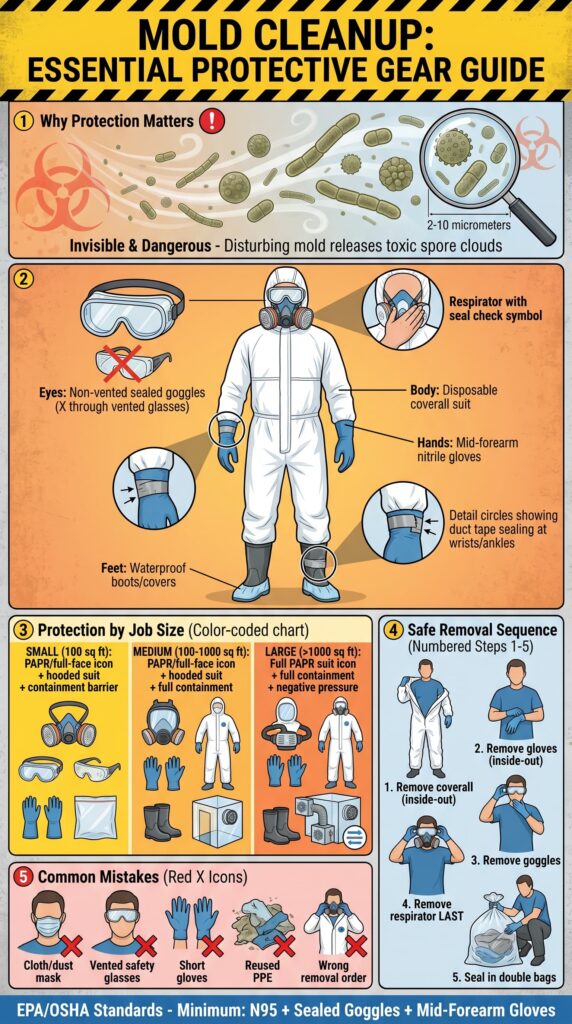
Respirators: The Most Important Part of Your Protective Gear for Mold Cleanup
Your lungs are the most vulnerable organ during mold remediation. A cloth mask or a basic dust mask will not cut it — the pores in those materials are far too large to stop mold spores. You need a NIOSH-approved respirator rated for the size of your job.
N95 Respirators for Small Areas
An N95 respirator filters at least 95% of airborne particles, including mold spores, and is the standard minimum for any mold cleanup job.[3] The EPA’s mold course specifies that for areas under 10 square feet, an N95 is acceptable baseline protection when paired with gloves and eye protection.[2] These respirators are widely available at hardware stores and home improvement centers across the Peoria area.
A critical point that often gets overlooked: fit matters enormously. An N95 that gaps at the sides or sits loose on a bearded face lets unfiltered air in around the edges. Always perform a seal check before entering a contaminated area by cupping your hands over the mask and exhaling firmly — air should not escape around the edges. If it does, adjust the nose wire and straps before proceeding.
P100 Respirators for Medium and Large Jobs
Once a mold-affected area exceeds 10 square feet, or when demolition work is involved, a half-face or full-face respirator with P100 filters becomes the appropriate choice. P100 filters block 99.97% of airborne particles — a substantial improvement over the N95’s 95% rating.[4] These filters also commonly include an activated charcoal layer that helps reduce the musty odors associated with heavy mold growth.
For very large jobs — anything over 100 square feet — or in confined spaces with poor ventilation, a powered air-purifying respirator (PAPR) offers the highest level of respiratory protection. PAPRs use a battery-powered blower to force air through a HEPA filter, eliminating the fit problems that can compromise standard respirators.
| Job Size | Respirator | Body Protection | Containment Needed? |
|---|---|---|---|
| Small (<10 sq. ft.) | N95 | Long sleeves & pants | Usually not required |
| Medium (10–100 sq. ft.) | Half-face with P100 filters | Disposable coveralls | Recommended |
| Large (>100 sq. ft.) | Full-face P100 or PAPR | Full-body disposable suit with hood and boot covers | Required |
Eye and Skin Protection During Mold Remediation
Your eyes are a direct route for mold spores to enter your body. The mucous membrane of the eye is warm and moist — exactly the environment mold thrives in. This is why the EPA and OSHA both specify non-vented goggles as the standard, not safety glasses with open side vents.[5] Goggles that form a continuous seal against your face are the only option that reliably keeps spores out during active remediation work.
Choosing the Right Gloves
OSHA specifies that gloves for mold cleanup should be long enough to reach the middle of the forearm.[5] When you are reaching overhead or crouching to scrub a floor, shorter gloves create a gap between the cuff and your sleeve where spores and cleaning chemicals can contact your skin.
Glove material matters depending on what cleaning agents you use. For general mold scrubbing with mild detergents, standard nitrile gloves work well. If you are using biocides, chlorine bleach, or stronger disinfectants, OSHA recommends gloves made from natural rubber, neoprene, nitrile, polyurethane, or PVC — materials with genuine chemical resistance.[5] Never reuse mold-contaminated gloves; dispose of them in a sealed plastic bag immediately after leaving the work area.
Coveralls and Body Protection
For a small spot under a bathroom sink, long sleeves and pants may be all you need. Once the job gets bigger — or involves cutting into drywall, pulling up flooring, or working in an attic — disposable coveralls become essential. Look for coveralls rated for particulate protection, and seal the cuffs at your wrists and ankles with duct tape to close any gaps where your gloves and boot covers meet the suit. When you are done, turn the coverall inside-out as you remove it to trap spores against the inside fabric, then bag it immediately.
Dealing with mold cleanup waste in Peoria, IL?
Zap Dumpsters Peoria helps you source the right container for mold remediation debris — fast, local, and hassle-free.
Footwear and Floor-Level Protection
Mold loves damp floors — basement slabs, bathroom subfloors, and crawl space ground covers are common hotspots in Peoria homes. Waterproof rubber boots or disposable boot covers stop spores from clinging to your footwear and spreading through the rest of the building. If you are using disposable shoe covers, look for ones that integrate with your coverall cuffs, and replace them before you step out of the work area. Dedicated rubber boots worn only during remediation can be washed down with a disinfectant solution before you remove them at the door.
Donning and Doffing: Getting Gear On and Off Safely
Putting on your protective gear for mold cleanup is straightforward, but taking it off is where most people make mistakes. Improper doffing — the technical term for removing PPE — is one of the most common ways contamination spreads from a mold work area to the rest of a building.
The general sequence recommended by remediation professionals starts with removing your coverall first, turning it inside-out as you peel it down. Your gloves come off next, also turned inside-out as you pull them off so contaminated surfaces end up on the inside. Your goggles come off after the gloves. Your respirator is always the last item removed, and you should already be standing outside the contaminated area before you take it off. This matters because the respirator is protecting you from any residual airborne spores even as you finish removing everything else.
Everything disposable goes into a sealed plastic bag immediately. Never set contaminated gear down on a clean surface, and never carry it through living areas to a trash can outside — bag it in place.
Mold Remediation Gear vs. General Cleaning Gear: A Real Comparison
| Gear Item | General Cleaning | Mold Remediation |
|---|---|---|
| Mask | None or cloth mask | NIOSH-approved N95 minimum; P100 for larger jobs |
| Eye protection | None required | Non-vented, sealed goggles |
| Gloves | Household rubber | Nitrile, neoprene, or natural rubber to mid-forearm |
| Clothing | Work clothes | Disposable Tyvek-style coveralls for medium/large jobs |
| Footwear | Regular shoes | Rubber boots or disposable boot covers |
| Disposal plan | Trash bag | Sealed, double-bagged waste — potentially requiring a roll-off container |
Expert Guidance on Mold Cleanup Safety
OSHA’s guidance on mold in the workplace makes the protective equipment requirements unambiguous: the primary function of PPE during mold remediation is to prevent inhalation and ingestion of mold and mold spores, and to avoid mold contact with the skin or eyes.[5] This is not a suggestion — it is the standard framework that professional remediation crews across Central Illinois follow on every job.
A contractor handling a basement remediation project in Peoria put it simply: the gear you skip to save ten minutes is the gear that puts you in a doctor’s office for ten days. That on-the-ground reality reflects what the EPA and OSHA data consistently show — respiratory and skin reactions from mold exposure are preventable with the right PPE, and they become far more likely without it.
For contractors managing medium-to-large mold remediation projects in the Peoria area, a key part of planning involves not just the PPE itself but also having a clear plan for disposing of contaminated materials. Bagged mold debris, removed drywall, wet insulation, and used coveralls all need to go somewhere. Zap Dumpsters Peoria helps contractors and homeowners source the right roll-off containers for mold remediation cleanup — check out the mold remediation dumpster rental options to see what fits your project.
What to Do With Mold Cleanup Waste
Protective gear keeps spores off your body during the job, but you also need a plan for the contaminated materials coming out of the space. Moldy drywall, insulation, carpet, and ceiling tiles need to be double-bagged in heavy plastic before transport. For small cleanups, standard contractor bags work fine. For larger projects — anything involving multiple rooms, a finished basement, or structural materials — a roll-off dumpster positioned close to the work area dramatically reduces the risk of cross-contamination during material removal.
Proper handling of mold-infested debris is a topic worth reading about in depth before your project starts. The details on safe disposal of mold-infested materials covers bagging requirements, what can and cannot go in a standard container, and how to coordinate waste removal efficiently.
For larger commercial remediation jobs in Peoria — office buildings, rental properties, or industrial spaces — the EPA’s mold remediation guidelines for schools and commercial buildings provide the framework that certified contractors reference for both PPE selection and containment procedures.[6]
Need a dumpster for your mold remediation project?
Zap Dumpsters Peoria connects you with the right roll-off container for safe, efficient mold debris removal across the Peoria, IL area.
Conclusion: Get the Right Protective Gear for Mold Cleanup Near You in Peoria, IL
Mold remediation is a job where the right gear is not a luxury — it is the difference between finishing the project safely and ending up with a respiratory infection, skin irritation, or a contamination problem that spread to rooms you never intended to touch. Start with the basics every time: a NIOSH-approved respirator, sealed non-vented goggles, and long chemical-resistant gloves. Scale up to P100 respirators, disposable coveralls, and full containment as the job size grows. And never skip the doffing sequence — how you remove your gear is as important as wearing it in the first place.
If your remediation project is generating significant debris and you need a container to handle it properly, Zap Dumpsters Peoria is ready to help you source the right roll-off dumpster for mold cleanup waste. Give us a call at (309) 650-8954 and we will get you set up fast.
Protective Gear for Mold Cleanup FAQs
What protective gear for mold cleanup do I need for a small bathroom spot?
For a small mold spot under 10 square feet — such as a bathroom corner or under a sink — the protective gear for mold cleanup you need includes an N95 respirator, non-vented goggles, and nitrile or rubber gloves that reach mid-forearm. Long sleeves and pants are also recommended to keep spores off your skin, and any disposable items should be bagged immediately when you are finished.
Is an N95 enough for mold cleanup, or do I need something stronger?
An N95 is sufficient for small mold areas under 10 square feet, but for jobs between 10 and 100 square feet, a half-face respirator with P100 filters is the better choice. For anything larger — or when demolition work is involved — upgrade to a full-face P100 respirator or a powered air-purifying respirator (PAPR).
Can I reuse my gloves and coveralls after mold remediation?
Disposable gloves and coveralls should never be reused after mold remediation — they should be turned inside-out during removal, sealed in a plastic bag, and disposed of immediately. Reusing contaminated gear spreads spores to clean surfaces and defeats the purpose of wearing it in the first place.
What kind of goggles should I wear during mold remediation?
Use non-vented, sealed goggles that form a continuous barrier against your face — not standard safety glasses or goggles with open side vents. Open-vent goggles allow airborne mold spores to reach your eyes, which can cause irritation and provide a route for spore exposure. The EPA specifically recommends non-vented goggles for mold cleanup work.
What protective gear for mold cleanup do professionals use on large jobs?
Professional mold remediation crews use protective gear for mold cleanup that includes full-face respirators with P100 filters, disposable Tyvek-style coveralls sealed at wrists and ankles, non-vented goggles, long chemical-resistant gloves, and waterproof boot covers. On very large or heavily contaminated jobs, powered air-purifying respirators and full containment barriers are standard practice.
Protective Gear for Mold Cleanup Citations
- Quora — N95 and KN95 masks for mold: spore size discussion referencing Aspergillus, Penicillium, Cladosporium (2–10 µm range)
- U.S. EPA — Mold Course Chapter 6: Minimum PPE requirements by area size
- Wellbefore — Do N95 Masks Protect Against Mold? Filtration capability and mold spore size overview
- Harmony Lab & Safety — Best Masks to Protect Against Mold: N95 vs. P100 filtration ratings
- OSHA — A Brief Guide to Mold in the Workplace: PPE requirements including glove material, goggle type, and mid-forearm length
- U.S. EPA — Mold Remediation in Schools and Commercial Buildings Guide: Chapter 3 — PPE and containment guidelines for commercial projects