
- Building Information Modeling (BIM), when deployed across an entire project, can cut construction waste by up to 15%.[1]
- Modular and prefabricated construction reduces on-site debris by an average of around 52% compared to conventional methods, with some studies showing reductions above 80%.[2]
- 3D concrete printing can cut material waste by 30 to 60% by placing material only where it is structurally needed.[3]
- AI-powered robotic sorters like ZenRobotics achieve material separation purity of up to 98%, diverting valuable C&D materials from landfills.[4]
- Construction and demolition (C&D) waste accounts for over 30% of total global solid waste.[5]
- Contractors who pair smart planning tools with the right roll-off container setup keep their sites cleaner, safer, and more compliant from day one.
The construction industry has long run on a simple but wasteful model: order materials, build something, and haul off whatever is left over. Emerging construction tech for waste reduction is changing that fast. From AI robots that sort debris with machine precision to software that catches over-ordering before the first truck arrives, these tools pull waste out of the process instead of managing it at the back end. For contractors in Peoria, IL and across Central Illinois, knowing what these technologies do — and what they mean for your site — is becoming part of staying competitive and keeping bids clean.
Managing C&D waste on your Peoria job site?
Zap Dumpsters Peoria helps contractors source the right roll-off container for construction and demolition projects across Central Illinois — no hassle, no guesswork.
Why Emerging Construction Tech Targets Waste First
C&D waste is one of the most persistent problems in the built environment. According to the World Bank, construction and demolition debris accounts for more than 30% of total global solid waste, with millions of tons ending up in landfills each year despite being made of materials that could be recovered and reused.[5] The environmental cost is real, but so is the financial one. Material over-ordering, off-cuts, and debris disposal add up to a significant share of project costs on both residential and commercial builds.
What makes the current wave of emerging construction tech different from past attempts is where it targets the problem. Older approaches focused on better disposal — sorting at the end, recycling programs, diversion goals. Today’s tools attack waste earlier in the lifecycle, during design, procurement, and assembly, which is where most of the opportunity actually sits. When you stop material waste from being generated in the first place, there is far less to manage on the back end. That shift has direct consequences for contractors and project managers across Central Illinois who are used to budgeting for a certain level of debris every time a job kicks off.
The Shift Away from the Take-Make-Dispose Model
Traditional construction works in a straight line: extract raw materials, use them once, discard what is left. The circular economy model that many of these new technologies support works differently. It asks what happens to a material at every stage of its life — can it be reused, recycled, or returned to the supply chain rather than sent to a landfill? McKinsey research on the built environment found that only about 1% of materials from building demolitions are currently reused, which points to an enormous unrealized opportunity.[6] Technologies like digital material passports, AI-powered sorting, and Design for Disassembly (DfD) principles are what make closing that loop practical at a real project scale.
Construction and demolition waste represents one of the most recoverable waste streams in existence — the main barrier has never been the material itself, but the technology and planning needed to capture it.
| Technology | Primary Function | Documented Waste Impact |
|---|---|---|
| BIM + AI Planning | Precise material take-offs, clash detection | Up to 15% waste reduction across full project[1] |
| 3D Concrete Printing | Additive manufacturing, no formwork waste | 30–60% less material waste[3] |
| Modular / Prefabrication | Factory-controlled assembly, precision cutting | Average 52% on-site debris reduction[2] |
| AI Robotic Sorting | Material identification and stream separation | Up to 98% sorting purity[4] |
| IoT Smart Bins | Real-time fill monitoring, optimized pickup | Reduced haulage cost and overflow incidents[5] |
Digital Planning Tools: Stopping Emerging Construction Tech Waste Before It Starts
The biggest gains from emerging construction tech do not come from better recycling at the end of a job. They come from smarter planning at the front end. Digital design and procurement tools have matured quickly, and their impact on material waste is now well-documented.
Building Information Modeling (BIM)
BIM creates a detailed 3D digital model of a project before a shovel hits the ground. That model includes precise material quantities, which means procurement can be based on actual need rather than rough estimates padded for safety. When BIM is applied across the full project lifecycle — not just the design phase — research shows it can reduce construction waste by up to 15%.[1] The tool also performs clash detection, identifying conflicts between structural systems before construction begins. According to data from Dodge Construction Network, clash detection alone reduces change orders by an average of 40%.[7] Fewer change orders means less rework, and less rework means less wasted material. For contractors managing construction and demolition waste removal in Peoria, IL, that reduction in unexpected debris is something you feel on every pickup schedule.
AI-Driven Predictive Procurement
Paired with BIM, AI-powered procurement tools analyze historical project data to forecast material needs with greater accuracy. The goal is just-in-time delivery — materials arrive when they are actually needed rather than sitting on site where they can be damaged, stolen, or over-ordered into scrap. A study from Autodesk found that digital material take-offs reduce waste by up to 25% compared to manual estimation methods.[7] For contractors running multiple jobs at once across the Peoria region, that kind of precision compounds quickly.
“The future of construction waste management is being shaped by technological innovation, circular economy strategies, and regulatory frameworks. AI-powered sorting systems, blockchain transparency, 3D printing with recycled materials, and digital waste management platforms are transforming how the industry tackles waste.”
Robots, Drones, and On-Site Emerging Construction Tech for Waste Reduction
Smart planning reduces the waste that enters a site. Once the job is underway, a second category of emerging construction tech takes over — tools that work in the field to generate less debris and recover more of what remains.
3D Concrete Printing: Additive Instead of Subtractive
Traditional concrete construction is a subtractive process. You pour more than you need, form it, and trim or break away the excess. 3D concrete printing flips that entirely. It deposits material layer by layer, placing concrete precisely where structural analysis says it belongs and nowhere else. The result is a dramatic reduction in material waste. Research across multiple studies shows that 3D concrete printing can reduce construction waste by 30 to 60% compared to conventional methods.[3] Heidelberg Materials, one of the world’s largest concrete producers, reports reductions in material use of up to 75% depending on the design geometry.[9] That is not a marginal improvement — it is a fundamentally different relationship with material consumption.
Prefabrication and Modular Construction
Moving assembly off-site into a factory environment is one of the most proven forms of emerging construction tech for waste reduction. In a controlled factory setting, cutting is computer-guided, off-cuts are collected and recycled within the same facility, and materials are ordered to exact specifications rather than with a buffer. The Modular Building Institute, citing data from the Waste & Resources Action Programme (WRAP), reports that modular construction can reduce waste materials by up to 90% compared to traditional site-built methods for certain material categories.[10] Across a broader comparison of studies, the average on-site debris reduction from prefabrication runs around 52%, with some modular builds achieving above 80% overall waste reduction.[2] For contractors who are also partnering with site services providers to streamline job site logistics, prefabrication adds a measurable layer of predictability — you know roughly how much debris the site will generate before the first module arrives.
AI-Powered Robotic Sorting
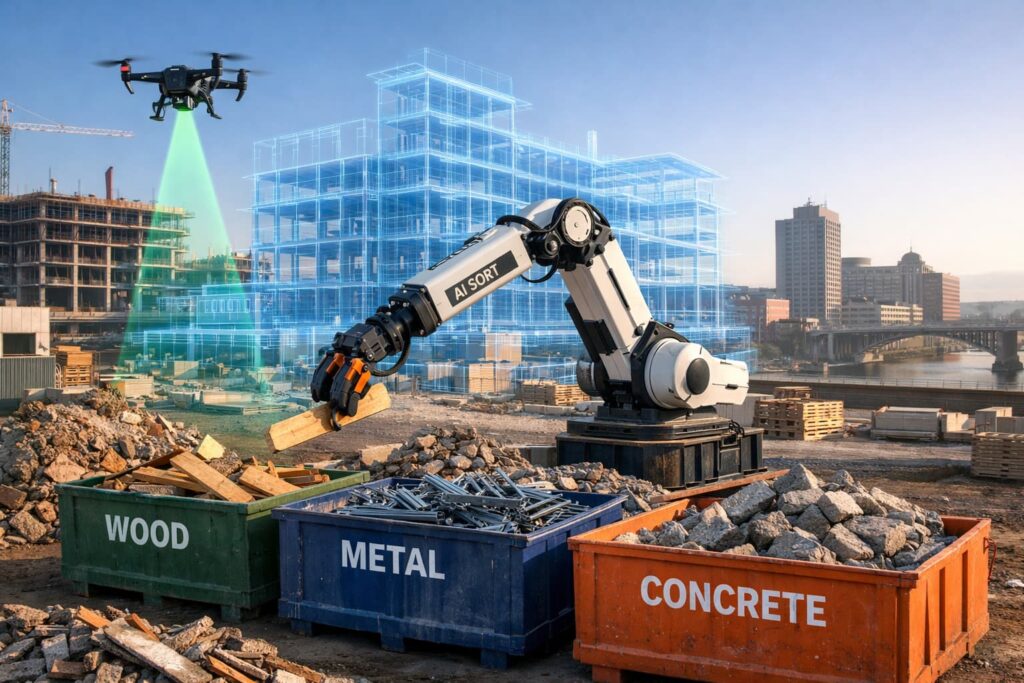
When C&D waste does reach the collection and processing stage, AI-powered robotic systems change what is recoverable. Companies like ZenRobotics use machine learning and computer vision to identify and separate concrete, wood, metal, and plastic from mixed debris streams at speeds no human sorting team can match. Their systems achieve material separation purity of up to 98%, which means cleaner recyclable streams and higher recovery rates.[4] ZenRobotics robots can process thousands of picks per hour compared to around 700 picks per hour for a human worker.[11] The practical result is that materials that once went to landfill because mixed debris is too contaminated to recycle now get cleanly separated and returned to the supply chain.
When AI-powered sorting brings recycling purity above 95%, it becomes economically viable to recover C&D materials that would otherwise cost more to sort than they are worth — turning a disposal cost into a recovered resource.
IoT-Enabled Smart Containers and Monitoring
Sensor-equipped waste containers track fill levels in real time, feeding data to collection scheduling systems. The immediate benefit is route optimization — trucks do not run to half-empty containers, and overfull containers do not spill debris onto work areas. Beyond logistics, the data from smart bins gives project managers visibility into where waste is being generated fastest, which helps target process improvements on the right phases of the job.
| Scenario | Traditional Approach | Tech-Enabled Approach |
|---|---|---|
| Material ordering | Estimate with safety buffer; over-ordering common | BIM take-offs with AI optimization; order to need |
| On-site assembly | Field cutting generates significant off-cut waste | Prefab and modular; cutting done in factory, waste recaptured |
| Debris sorting | Manual separation; high contamination, low recovery | AI robotic sorting; up to 98% purity, high recovery rates |
| Container pickup | Fixed schedule regardless of fill level | IoT-triggered scheduling; pickup when needed |
| End-of-life planning | Demolition; most material mixed and landfilled | Design for Disassembly; materials catalogued and reused |
Blockchain and Material Passports: Tracking Emerging Construction Tech Through the Supply Chain
One of the more forward-looking applications in emerging construction tech waste reduction is the use of blockchain to create digital material passports. When a building is constructed using a blockchain-backed system, every material — a steel beam, a concrete panel, a cladding unit — gets a digital record that follows it through its entire lifecycle. That record includes what the material is made of, where it came from, and critically, whether it is safe and suitable for reuse when the building is eventually modified or demolished.
The practical value for future contractors is significant. Instead of treating demolition debris as unknown mixed waste, a project team can pull up the material passport for a structure and know precisely which components can be salvaged intact, which need processing before reuse, and which require specialist disposal. Online platforms like Excess Materials Exchange and Loopfront are already building marketplaces that connect surplus and salvaged construction materials with buyers who can use them, diverting materials that would otherwise become waste.[8] This is the circular economy model moving from theory to practice on real job sites.
What Emerging Construction Tech Waste Reduction Means for Your Peoria Job Site
Most of the technologies covered above are currently deployed on larger commercial and industrial projects. But the tools are scaling down fast, and the decisions contractors make today — especially around planning precision and waste container strategy — already benefit from the broader shift these technologies represent.
For a renovation contractor in Washington or Morton, that might mean being asked by a client or GC to document your waste diversion rate. For a demo crew working in East Peoria, it might mean a bid spec that requires material separation on site. For a new-build team across the Peoria region, it might mean working alongside a project using prefabricated components that generates far less debris than a conventional build — meaning the roll-off container needs and pickup schedule look very different from what you would have planned five years ago.
A Peoria-area general contractor managing a mixed-use renovation in Pekin found that adopting a waste pre-sort protocol — separating concrete, metal, and wood at the point of generation rather than mixing everything into one container — cut their tipping fees by allowing cleaner loads to go to lower-cost processing facilities rather than the general landfill. The extra planning up front paid back quickly in reduced disposal costs over the course of the project.
Ready for a smarter C&D waste setup on your next job?
Zap Dumpsters Peoria sources roll-off containers sized for construction and demolition projects throughout the Peoria area and Central Illinois. One call gets you set up.
Conclusion: Finding Emerging Construction Tech Waste Reduction Solutions Near You
The construction industry’s waste problem is not going away on its own — but the tools to fix it are arriving fast. BIM and AI procurement tools stop waste before it enters the site. Prefabrication and 3D printing reduce what gets generated during assembly. AI robotic sorters recover far more from what remains. And blockchain material passports are beginning to close the loop on what happens to those materials at the end of a building’s life. Together, these technologies represent a genuine shift away from the take-make-dispose model that has defined construction for generations.
For contractors in Peoria, IL, the most immediate takeaway is practical. Waste reduction starts with planning, and the right container strategy is part of that plan. Knowing your project’s debris profile — what materials will be generated, in what volumes, and in what sequence — lets you size containers correctly, schedule pickups efficiently, and keep your site compliant without overspending on disposal. Zap Dumpsters Peoria works as a sourcing partner for contractors across Central Illinois, helping match job sites with the right roll-off containers for every phase of construction, renovation, and demolition. If you are looking for C&D waste management support near you, the conversation starts with a quick call.
Emerging Construction Tech Waste Reduction FAQs
What is emerging construction tech waste reduction?
Emerging construction tech waste reduction refers to the use of new digital, robotic, and manufacturing technologies — including BIM software, AI-powered sorting systems, 3D concrete printing, and prefabrication — to generate less waste during construction and recover more materials from what remains. These tools shift waste management from a back-end disposal problem to a front-end planning priority.
How does emerging construction tech waste reduction work on a typical job site?
Emerging construction tech waste reduction works at multiple points in the project lifecycle. Before construction begins, BIM and AI procurement tools minimize over-ordering. During construction, prefabrication and precision assembly techniques reduce off-cut debris. After the job, smart sorting systems and material recovery platforms capture and redirect materials that would otherwise go to a landfill.
Can 3D printing really reduce construction waste that much?
Yes. Because 3D concrete printing deposits material only where it is structurally needed — rather than pouring, forming, and trimming — it eliminates the formwork waste and off-cut scrap that traditional methods create. Multiple peer-reviewed studies document waste reductions of 30 to 60% compared to conventional concrete construction.[3]
How does BIM help with emerging construction tech waste reduction?
BIM creates precise digital models that allow contractors to calculate exact material quantities before ordering. When BIM is applied across the full project — not just at the design stage — research shows it can reduce construction waste by up to 15%.[1] It also catches design clashes early, reducing costly rework that generates additional debris.
How do Peoria contractors benefit from emerging construction tech waste reduction trends?
Peoria contractors benefit from these trends in several ways: smarter waste planning reduces disposal costs, cleaner material separation can lower tipping fees, and clients on commercial projects increasingly expect documented waste diversion rates. Understanding how prefabrication and AI sorting affect debris volumes also helps contractors size roll-off containers accurately and avoid overage charges on C&D projects.
Emerging Construction Tech For Waste Reduction Citations
- AZoBuild — What Are the Benefits of Using BIM for Construction Waste Management?
- MDPI Buildings — Quantifying Advantages of Modular Construction: Waste Generation
- HUD Cityscape — Seismic Design Methodology for 3D Printed Concrete (waste reduction 30–60%)
- European Circular Economy Stakeholder Platform — ZenRobotics Good Practice Profile
- Mohammed Munir — The Future of Construction Waste Management Technologies (LinkedIn, February 2025)
- McKinsey & Company — How Circularity Can Make the Built Environment More Sustainable
- ARKANCE — Reducing Waste in Factory Construction with BIM and Automated Workflows
- Mohammed Munir — The Future of Construction Waste Management Technologies (LinkedIn, February 2025) — circular economy platforms and blockchain tracking
- Heidelberg Materials — 3D Concrete Printing: Sustainability and Material Use
- Modular Building Institute — How Modular Construction Leads to Zero-Waste and Eco-Efficiency
- Recycling Product News — How ZenRobotics’ Sorting Technology is Helping C&D Recyclers