
Key Takeaways:
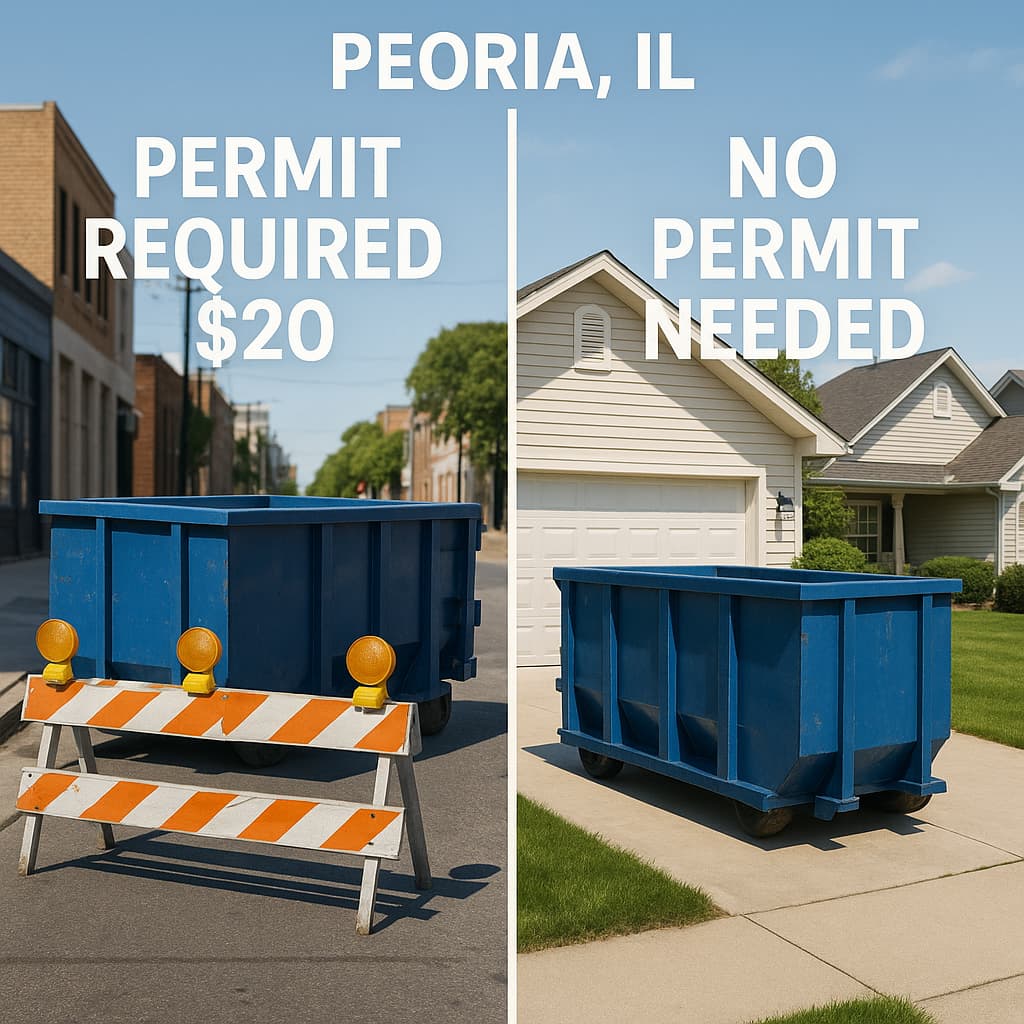
- Private property placement requires no city permit from Public Works, but public right-of-way placement costs $20 per 30-day period
- Right-of-way dumpsters must be 50 feet from intersections, 10 feet from hydrants, and include barricades with flashing lights
- Weight limits for 10-yard containers typically range from 2 to 3 tons, with overage fees charged per ton
- Hazardous materials including paints, chemicals, batteries, asbestos, and propane tanks are prohibited by law
- Documentation and application submission to Public Works at 3505 N Dries Lane ensures legal compliance
Article Summary: Contractors placing 10-yard dumpsters in Peoria face different regulations based on location—private property requires no permit while public placement demands $20 permits, safety equipment, and strict positioning rules to maintain compliance and avoid fines.
Understanding Peoria’s 10-Yard Dumpster Permit Framework
Small contractors working residential projects in Peoria need clear guidance on local dumpster regulations. The City of Peoria distinguishes between private property placement and public right-of-way placement, each with separate compliance requirements.[1]
A 10-yard dumpster typically measures 12 to 14 feet long, 7 to 8 feet wide, and 3.5 to 4 feet tall.[2] This compact footprint makes it ideal for single-room remodels, small deck removals, and garage cleanouts—but size alone doesn't determine permit requirements.
The critical factor is location. Dumpsters placed entirely on private property like driveways or yards generally require no permit from the Public Works Department.[1] However, placing that same container on city streets, alleys, or other public right-of-way triggers mandatory permitting with associated fees and safety obligations.
For contractors juggling multiple small projects across Peoria, understanding these location-based rules prevents costly delays. One improperly placed dumpster can halt work while you scramble to obtain retroactive permits or relocate equipment. When you source dumpsters through Zap Dumpsters, you get clarity on these requirements before placement day arrives.
Get Compliant Dumpster Sourcing in Peoria
We coordinate with local haulers who understand Peoria regulations
Call (309) 650-8954Private Property vs. Public Right-of-Way Placement
Private Property Placement Guidelines
When your 10-yard dumpster sits completely on private property, Peoria's Public Works Department does not require a permit.[1] This applies to residential driveways, commercial parking lots, and private yards where you have explicit permission from the property owner.
However, "no permit required" doesn't mean "no rules apply." Long-term storage may trigger property maintenance codes or zoning requirements. For any questions about extended placement on private land, contact the City of Peoria Public Works Department at (309) 494-8800.[1]
Contractors should also verify homeowner association restrictions before placement. HOAs in Peoria neighborhoods often impose their own dumpster rules including approved locations, screening requirements, and maximum rental durations. These private covenants carry separate penalties from city regulations.
Public Right-of-Way Permit Requirements
Public right-of-way placement requires a formal permit from the City of Peoria Public Works Department.[1] The application process involves:
Application submission: Download the fillable PDF from the City of Peoria website or request it directly from Public Works.
Permit fee payment: $20 for every 30-day period the dumpster occupies the right-of-way.[1]
Documentation: Include exact placement location, rental duration, emergency contact information, and hauler details.
Submission address: City of Peoria Public Works Department Permits Division: Dumpster or Storage Container Permit 3505 N Dries Lane Peoria, IL 61604 Phone: 309-494-8800[1]
Processing times vary based on application completeness and current department workload. Submitting applications at least five business days before your planned dumpster sourcing date provides a safety buffer for approval.
Decision Table: Permit Requirements by Location
| Placement Location | Permit Required? | Cost | Processing Time | Best For |
|---|---|---|---|---|
| Private driveway | No | $0 | N/A | Residential remodels, quick projects |
| Private yard (with permission) | No | $0 | N/A | Extended rentals, large properties |
| City street | Yes | $20/30 days | 3-5 business days | Urban sites with no driveway access |
| Alley (public) | Yes | $20/30 days | 3-5 business days | Commercial districts, limited space |
| Metered parking space | Yes | $20/30 days + meter fees | 3-5 business days | Downtown projects (not recommended) |
Mandatory Safety and Positioning Standards for Public Placement
Distance Requirements from Critical Infrastructure
Peoria enforces strict distance rules to protect emergency access and traffic flow:[1]
50-foot minimum from intersections or alleys — This sight distance requirement prevents your dumpster from creating blind spots for drivers entering or exiting roadways.
10-foot minimum from fire hydrants — Fire departments must maintain unobstructed access to hydrants. Violations can result in immediate removal orders.
Sufficient clearance for emergency vehicles — The Fire Department has authority to deny any location that restricts emergency response routes.[1]
Contractors should walk the proposed placement site with a measuring tape before requesting permits. Measure from the nearest intersection curb, alley entrance, and fire hydrant. Document these measurements on your permit application to streamline approval.
Required Safety Equipment and Markings
Public right-of-way placement demands visible safety equipment:[1]
Barricades with flashing lights: Position at each end of the dumpster along the traffic side. These battery-powered warning lights must function throughout darkness hours.
Reflective strips: Apply to all visible dumpster sides facing traffic. Reflective tape increases nighttime visibility from approaching vehicles.
Protective boards: Place boards or plywood sheets under the dumpster to protect road surfaces from damage. Asphalt and concrete can crack or indent under concentrated weight.
The permit applicant assumes full responsibility for road surface damage during the rental period.[1] If your dumpster leaves ruts, cracks, or surface failures, you'll pay repair costs at no expense to the city. Using protective boards and selecting stable placement sites minimizes this liability.
Traffic and Loading Zone Compliance
Your dumpster may not block active traffic lanes.[1] Even with permits, positioning that forces vehicles into oncoming traffic creates liability and violates placement approval.
Allow sufficient space for:
- Emergency vehicles to pass without entering opposing lanes
- Delivery trucks to access adjacent properties
- Pedestrians to use sidewalks without stepping into roadways
Narrow streets present particular challenges for 10-yard containers. The 12- to 14-foot length may consume most available shoulder width. In these situations, contractors often find private property placement more practical despite potential access limitations.
Weight Limits, Prohibited Materials, and Load Requirements
Standard Weight Capacity for 10-Yard Containers
Most 10-yard dumpsters in Peoria include 2 to 3 tons (4,000 to 6,000 pounds) of disposal capacity in base pricing.[2][3] This weight allowance suits typical residential renovation debris—drywall, lumber, flooring, and general construction waste.
Heavy materials consume weight capacity quickly:
- Concrete and asphalt: Approximately 4,000 pounds per cubic yard
- Dirt and soil: Approximately 2,200 pounds per cubic yard
- Roofing shingles: Approximately 800 pounds per 100 square feet
A 10-yard container filled entirely with concrete exceeds most weight limits by 5 to 7 tons. Contractors handling heavy materials should discuss load planning with haulers before scheduling placement. Some services offer heavy debris containers with reinforced floors and higher weight allowances specifically for concrete, dirt, and masonry.
Calculating Your Project Weight
Estimate total debris weight before ordering:
- Measure project area: Calculate square footage of material removal (floors, roofing, walls)
- Apply material weight factors: Use the weights above to estimate total tonnage
- Add 15% buffer: Account for hidden materials, fasteners, and debris compaction
- Compare to included weight: Ensure your estimate falls below the 2-3 ton standard limit
For example, a 600-square-foot shingle removal generates approximately 4,800 pounds of debris (800 pounds × 6 squares). This fits comfortably within a 3-ton weight limit. However, a 1,000-square-foot removal approaches 8,000 pounds—requiring either a larger container or multiple dumpster cycles.
Prohibited Materials Under Peoria and Illinois Law
Environmental regulations prohibit certain materials from dumpster disposal regardless of container size or placement location.[1] These restrictions protect landfill operations, waste management workers, and groundwater quality.
Universally prohibited items:
- Hazardous, toxic, and flammable waste
- Paints, solvents, and chemical cleaners
- Batteries of any type (automotive, household, lithium)
- Asbestos-containing materials
- Propane tanks and compressed gas cylinders
- Tires and rubber products
- Electronics containing hazardous components
Haulers will refuse pickup of containers with prohibited materials. The customer remains responsible for removing these items and disposing through proper channels. Peoria County operates a household hazardous waste collection program for many of these materials. Contact Peoria County Public Works at (309) 494-8800 for current drop-off schedules and accepted items.
Contractors face liability for prohibited material disposal. Fines and cleanup costs transfer to the party who filled the container, not the hauling company. Educate your crew on prohibited items and conduct visual inspections before requesting pickup.
Fill Height and Door Closure Requirements
Debris must not exceed the top rim of the dumpster.[1] Overfilled containers create multiple violations:
- Transportation safety hazard: Materials can shift or fall during transport
- Legal non-compliance: Loads exceeding container height violate Illinois vehicle codes
- Pickup refusal: Haulers cannot legally transport overfilled dumpsters
Back doors must close completely before pickup.[1] Open doors indicate overfilled containers or improperly distributed loads. Spend 10-15 minutes redistributing debris to allow door closure—this prevents pickup delays and potential overfill fees.
Contractors should load strategically: heavy items on the bottom, bulky items broken down when possible, and void spaces filled with smaller debris. This approach maximizes capacity while maintaining legal fill levels. When you coordinate sourcing through services like our 10-yard dumpster loading guides, you learn professional techniques that prevent overfill situations.
Permit Application Process and Timeline Management
Step-by-Step Application Submission
Step 1: Download the application Access the "Dumpster in the ROW Permit App - Fillable (PDF)" from peoriagov.org or request by phone from Public Works at (309) 494-8800.
Step 2: Complete all required fields
- Applicant name and business information
- Property address where dumpster will be placed
- Exact street location with cross-street references
- Rental start date and duration (calculate 30-day increments)
- Hauler company name and contact information
- Safety equipment confirmation checklist
Step 3: Calculate permit fees Count the number of 30-day periods needed. A 7-day rental requires one $20 permit. A 45-day rental requires two permits ($40 total).[1]
Step 4: Submit application and payment Mail or deliver in person to: City of Peoria Public Works Department Permits Division: Dumpster or Storage Container Permit 3505 N Dries Lane Peoria, IL 61604
Payment methods vary—contact the department to confirm accepted forms (check, money order, or credit card).
Step 5: Receive permit approval Public Works will review your application for completeness and compliance. Approval typically arrives within 3-5 business days for straightforward placements. Complex locations near intersections or high-traffic areas may require additional review time.
Step 6: Display permit documentation Keep approved permits accessible at the job site. Inspectors may verify permit status during routine checks.
Timeline Planning for Multi-Location Projects
Contractors managing several concurrent projects must coordinate permit applications with work schedules. Consider these timeline factors:
7-10 days before dumpster need: Submit permit applications for all public right-of-way placements. This buffer accommodates processing delays and potential application corrections.
3-5 days before dumpster need: Confirm permit approval before scheduling dumpster sourcing. Delivery without valid permits risks citations and removal orders.
Day of placement: Ensure safety equipment (barricades, lights, protective boards) arrives with the dumpster. Installing these items after placement creates temporary non-compliance.
Throughout rental period: Monitor equipment condition. Replace burned-out warning lights immediately to maintain continuous compliance.
Before pickup request: Remove all prohibited materials, ensure proper fill height, and confirm doors close completely.
Small contractor firms often lack dedicated administrative staff for permit management. Creating a standardized checklist and calendar system prevents missed deadlines. Digital calendar reminders 10 days before planned placements trigger permit application preparation.
Permit Extensions and Renewal Procedures
Projects sometimes run longer than anticipated. Peoria's 30-day permit periods accommodate extensions:[1]
If your project requires additional time, submit a new permit application and $20 fee for each additional 30-day period. Processing for extensions typically happens faster than initial applications since the location has been pre-approved.
Plan extension applications 5-7 days before your current permit expires. This prevents gaps in permit coverage that could trigger violations. Coordinate extension timing with your hauler—some companies charge daily rental fees beyond standard periods, creating dual costs (permit fees + rental fees).
Common Application Mistakes That Delay Approval
Incomplete measurement documentation: Applications without specific distance measurements from hydrants and intersections require follow-up. Measure and record these details before submission.
Unclear rental duration: Vague statements like "approximately two weeks" force Public Works to request clarification. Calculate exact start and end dates.
Missing hauler information: The city needs hauler contact details for verification purposes. Confirm your dumpster source provides their business license and insurance information for your application.
Incorrect fee calculation: Count 30-day increments carefully. A 31-day rental requires two permit periods ($40), not one.
Illegible handwriting on paper forms: Use the fillable PDF version or print clearly. Illegible applications require resubmission.
Contractors who submit clean, complete applications on first attempt build positive relationships with Public Works staff. These relationships prove valuable when you need expedited processing for emergency situations or last-minute project changes.
Cost Analysis and Budget Planning for Compliant Rentals
Base Rental Costs in Peoria's Market
10-yard dumpster rentals in Peoria range from $220 to $580 for standard 7-10 day periods.[4][5] This pricing variation reflects several factors:
Distance from hauler facilities: Locations more than 20 miles from hauler yards often incur fuel surcharges.[6]
Material type: General construction debris falls in standard pricing. Heavy materials like concrete may require specialized containers with premium rates.
Local disposal fees: Landfill tipping fees in Peoria range from $65 to $93 per ton, directly impacting total rental cost.[7]
Hauler business model: National chains and local independents structure pricing differently. Local operators often offer more competitive rates for Peoria-area contractors.
Average pricing for compliant 10-yard rentals with standard inclusions:
- Base rental: $350-450
- Delivery and pickup: Usually included in base rate
- Weight allowance: 2-3 tons included
- Rental period: 7-10 days standard
Adding Permit Costs to Your Budget
Public right-of-way placement adds $20 per 30-day period to your project costs.[1] For most small remodeling projects completed within two weeks, this represents a minimal cost addition (under 6% of total rental expense).
However, extended projects accumulate permit costs:
- 30-day project: $20 permit fee
- 60-day project: $40 permit fee (two periods)
- 90-day project: $60 permit fee (three periods)
Multi-location contractors working three concurrent sites with right-of-way placement face $60 in monthly permit costs. Annual permit expenses for high-volume small contractors can reach $500-1,000. Budget these fees as part of overhead rather than project-specific costs to maintain accurate job bidding.
Hidden Costs of Non-Compliance
Permit violations carry consequences beyond citation fines:
Project delays: Code enforcement can order immediate dumpster removal until proper permits are obtained. This halts work while you scramble for alternative debris disposal.
Relationship damage: Property owners blame contractors for compliance failures even when they result from miscommunication. Permit violations on residential projects damage your reputation and referral network.
Overfill penalties: Haulers charge $75-100 per ton for weight overages.[8] A 10-yard container filled with 5 tons of material (2 tons over standard limits) generates $150-200 in additional fees.
Prohibited material cleanup: If haulers discover prohibited materials, they'll return the full container to your site. You'll pay for the refused trip, proper disposal of prohibited items through appropriate channels, and a new pickup fee. Total costs can exceed $500.
Road damage liability: Dumpsters placed without protective boards that damage city streets transfer full repair costs to the permit holder.[1] Asphalt resurfacing can cost $500-1,500 depending on damage extent.
Smart contractors calculate these risk costs when deciding whether to pursue permitting or find alternative private property placement. A $20 permit fee represents cheap insurance against multi-hundred-dollar compliance failures.
Comparison Table: Private vs. Public Placement Total Costs
| Cost Component | Private Property | Public Right-of-Way |
|---|---|---|
| Base dumpster rental (7 days) | $350-450 | $350-450 |
| Permit fee (first 30 days) | $0 | $20 |
| Safety equipment (barricades, lights, boards) | $0 | $75-150 (if not provided by hauler) |
| Extended rental fee (daily, days 8-30) | $10-15/day | $10-15/day |
| Administrative time (permit application) | 0 hours | 1-2 hours |
| Total for standard 7-day rental | $350-450 | $445-620 |
| Total for 30-day rental | $580-795 | $675-960 |
Private property placement saves $95-170 per rental cycle. For contractors completing 20 small projects annually, private placement preference saves $1,900-3,400 in direct costs plus 20-40 hours of administrative time.
However, private placement isn't always possible. Urban rowhouses, narrow lots, and projects without off-street parking require right-of-way placement. In these scenarios, permit costs become unavoidable project expenses. When you source through services that understand Peoria's 10-yard requirements, you get placement guidance that identifies cost-effective options for your specific site.
Who These Regulations Benefit and When Compliance Matters Most
Ideal Compliance Scenarios for Small Contractors
Single-location renovators: Contractors specializing in kitchen and bathroom remodels typically maintain one active site at a time. The simplified permit workflow suits this business model—one application every few months rather than complex multi-site coordination.
Residential specialists: Homes usually offer driveway placement options, eliminating permit requirements entirely. However, understanding right-of-way rules proves essential for townhomes and properties with shared driveways.
Licensed professionals building long-term reputations: Compliance protects your contractor license and business standing. Citation records can appear in background checks performed by prospective clients, particularly for high-value residential work.
When to Prioritize Private Property Placement
Seek private property placement when:
- The site offers adequate driveway or yard space (14+ feet of length, stable ground surface)
- You can access the loading area safely throughout the project
- The property owner provides written permission for extended placement
- Project duration exceeds 30 days (avoiding multiple permit renewals)
- You're managing multiple concurrent sites and want to minimize administrative overhead
Private placement doesn't mean zero preparation. Document your placement agreement with property owners, verify ground stability to prevent settling damage, and confirm adequate clearance for delivery and pickup trucks (typically 60 feet of straight-line access and 23-25 feet of vertical clearance).[9]
When Right-of-Way Placement Becomes Necessary
Accept right-of-way placement requirements when:
- No private property access exists (urban infill projects, attached homes)
- Driveway surfaces can't support dumpster weight (old pavers, decorative brick)
- HOA restrictions prohibit visible dumpsters on private property
- Emergency repair situations require immediate placement with no time to negotiate private access
- The project owner refuses placement on their property (liability concerns, aesthetic preferences)
In these scenarios, factor permit costs and safety equipment expenses into your project bids from the start. Absorbing unexpected compliance costs erodes already-thin margins on small remodeling jobs.
Conclusion
Peoria's 10-yard dumpster regulations protect public safety and infrastructure while allowing contractors flexible placement options. Private property locations avoid permitting requirements, while right-of-way placement demands $20 permits, safety equipment, and strict positioning standards. Understanding these rules before project start prevents costly delays and compliance failures that damage your professional reputation.
Small contractor firms thrive by mastering local regulations that larger competitors overlook. The time invested in learning Peoria's specific requirements pays dividends through faster project starts, predictable costs, and zero citation delays. Pair this regulatory knowledge with strategic dumpster sourcing, and you create efficient waste management workflows that keep small-scale projects profitable.
Source Compliant 10-Yard Dumpsters in Peoria
We match contractors with haulers who understand local placement regulations
Call (309) 650-8954 for Expert Guidance10-Yard Dumpster Regulations Peoria IL FAQs
Do I need a permit for a 10-yard dumpster on my driveway in Peoria?
No, Peoria does not require permits from the Public Works Department when you place dumpsters entirely on private property like driveways or yards. However, for questions about extended storage beyond typical 7-14 day rentals, contact Public Works at (309) 494-8800 as property maintenance codes may apply. Always verify the placement location falls completely within property lines rather than extending into public sidewalks or streets.
How much does a dumpster permit cost in Peoria, Illinois?
The City of Peoria charges $20 for every 30-day period when a dumpster occupies public right-of-way such as streets or alleys. A standard 7-10 day rental requires one $20 permit. Projects lasting 31-60 days require two permits ($40 total). Calculate your project timeline in 30-day increments and budget accordingly. Submit applications to Public Works at 3505 N Dries Lane with payment to receive approval typically within 3-5 business days.
What materials cannot go in a 10-yard dumpster rental in Peoria?
Illinois law and Peoria regulations prohibit hazardous materials including paints, chemicals, batteries, asbestos, propane tanks, tires, and flammable substances. Haulers will refuse pickup of containers with these items, and the customer remains liable for proper disposal through authorized channels. Peoria County operates hazardous waste collection programs for household and commercial quantities. Always educate your crew on prohibited items and conduct visual inspections before requesting pickup to avoid refused loads and additional fees.
Can I place a 10-yard dumpster on the street in front of my house?
Yes, but you must obtain a right-of-way permit from Peoria Public Works first. The application requires a $20 fee, documentation of safety equipment (barricades with flashing lights, reflective strips), and protective boards to prevent road damage. Your dumpster must be positioned at least 50 feet from intersections, 10 feet from fire hydrants, and cannot block traffic lanes or emergency vehicle access. Processing takes 3-5 business days, so apply well before your planned placement date.
How do I avoid overage fees on 10-yard dumpster weight limits in Peoria?
Standard 10-yard containers include 2-3 tons (4,000-6,000 pounds) of weight capacity. Estimate your debris weight before loading by multiplying material square footage by weight factors—concrete runs about 4,000 pounds per cubic yard, shingles approximately 800 pounds per 100 square feet. Keep debris level with the container rim and ensure back doors close completely. When handling heavy materials like concrete or dirt, discuss load planning with your hauler before placement to ensure you select appropriate container specifications and avoid $75-100 per ton overage charges.
10-Yard Dumpster Regulations Peoria IL Citations
- City of Peoria Public Works Department. "Dumpster or Portable Storage Containers (PODs) on the Right-of-Way." City of Peoria, Illinois. https://www.peoriagov.org/459/Dumpster-or-Portable-Storage-Containers-
- Dumpsters.com. "10 Yard Dumpster Rental." https://www.dumpsters.com/sizes/10-yard-dumpster
- Hometown Dumpster Rental. "What Fits In a 10 Yard Dumpster?" https://www.hometowndumpsterrental.com/blog/what-fits-in-a-10-yard-dumpster
- Bro's Hauling. "Dumpster Rental Peoria, IL | 10, 20, 30 & 40 Yard." https://broshauling.com/dumpster-rentals-peoria-illinois/
- Easy Dumpster Rental. "Dumpster Rental Peoria, IL." https://easydumpsterrental.com/illinois/dumpster-rental-peoria-il/
- Tom's Tubs Tubby's Tubs Dumpsters. "Your low cost dumpster provider in Peoria and Central Illinois." https://tomstubstubbystubs.com/
- Easy Dumpster Rental. "Dumpster Rental Peoria, IL - Pricing Information." https://easydumpsterrental.com/illinois/dumpster-rental-peoria-il/
- Hometown Dumpster Rental. "What Fits In a 10 Yard Dumpster - Overage Fee Information." https://www.hometowndumpsterrental.com/blog/what-fits-in-a-10-yard-dumpster
- Budget Dumpster. "10 Yard Dumpster Rentals: A Complete Guide." https://www.budgetdumpster.com/budget-dumpster-sizes/ten-yard-dumpster.php