
Key Takeaways
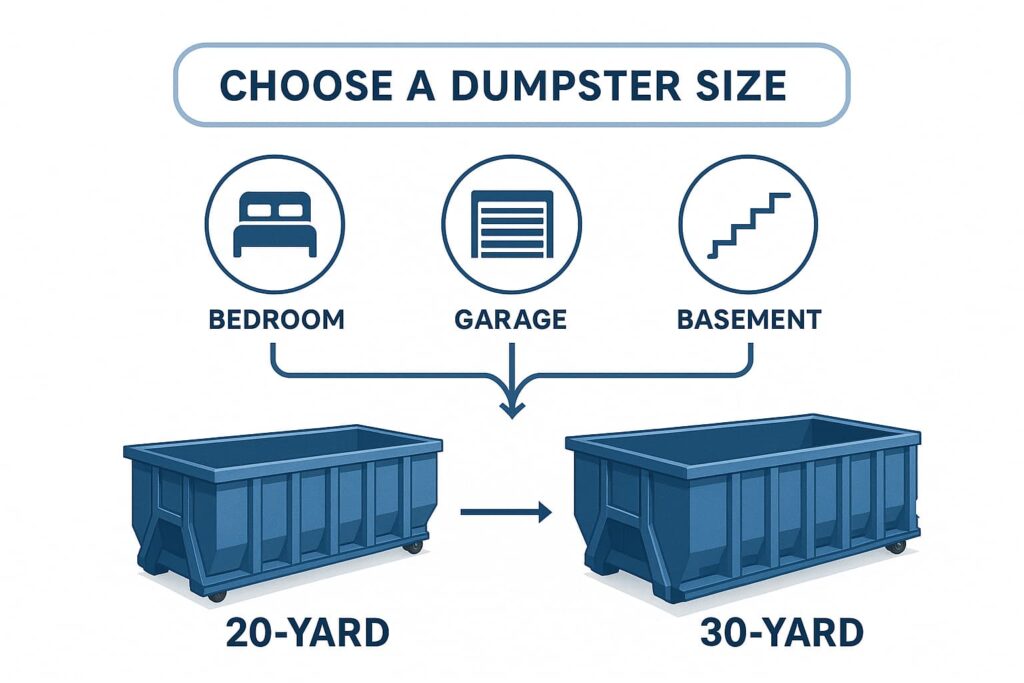
- Most large home cleanouts call for a 20-yard or 30-yard roll-off dumpster — the right choice depends on how many rooms you are clearing and whether you have a basement, attic, or garage to empty at the same time.
- A 20-yard dumpster holds roughly 8 to 10 pickup truck loads and works well for moderate cleanouts covering multiple rooms or a full basement.
- A 30-yard dumpster holds roughly 12 pickup truck loads and is the go-to choice for whole-house cleanouts, estate sales, and projects where every room needs emptying.
- Sizing up costs only $100–$150 more upfront but protects you from the $400–$600 expense of needing a second rental when you run out of room mid-project.
- Furniture, appliances, and “hidden” junk always take more space than expected — add a 25% buffer to any volume estimate before you choose a size.
Article Summary: For most large home cleanouts in Peoria and Central Illinois, a 20-yard roll-off dumpster handles multi-room projects, while a 30-yard container is the smarter pick for whole-house or estate cleanouts. Choosing the right size from the start avoids costly second rentals and keeps your project moving without delay.
Why the Best Dumpster Size for a Large Cleanout Matters More Than You Think
Picking the wrong dumpster size is one of the most common — and most expensive — mistakes homeowners make when tackling a large cleanout. Order too small, and you hit a wall halfway through the job. Order too large, and you feel like you wasted money on empty space. Getting the size right from the start keeps your schedule intact and your budget under control.
Roll-off containers are the standard tool for residential cleanouts because their open-top design lets you toss in bulky items — old furniture, appliances, boxes of decades-old belongings — without any awkward maneuvering.[1] The name “roll-off” describes exactly how they work: the container rolls off the back of a truck onto your driveway or designated spot, sits while you fill it, then rolls back on for pickup.
For large cleanouts across Peoria IL and the surrounding Central Illinois area, the decision almost always comes down to 20-yard versus 30-yard. Understanding what separates these two sizes — and how to calculate which one fits your specific project — is what this guide is all about.
The 20-Yard Dumpster: Best for Moderate Large Cleanouts
The 20-yard roll-off is the most popular container size for residential projects, and for good reason. It measures approximately 22 feet long, 8 feet wide, and 4.5 feet tall, giving you around 8 to 10 pickup truck loads of capacity.[1][2] That footprint fits in most standard driveways without blocking traffic or requiring special permits.
This size hits the sweet spot for projects like clearing out a full basement that has been collecting items for years, emptying a two-car garage packed with tools and seasonal equipment, or removing furniture and belongings from three or four rooms during a major declutter. You get genuine capacity for bulky items without paying for a container that dwarfs your property.
Homeowners who are downsizing — moving from a family home into a smaller place — often find the 20-yard works well when they are keeping roughly 30 to 40 percent of their belongings and disposing of the rest. The key is being realistic about how much space furniture actually takes up once it is inside a container rather than spread across rooms where it looks manageable.
The 20-yard dumpster is the right call when you are clearing three to four rooms or a single large storage area like a basement — but if you have multiple major spaces to empty at once, read the 30-yard section carefully before you decide.
The 30-Yard Dumpster: Best for Whole-House and Estate Cleanouts
When the project means emptying an entire home — every bedroom, the basement, the garage, and the attic — the 30-yard container becomes the right tool. It measures approximately 22 feet long, 8 feet wide, and 6 feet tall, holding roughly 12 pickup truck loads of material.[2][3] That extra 1.5 feet of height compared to a 20-yard makes a real difference when you are stacking furniture and bulky items.
Estate cleanouts are the clearest use case. When adult children clear a parent’s home that has been occupied for 40-plus years, the sheer volume of accumulated belongings — furniture in every room, boxes in closets, tools in the garage, items in the attic — can push well past what a 20-yard can hold. Starting with a 30-yard means you can work through the entire house without hitting a wall three-quarters of the way through.
Foreclosure cleanouts, properties being prepared for major renovation, and homes where every room needs clearing simultaneously all warrant the 30-yard. These projects almost always surface more volume than the initial walk-through suggests, and the buffer capacity in a 30-yard container is what allows you to finish the job in a single rental period.
If you are clearing an entire house — or a modest-sized home plus a fully packed garage and attic — the 30-yard is almost always the better choice, even if your estimate puts you on the border.
| Dumpster Size | Dimensions (L × W × H) | Capacity | Best For |
|---|---|---|---|
| 15-Yard | 16′ × 8′ × 3.5′ | ~4–5 truck loads | 1–2 rooms, small garage cleanout |
| 20-Yard | 22′ × 8′ × 4.5′ | ~8–10 truck loads | 3–4 rooms, full basement or large garage |
| 30-Yard | 22′ × 8′ × 6′ | ~12 truck loads | Whole-house, estate, or foreclosure cleanout |
| 40-Yard | 22′ × 8′ × 8′ | ~16 truck loads | Large commercial cleanouts, major demolition |
| *Dimensions vary by manufacturer. Confirm exact specs with your rental provider. Truck load estimates based on a standard pickup carrying approximately 2 cubic yards of material. | |||
The Three Sizing Mistakes That Cost Peoria Homeowners the Most
Mistake 1: Underestimating How Much Space Furniture Takes
Furniture is the great surprise of every cleanout. A sectional sofa sitting in your living room looks like one item. Inside a dumpster, it occupies a huge footprint and cannot be stacked over efficiently because of its shape. Add a dining table, six chairs, a dresser, and a pair of nightstands, and you have easily consumed half of a 20-yard container before you have touched a single box.[1]
The mental trick that gets people is comparing the visible room space to the dumpster capacity. Rooms feel large; a dumpster feels even larger. But furniture fills containers in a fundamentally different way than it fills a room — it stacks awkwardly, leaves gaps, and takes up far more cubic footage per pound than almost anything else you will throw away. A practical rule: if you are clearing more than two fully furnished rooms, start your size estimate at the 30-yard.
Mistake 2: Ignoring Weight on Heavy Items
Every dumpster comes with a weight limit, and exceeding it triggers overage fees that can significantly increase your total cost. A 20-yard container typically allows 2 to 3 tons (4,000–6,000 pounds), while a 30-yard usually allows 3 to 4 tons.[3] For a typical household cleanout of furniture and boxes, you are unlikely to hit the weight ceiling. But the moment you add appliances — a refrigerator runs 200–300 pounds, a washer and dryer together add another 200–300 — plus exercise equipment and any stored building materials, the numbers shift quickly.
Homeowners who order a small dumpster to save money sometimes discover they have hit the weight limit before the container is visually full. Now they face two problems: overage fees on the first rental and a second rental to finish the job. That combination easily runs $500 or more — far above the $100–$150 upcharge they were trying to avoid by sizing down.
Mistake 3: Not Planning for the “Discovery Factor”
Every large cleanout uncovers more than the initial walk-through reveals. You pull out the sofa and find three boxes behind it. You open the hall closet and discover shelving units. The attic has holiday decorations going back to the 1990s. The basement holds paint cans, old tools, and a broken treadmill you forgot you owned.
This is not carelessness — it is the nature of the task. Items accumulate in out-of-sight places over years, and a pre-cleanout assessment can only capture what you can actually see. Professional waste removal operators consistently report that final volumes run 20 to 30 percent above what clients estimate before the work starts. Adding a 25% buffer to your initial volume calculation before choosing a size is a simple habit that prevents the most common mid-project headache.[1][2]
Not Sure Which Size You Need?
Talk to Zap Dumpsters — Peoria’s family-owned dumpster sourcing service. We’ll help you match the right container to your project.
Call (309) 650-8954Family-owned sourcing service • Peoria IL • Fast, flexible scheduling
How to Calculate the Right Dumpster Size for Your Cleanout
Step 1 — Walk Through and Document What Is Coming Out
Before you pick up a phone to arrange a rental, walk every room with a notepad or your phone and write down what needs to go. Break it into categories: large furniture, appliances, boxes and bags, outdoor items, and anything unusual. Take a photo of stacked storage areas or rooms where it is hard to see everything at once. This documentation takes 15 minutes and will save you hours of regret later.[4]
Pay particular attention to spaces that are easy to underestimate: the back of closets, under-stair storage, utility rooms, and crawl spaces. If you are clearing an inherited property, plan for at least one full day of discovery before you commit to a container size — long-occupied homes almost always hold more than they appear to from the doorway.
Step 2 — Convert Your Inventory to Pickup Truck Loads
Pickup truck loads are the most practical unit for estimating dumpster needs because most people can visualize a full truck bed. A standard pickup carries roughly 2 cubic yards of material. Use these rough benchmarks to convert your room-by-room list:
- Large furniture piece (sofa, bed frame, dresser): 15–25 cubic feet each
- Standard appliance (fridge, washer, dryer): 20–30 cubic feet each
- Standard moving box: 2–3 cubic feet each
- Large trash bag: 1–2 cubic feet each
- One pickup truck load: approximately 50–60 cubic feet
Add up your cubic feet total and divide by 55 to get an approximate truck load count. That number maps directly to dumpster capacity: 8–10 loads points to a 20-yard, 12 or more loads points to a 30-yard.[1][2][3]
Step 3 — Add Your 25% Buffer and Pick a Size
Once you have a truck load estimate, multiply it by 1.25. That adjusted figure is your target capacity. If your estimate comes to 8 loads, your adjusted target is 10 — comfortably within a 20-yard. If your estimate comes to 10 loads, your adjusted target is 12.5 — that is 30-yard territory. Any time your adjusted number falls on the border between sizes, choose the larger one. The cost difference between adjacent sizes rarely exceeds $100–$150, which is almost always less than the cost of a second rental.
Step 4 — Consult With Your Rental Provider Before You Commit
Your calculated estimate is a good starting point, but nothing replaces a conversation with a provider who has handled hundreds of similar projects in the Peoria area. Share your room-by-room list, mention any heavy items, and describe your timeline. Local providers understand what a “full basement in a 1970s ranch house” or a “3-bedroom estate cleanout with a packed garage” typically generates — that real-world pattern recognition is something no formula can fully replace.
When you are ready to source a container for your cleanout, the home cleanout dumpster sourcing service at Zap Dumpsters Peoria connects Peoria-area residents with the right roll-off container size by walking through project details before any commitment is made.
Real Cleanout Scenarios and the Right Dumpster Size for Each
Downsizing from a 3-Bedroom Family Home
A couple in their 60s moving from a longtime 3-bedroom home into a condo — keeping about 30% of their belongings, disposing of excess furniture, garage contents, and decades of accumulated items. This scenario typically generates 10 to 12 truck loads once you count furniture from the rooms being cleared, partial living room pieces, kitchen items that won’t fit the new place, and what is in the garage. The 30-yard is the safer choice here; it provides enough breathing room for the surprises that inevitably show up.[4]
Estate Cleanout After Inheritance
Adult children clearing a 2-bedroom ranch with a full basement, single-car garage, and attic — occupied for 40-plus years with minimal disposal along the way. Long-term accumulation from earlier generations who saved everything can fill a 30-yard container and sometimes push into a second rental. Starting with the 30-yard and reassessing at the 75% mark is a sound approach: if a second rental is needed, you have made enough progress to accurately gauge what remains.[4]
Foreclosure Property Preparation
A 4-bedroom foreclosure where the previous occupants left all furnishings, personal belongings, and accumulated items — needs complete emptying before renovation or resale. Four fully furnished bedrooms, common areas, a garage, and outdoor items commonly generate 14 or more truck loads. The 30-yard serves most of these situations; larger homes or properties with significant outdoor accumulation may require the 40-yard. When in doubt on a commercial-scale cleanout, your rental provider can help you weigh the cost of sizing up against the near-certain cost of a second haul.
Material-Specific Tips for the Best Dumpster Size Decision
Furniture and Household Goods
Furniture occupies space in a dumpster very differently from how it occupies a room. A sectional sofa might weigh only 200 pounds but take up 15 to 20 cubic feet. Mattresses and box springs are lightweight but consume significant volume and will not lay flat against other items. When your cleanout includes multiple bedrooms of furniture plus common area pieces, make a deliberate count of large items before finalizing your size choice. For those with multiple rooms to clear, the garage cleanout dumpster rental guide covers efficient loading strategies that can meaningfully increase the usable capacity of whatever size you choose.[5]
Appliances and Heavy Equipment
A standard refrigerator runs 200 to 300 pounds and occupies 25 to 30 cubic feet. When you are clearing a home that includes multiple appliances — refrigerator, stove, dishwasher, washing machine, dryer, water heater — you are looking at 1,000 to 1,500 pounds just from those items, plus significant volume.[3] Exercise equipment like treadmills and multi-gym setups adds more weight and awkward dimensions that make efficient packing harder.
One important note on appliances: Illinois law bans large appliances — refrigerators, freezers, air conditioners, water heaters, ranges, and similar “white goods” — from landfills unless their CFC refrigerant, mercury switches, and PCB-containing components have been removed first.[6] Confirm with your rental provider how they handle appliance disposal before you load one into the container, so you do not face unexpected fees or compliance issues at the other end.
Boxes, Bags, and the Miscellaneous Category
A typical whole-house cleanout might involve 50 to 100 moving boxes of clothes, books, kitchenware, and decorations. At 2 to 3 cubic feet each, that is 100 to 300 cubic feet before you have touched a single piece of furniture. Then add the miscellaneous category: old toys, sporting gear, holiday decorations, craft supplies, and random items that fill the gaps between larger pieces. These fill-in items are easy to undercount during the planning stage and are exactly why the 25% buffer rule exists.
What You Cannot Put in a Cleanout Dumpster in Peoria IL
Knowing what stays out of the container protects you from unexpected fees and keeps your project compliant with Illinois waste disposal regulations. The Illinois EPA’s household waste disposal guidance bans a specific list of materials from landfills statewide — and dumpster rental providers apply these restrictions to their containers accordingly.[6]
Items that cannot go into a standard roll-off dumpster for a residential cleanout include: large appliances containing refrigerants (unless properly de-gassed), electronics such as computers, televisions, and monitors, lead-acid batteries, waste tires, used motor oil, yard waste and landscape trimmings, lithium-ion batteries, and untreated medical waste. Oil-based paints are handled through household hazardous waste collection events; latex paint, however, can be dried with cat litter and disposed of as regular household waste at a permitted landfill.[6]
For prohibited items discovered during your cleanout, GFL Environmental operates the Peoria County area’s active disposal facilities — including Indian Creek Landfill in Hopedale (open Monday–Friday 7 a.m.–3:30 p.m., Saturday 7 a.m.–noon) and the Chillicothe Transfer Station — and can direct you to the right disposal pathway. You can reach GFL at (309) 688-0760.[7]
Peoria IL Placement Rules and What to Know Before the Dumpster Arrives
No Permit Needed for Driveway Placement
Placing a roll-off dumpster on your own private property — including your driveway — does not require a permit from the City of Peoria Public Works Department.[8] For the vast majority of residential cleanouts, this means you can schedule your rental and have the container placed without any paperwork.
Street Placement Requires a Permit
If limited driveway access or ongoing work means you need to place the container on a city street, alley, or public right-of-way, a right-of-way use permit is required. The City of Peoria charges $20 for every 30 days of street placement. The container must also have barricades with flashing lights at each end on the traffic side, reflective strips on the sides, and boards underneath to protect the road surface. Applications go through the City of Peoria Public Works Department’s Permits Division at 3505 N. Dries Lane, or you can call 309-494-8800.[8]
Protecting Your Driveway
Placing plywood sheets under the dumpster’s contact points is a simple way to protect concrete or paver driveways from surface damage during placement and pickup. This is especially worth doing on newer driveways or decorative surfaces. Most rental providers can advise on protective measures, and the minor cost of a few plywood sheets is well worth the peace of mind during a project that might keep the container in place for a week or two.
Cost Realities: Why Sizing Up Usually Saves You Money
The True Cost of Undersizing
The upfront cost difference between a 20-yard and a 30-yard dumpster typically falls in the $100–$150 range, though pricing varies by provider and rental duration. Many homeowners see that number and instinctively choose the smaller size. But if you underestimate and need a second rental, you are looking at another delivery fee, another pickup fee, another disposal charge, and a second rental period — costs that routinely add up to $400 or more. The math on sizing up almost always favors the larger container when the project is genuinely on the border between two sizes.
Weight overage fees add another layer to the calculation. Most dumpster rentals include a set weight allowance, with overage charges running $50–$100 per additional ton at many providers. If your cleanout includes several appliances, exercise equipment, or any stored building materials, those items add weight quickly. The higher base weight allowance that comes with a 30-yard container can be worth the upgrade on its own, even before you factor in extra volume.
Loading Efficiency: Getting More From Any Size You Choose
How you load the container makes a meaningful difference in how much you can fit. Start with flat items — disassembled furniture panels, mattresses, doors — along the bottom to create a level base. Break down furniture where you can: removing table legs, collapsing shelving units, and flattening cardboard boxes all help items nest together more efficiently. Fill voids between large pieces with bags and boxes as you go rather than loading categories in sequence. Done well, strategic loading can increase the effective capacity of a container by 20 to 30 percent compared to tossing items in randomly.
| Scenario | Recommended Size | Why |
|---|---|---|
| 1–2 rooms + small garage items | 15-Yard | Adequate for lower-volume projects; smaller footprint |
| 3–4 rooms or full basement | 20-Yard | Handles substantial cleanouts; fits most driveways |
| Entire house or full estate cleanout | 30-Yard | Discovery factor and furniture volume justify the upgrade |
| Large home + outdoor structures or commercial scope | 40-Yard | Maximum volume; ideal for the largest residential and commercial jobs |
Finding the Best Dumpster Size for Your Cleanout Project Near You
Choosing the right roll-off container for a large cleanout comes down to three things: an honest assessment of what is coming out, a volume calculation with a buffer built in, and a conversation with a provider who knows the local market. For most large home cleanouts in Peoria IL, the 20-yard handles multi-room projects well, while the 30-yard is the smarter call whenever an entire house — or any project where multiple major spaces need emptying at once — is involved.
The modest cost difference between sizes almost always pays for itself in avoided headaches. Mid-project delays, second rentals, and overage fees are all predictable outcomes of undersizing — and all of them are avoidable. Take the time to walk through your property, do the truck load math, add your 25% buffer, and when the number puts you on the border, size up. Your future self, standing in a clean and empty space on schedule, will thank you.
If you are ready to move forward with your cleanout project in the Peoria area, calling Zap Dumpsters at (309) 650-8954 puts you in touch with a family-owned sourcing service that helps match you with the right container for your specific project scope — so you can focus on the work, not the logistics.
Ready to Start Your Cleanout?
Zap Dumpsters Peoria helps you source the right roll-off container for your project — fast, simple, and sized right the first time.
Call (309) 650-8954Family-owned sourcing service • Peoria IL • Expert sizing consultation
Best Dumpster Size for Large Cleanout FAQs
What is the best dumpster size for a large cleanout of a whole house?
The best dumpster size for a large cleanout of a whole house is typically a 30-yard roll-off container, which holds approximately 12 pickup truck loads of material. This size accommodates the furniture, appliances, boxes, and “hidden” items that surface during a full home emptying without requiring a second rental to finish the job.[1][2]
How do I know if a 20-yard or 30-yard dumpster is right for my cleanout?
If you are clearing three to four rooms or a single large storage area, a 20-yard dumpster (8–10 truck loads) usually works well. If you are emptying an entire house — or any combination of a full house plus a garage, basement, or attic — the 30-yard (12 truck loads) is the safer pick to avoid running out of room mid-project.[1][2][3]
What happens if I choose too small a dumpster for my cleanout?
If your dumpster fills before your cleanout is finished, you will need a second rental — which means another delivery fee, pickup fee, rental period, and disposal charge that typically adds $400 or more to your total cost. Sizing up by one container grade at the start almost always costs less than this scenario.[1]
Do I need a permit to place a cleanout dumpster on my driveway in Peoria IL?
No permit is required to place a dumpster on your private property in Peoria, including your driveway. If you need to place the container on a city street or public right-of-way, a right-of-way use permit from the City of Peoria Public Works Department is required and costs $20 for every 30 days.[8]
What items cannot go in a large cleanout dumpster in Illinois?
Illinois law bans several items from landfills, meaning they also cannot go in standard roll-off dumpsters: large appliances with refrigerants (unless properly de-gassed), electronics, lead-acid batteries, waste tires, used motor oil, yard waste, lithium-ion batteries, and untreated medical waste. Oil-based paint is also excluded; latex paint can be dried and disposed of as regular household waste.[6]
Best Dumpster Size for Large Cleanout Citations
- Budget Dumpster — Complete Breakdown of Roll-Off Dumpster Sizes
- Hometown Dumpster Rental — The Ultimate Guide to Dumpster Sizes
- Sourgum — Roll-Off Dumpster Sizes and Capacities
- Dumpsters.com — Roll-Off Dumpster Sizes Guide
- Zap Dumpsters Peoria — Garage Cleanout Dumpster Rental Guide
- Illinois EPA — Household Waste Disposal: Banned Items and Proper Disposal Guidance
- Peoria County — City/County Landfill Information and Active Disposal Facility Locations
- City of Peoria — Dumpster and Portable Storage Containers on the Right-of-Way