
- Sort waste into at least four zones — metal, clean wood, drywall, and general debris — before your first piece of material hits the floor.
- Hazardous materials like paint and solvents must be separated immediately and never placed in a roll-off container.
- Sorted loads cost less to dispose of — many facilities charge lower tipping fees for pre-separated materials.
- Peoria County Landfill #2 closed April 19, 2025, so knowing where your C&D debris goes right now matters more than ever.
- Renting a construction dumpster for your renovation makes sorting easier by giving you dedicated space to stage each material type on-site.
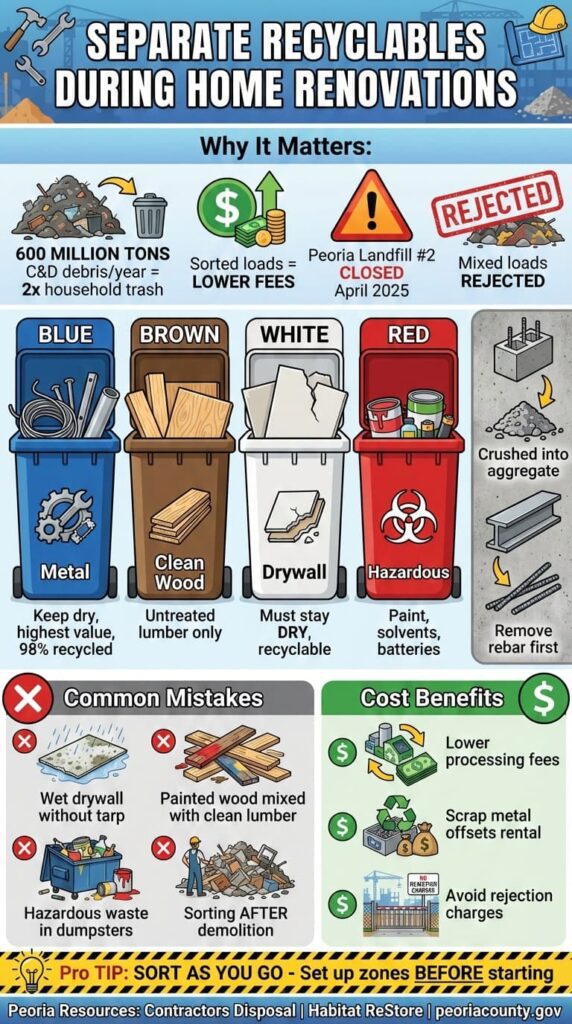
To separate recyclables during home renovations, set up labeled bins for metal, clean wood, drywall, and hazardous materials before demolition starts, sort each material as it comes out, and keep loads dry and uncontaminated so recycling facilities will accept them. Getting this right from day one saves money, keeps your project legal, and diverts a meaningful share of your debris away from landfills.
Why Sorting Recyclables During Home Renovations in Peoria Matters Right Now
The U.S. EPA estimated that 600 million tons of construction and demolition (C&D) debris were generated in the United States in 2018 alone — more than twice the amount of regular household trash.[1] That number hasn’t shrunk since. For Peoria homeowners, the stakes just got more local: the City/County Landfill #2 closed on April 19, 2025, and a replacement transfer station is not expected to open until 2026.[2] Until then, how you manage renovation debris — what you sort, what you recycle, and what actually goes in the dumpster — has a direct impact on where your materials end up and what you pay.
Here’s the thing most renovation guides miss: sorting is not just an environmental gesture. It’s a money decision. Many C&D recycling facilities offer lower tipping fees for pre-separated loads because sorted materials require less processing. Mixed loads cost more to handle, and in some cases facilities will reject them entirely if they contain contaminated drywall, treated wood mixed with clean lumber, or any prohibited material. Getting into the habit of separating recyclables during home renovations from the start — not as an afterthought — is the single most effective thing you can do to control disposal costs.
Peoria County also has a Commercial Recycling Ordinance that requires all businesses in the county to recycle at least two of their most quantified recyclables from their waste stream.[3] If you’re a contractor working a job in Peoria, that ordinance applies. And even if you’re a homeowner doing a DIY renovation, the spirit of that rule points you in the right direction: separate early, separate often, and know what you’re throwing out.
What Makes Renovation Waste Different from Regular Household Trash
Regular curbside recycling programs — the kind that handles your bottles, cans, and cardboard — don’t accept construction debris. C&D waste is its own category entirely. It includes materials like drywall and plaster, wood products, steel, concrete, asphalt shingles, and brick.[1] Each of these requires a different processing pathway, and mixing them together contaminates the whole load. A single piece of treated lumber in a pile of clean wood can disqualify that entire batch from standard wood recycling. A drywall scrap coated in joint compound needs to go to a specialized gypsum facility, not a regular recycler. Understanding these distinctions is what separates a smooth renovation cleanup from a costly, rejected load.
For Peoria residents tackling bathroom remodels, kitchen gut-outs, or basement finishing projects, this distinction matters practically. Your contractor’s crew — or your own helpers — need to know the rules before the first sledgehammer swings. Set up the zones before the work begins. Label everything clearly. And if you’re handling remodeling waste disposal for cabinets, drywall, and flooring in Peoria, having the right container on-site from day one makes the whole process significantly cleaner and easier to manage.
Your Quick Sorting Guide: What Goes Where During a Home Renovation
Before we get into the how-to, this table gives you a fast-reference breakdown by material type. Use it to train helpers, post it in your work zone, or share it with your crew.
| Material | Recyclable? | Where It Goes | Key Rule |
|---|---|---|---|
| Clean (untreated) wood | Yes | C&D recycler or mulch/biomass facility | No painted, stained, or pressure-treated lumber |
| Metal (copper, steel, aluminum) | Yes — high value | Scrap metal yard or C&D facility | Keep dry, separate ferrous from non-ferrous if possible |
| Drywall / gypsum | Yes — specialized | Gypsum recycler or wallboard manufacturer | Keep separate and dry; do not mix with other debris |
| Concrete / masonry | Yes | Crushed aggregate facility | Remove rebar if possible; no asbestos-contaminated material |
| Paint / solvents | Hazardous — special disposal | Peoria County HHW event or approved facility | Never in a dumpster or down a drain |
| Batteries / electronics | Hazardous — special disposal | County HHW event or retail take-back | Illinois EPA bans these from landfills |
| Cardboard / packaging | Yes | Standard curbside recycling | Remove tape; keep dry |
| Fixtures / cabinets (reusable) | Donate or resell | Habitat for Humanity ReStore or similar | Must be in usable condition |
How to Separate Recyclables During Home Renovations: A Step-by-Step Approach
The most effective way to separate recyclables during home renovations is to build your sorting system before you start tearing anything out. Once demo begins, waste piles up fast, and trying to sort retroactively is messy, slow, and error-prone. A few hours of prep work before you start swinging a hammer pays dividends for the entire project.
Step 1 — Map Out Your Material Zones
Walk through your project and estimate the main material categories you’ll generate. A bathroom gut-out will produce tile, drywall, old fixtures, copper pipe, and cardboard packaging from new materials. A kitchen remodel adds cabinet boxes, countertop material, and possibly flooring. Each category needs its own designated spot — whether that’s a labeled bin, a tarp corner in the garage, or a dedicated section of a roll-off container. On-site sorting consistently yields higher recycling rates and better pricing at recycling facilities than mixed loads, because separated materials require less downstream processing.[4] Give each zone enough room to work in without materials bleeding into each other.
Step 2 — Color-Code and Label Everything
Color-coding is one of the most practical tools for keeping a renovation sorting system on track, especially when you have multiple helpers or a contractor crew working at once. Blue bins for metal, brown for clean wood, white for drywall, and red for hazardous materials creates an intuitive visual system that doesn’t rely on everyone remembering a list. Use large, clear labels — not small sticky notes — and post a simple reference chart in the main work area. This step might feel like overkill for a small bathroom remodel, but it becomes essential the moment a second person starts generating waste. Misplaced materials happen fast when people are busy.
Step 3 — Pull Hazardous Materials First, Every Time
Hazardous waste must be identified and separated before any general demolition starts — not during, not after. Materials like paint, stains, varnishes, solvents, pesticides, and batteries require special handling and cannot go in a construction dumpster or curbside bin. In Peoria, oil-based paint cannot be placed in regular garbage, and residents must hold it for an Illinois EPA Household Hazardous Waste collection event.[5] Peoria County runs these events by appointment — check peoriacounty.gov for current scheduling. Illinois EPA also bans certain materials from landfills outright, including lead-acid batteries and some electronics.[2] Homes built before 1978 may also contain lead-based paint or asbestos-containing materials, both of which require licensed abatement professionals — never amateur demo.
Step 4 — Handle Metal Separately for Maximum Value
Metal is one of the highest-value materials in any renovation waste stream. Copper pipe from old plumbing, aluminum window frames, steel studs, and electrical wire all have real scrap value — value you forfeit the moment they end up in a mixed debris load. 98% of steel from construction and demolition projects is recycled to new uses, making it one of the most consistently diverted materials in the C&D waste stream.[6] Keep a separate, dry container specifically for metal from day one. Ferrous metals (steel, iron) and non-ferrous metals (copper, aluminum) can be mixed together for most residential projects — scrap yards can sort them. Just make sure nothing is contaminated with paint, adhesives, or embedded concrete.
Step 5 — Treat Drywall as Its Own Category
Drywall — or gypsum wallboard — is one of the most commonly mismanaged renovation materials. It looks like general debris, so people throw it in with everything else. But gypsum is a specialized recyclable: it can be ground down and reused in new drywall manufacturing or processed as a soil amendment.[7] The key requirement is that it stays separate and dry. Wet gypsum is often rejected by recycling facilities. Gypsum mixed with other C&D debris becomes contaminated and ends up in the landfill. Keep drywall scraps and removed panels in their own pile or container, protected from rain or moisture. For larger projects, your dumpster sourcing partner can advise on whether separate containers make sense for your job volume.
Need a dumpster for your Peoria renovation?
Zap Dumpsters helps Peoria homeowners source the right container for renovation debris removal — fast and hassle-free.
Separating Renovation Recyclables: On-Site Sorting vs. Mixed Load Options
There are two main approaches to managing C&D recycling: sort materials yourself on-site, or put everything in one mixed container and let the facility sort it off-site. Each has real trade-offs, and which one works for you depends on your project size, available space, and recycling goals.
| Factor | On-Site Sorting | Mixed / Commingled Load |
|---|---|---|
| Recycling rate | Higher — materials are cleaner | Lower — contamination reduces diversion |
| Cost | Often lower tipping fees for sorted loads | Higher processing fees; possible rejection |
| Space needed | More — multiple bins or zones required | Less — one container handles all debris |
| Best for | Projects with high-volume recyclables (metal, wood) | Small or mixed projects with limited staging room |
| Worker training needed | Yes — clear labeling and crew buy-in required | Minimal — one bin, one rule |
For most Peoria homeowners, a hybrid approach works best. Use one roll-off container for general renovation debris while keeping separate, smaller bins for high-value recyclables like metal and clean wood. This gives you most of the recycling benefit without requiring a lot of extra space or containers. If your project involves mostly one material type — say, a full drywall replacement — a dedicated container can significantly reduce your tipping costs. A construction dumpster sourced through Zap Dumpsters for renovation debris removal gives you a managed, on-site solution that makes maintaining material separation far more practical.
As waste management expert Daniel Anderson, CEO of GoRubbishGo, has noted: “While the technology for recycling most C&D materials exists, the heavy weight and relatively low value of recycled C&D wastes often limit markets to regional scopes. Successful recycling models where regulators, recyclers, and manufacturers work together hold the strongest potential for replication.”[8] That’s a useful frame for Peoria renovators: the local options you use, and how well you separate before you send materials out, shapes what actually gets diverted from the landfill.
What Peoria Renovators Need to Know About Local Disposal and Recycling Options
With Peoria City/County Landfill #2 closed as of April 2025 and the new GFL transfer station not expected to open until 2026, construction debris disposal routing in central Illinois has shifted.[2] The Peoria County website is the best current source for where to take construction materials until new infrastructure opens — check peoriacounty.gov/203 for updated guidance. This is not a time to guess. Routing construction debris to the wrong facility can result in rejected loads, extra hauling costs, and potential fines.
For C&D recycling specifically, Contractor’s Disposal in East Peoria (412 Cass St, (309) 691-5410) provides local single-stream C&D recycling and delivers materials to a regional C&D recycling facility for sorting and processing.[9] This is a practical option for Peoria homeowners who want a managed solution for sorted renovation debris. For hazardous materials — paint, pesticides, solvents, batteries — the Illinois EPA runs Household Hazardous Waste collection events in Peoria by appointment. The 2025 event was scheduled at the Landmark Parking Lot, 3225 North Dries Lane, Peoria, IL 61604, in May 2025.[10] Check epa.illinois.gov for future events. Oil-based paint and many electronics are banned from regular landfills under Illinois law — these need the right outlet.
For items in reusable condition — old kitchen cabinets, working appliances, light fixtures, doors, and windows — Habitat for Humanity ReStore accepts a wide range of building materials and home goods.[11] Donating these items keeps them out of the waste stream entirely, gets you a potential tax receipt, and helps the local community. The DIY Stack Exchange community also has useful practical guidance on how to dispose of material waste during home construction, including step-by-step advice from experienced builders on ordering construction dumpsters and routing materials to the right facilities.[12]
Case Study: A Simple Sort Saved a Peoria Homeowner Real Money
A homeowner doing a full bathroom remodel in Peoria separated copper pipe, steel fixtures, and aluminum frames into a single metal bin throughout the project. At the end of the job, the metal alone covered a meaningful portion of the dumpster rental cost when taken to a local scrap yard — a return that would have been zero if those materials had ended up mixed in with the general debris load. The sorting took less than 10 extra minutes per day.
Mistakes That Get Sorted Loads Rejected — and How to Avoid Them
You can do everything right and still end up with a rejected or penalized load if a few common mistakes slip through. Contamination is the top reason recycling facilities turn away renovation debris. Even a small amount of the wrong material can downgrade or disqualify an otherwise clean batch. Here are the most frequent problems and how to avoid each one.
Wet drywall is the most common issue. Gypsum absorbs moisture quickly, and once wet, most facilities won’t accept it because the material degrades and becomes harder to process. Keep drywall scraps covered and out of the elements from the moment they come off the wall. Even a brief rain shower can contaminate a large pile. Use tarps, store inside, or stage drywall in a covered area.
Treated or painted lumber mixed with clean wood is the second-biggest problem. Clean, untreated wood can be chipped for mulch, processed into particleboard, or used for biomass energy.[7] The moment you mix in pressure-treated lumber or wood with lead-based paint (possible in pre-1978 homes), the whole batch becomes a different category of waste. Keep a separate pile or bin strictly for clean wood from the start. If you’re unsure whether lumber is treated, assume it is and route it accordingly.
Sorting your renovation debris correctly isn’t just good for the environment — it’s the most direct way to lower your disposal costs and avoid load rejection fees at the facility. A few labeled bins and a 10-minute crew briefing before demo starts can prevent hundreds of dollars in extra charges.
Finally, never put hazardous materials in a roll-off dumpster. This includes paint cans (even dry-looking ones), batteries, solvents, pesticides, fluorescent bulbs, and asbestos-containing materials. Dumpster providers will not accept these, and hauling companies are required to check. If prohibited materials are found in a container, you may face additional fees, load rejection, or in serious cases, regulatory action. The solution is simple: set up a dedicated hazardous materials box at the start of the project, communicate its location to everyone working on-site, and schedule proper disposal through Peoria County’s HHW program or an approved facility.
Ready to Separate Recyclables During Home Renovations Near You?
Sorting renovation materials doesn’t need to be complicated. Set up your zones before demo starts. Label everything clearly. Pull hazardous materials out first. Keep drywall dry and separate. Protect clean wood from treated lumber. And give high-value metal its own bin from day one. These five habits, done consistently from the first day of your project, can significantly reduce your disposal costs, keep your loads from being rejected at the facility, and make sure recyclable materials actually get recycled rather than ending up in a landfill.
For Peoria homeowners, the local landscape has changed with the 2025 landfill closure, making it even more important to plan your waste disposal strategy upfront — not as an afterthought when the dumpster is already full. Whether you’re gutting a bathroom, opening up a kitchen, or replacing flooring throughout the house, having the right container in place and a clear sorting plan ready makes the whole job run cleaner and cheaper. Zap Dumpsters helps Peoria area homeowners source the right dumpster rental for renovation debris removal, matched to your project size and material types — right dumpster rental services are easier to find than most people think when you have a local partner who knows the area. Call (309) 650-8954 or visit zapdumpsterspeoria.com to get started.
Get the right dumpster for your Peoria renovation project
Zap Dumpsters sources dumpsters for homeowners across Peoria and central Illinois. Tell us your project — we’ll match you with the right container.
Separate Recyclables During Home Renovations FAQs
How do you separate recyclables during home renovations?
To separate recyclables during home renovations, set up labeled bins or zones for each material type — clean wood, metal, drywall, cardboard, and hazardous waste — before demolition begins. Sort each material as it comes off the wall or floor, keep loads dry and uncontaminated, and route each category to the appropriate facility or dumpster.
Can you separate recyclables during home renovations into a regular dumpster?
You can use a roll-off construction dumpster to stage sorted renovation materials, but a standard dumpster is not designed to manage multiple separated waste streams on its own. For high-volume or high-value materials like metal or clean wood, separate containers or bins work better to keep loads clean and avoid contamination fees at the facility.
What renovation materials are most worth recycling?
Metal — including copper pipe, steel studs, and aluminum frames — is the highest-value renovation recyclable and the most consistently recovered material in C&D waste streams. Clean untreated wood, concrete, and gypsum drywall are all worth recycling if kept separated and dry, as they can be processed into mulch, aggregate, or new wallboard.
What happens to drywall removed during a renovation?
Drywall removed during a renovation can be recycled at specialized gypsum facilities, where it’s ground down and reused in new wallboard manufacturing or processed as a soil amendment. For this to work, the gypsum must be kept separate from other debris and protected from moisture, which is why it needs its own zone on your job site from day one.
Where can Peoria residents take hazardous renovation waste?
Peoria County residents can bring hazardous renovation materials — including paint, solvents, pesticides, and batteries — to Illinois EPA Household Hazardous Waste collection events held in Peoria by appointment. Oil-based paint and many electronics are banned from Illinois landfills and cannot go in regular trash or a construction dumpster.
Separate Recyclables During Home Renovations Citations
- U.S. EPA — Construction and Demolition Debris: Material-Specific Data
- Peoria County — City/County Landfill
- Peoria County — Waste & Recycling (Commercial Recycling Ordinance)
- Okon Recycling — What is Construction Waste Separation and Why is It Important?
- City of East Peoria — Recycling Other Miscellaneous Materials
- BigRentz — 24 Construction Waste Statistics
- U.S. EPA — Sustainable Management of Construction and Demolition Materials
- American Recycler — C&D Recycling Industry Faces Ongoing Challenges
- Contractor’s Disposal — C&D Recycling Services, East Peoria IL
- Illinois EPA — Peoria Household Hazardous Waste Collection Event 2025
- This Old House — Debris Disposal 101: A Guide to Managing Renovation Waste
- DIY Stack Exchange — How Should I Dispose of Material Waste During Home Construction?