
Key Takeaways:
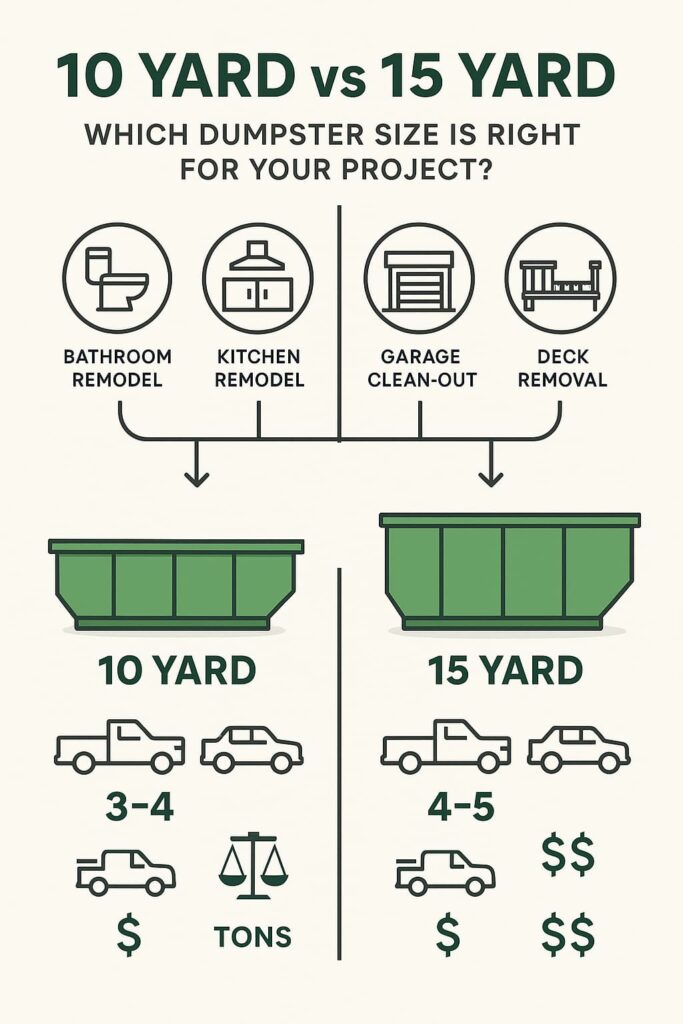
- A 10-yard dumpster holds 3 to 4 pickup truck loads and costs $220 to $580 per week, best for small cleanouts and heavy materials
- A 15-yard dumpster holds 4 to 5 pickup truck loads and costs $265 to $620 per week, ideal for multi-room projects and mixed debris
- Both sizes share similar weight limits of 1 to 2 tons for standard debris, but the 15-yard offers 50% more space
- The cost difference between sizes is typically $50 to $100, making the 15-yard a smart choice if you’re unsure about volume
- Choosing too small can lead to overage fees or a second rental that doubles your costs
Quick Answer: The main difference between a 10 yard vs 15 yard dumpster is capacity. The 10-yard works well for single-room cleanouts and heavy materials in tight spaces, while the 15-yard handles multi-room renovations and provides flexibility for first-time DIYers who might underestimate their debris volume. Both share similar weight limits, but the modest price difference makes the 15-yard a safer bet for residential projects.
Understanding Dumpster Size Differences for First-Time DIYers
When you’re planning your first home renovation, the question of dumpster size can feel overwhelming. You stand in your garage or basement, looking at years of accumulated stuff, and wonder: will a 10-yard dumpster be enough, or should I go with a 15-yard? The answer matters more than you might think, because choosing the wrong size can cost you twice as much and delay your entire project.
The difference between these two sizes comes down to volume and footprint. A 10-yard dumpster measures approximately 14 feet long, 7.5 feet wide, and 3.5 to 4 feet high.[1] Think of it as roughly the size of a mid-sized car sitting in your driveway. A 15-yard dumpster stretches to about 16 feet long, maintains that same 7.5-foot width, but stands taller at around 4.5 feet high.[2]
Both dumpsters fit comfortably in most residential driveways, which makes them popular choices for homeowners in Peoria and surrounding areas. The real question becomes: how much debris will your project actually create? First-time DIYers almost always underestimate this number, which is why understanding the practical differences between these sizes matters so much.
Here’s what most people don’t realize until it’s too late: a 10-yard dumpster holds roughly 50 to 70 trash bags, while a 15-yard can handle 80 to 100 bags.[3] That extra capacity translates to one or two additional pickup truck loads, which can be the difference between completing your project smoothly and having to stop mid-renovation to schedule a second dumpster.
If you’re tackling a bathroom remodel, garage cleanout, or small landscaping project, our 10-yard dumpster sourcing services can connect you with local haulers who specialize in compact residential projects. We coordinate availability from multiple providers in Peoria, making it simple to compare your options.
Capacity and Weight: What Each Size Really Holds
Volume Capacity Breakdown
Volume capacity tells you how much physical space you have to work with. A 10-yard dumpster offers 10 cubic yards of space, which equals about 270 cubic feet.[4] For most people, this abstract number doesn’t mean much until you translate it into real-world items.
Picture this: a standard three-seat couch measuring seven feet wide can fit in a 10-yard dumpster if you lay it flat.[5] Add in the contents of a small bathroom renovation—vanity, toilet, tiles, and drywall—and you’re approaching the fill line. That’s why 10-yard dumpsters work so well for focused, single-room projects where you know exactly what’s going out.
A 15-yard dumpster gives you 15 cubic yards, or roughly 405 cubic feet of space. That 50% increase in volume means you can handle a full kitchen cleanout, including cabinets, countertops, and appliances, without worrying about running out of room halfway through. The extra space also accommodates bulkier items that don’t stack neatly, like old furniture or bagged debris from attic cleanouts.
Weight Limits and Overage Fees
Here’s where things get tricky for first-timers: volume and weight are two different measurements. Both 10-yard and 15-yard dumpsters typically come with weight limits of 1 to 2 tons (2,000 to 4,000 pounds) for household debris.[6] Some providers in the Peoria area may offer up to 2.5 or 3 tons, but this varies by company and debris type.
Weight limits exist for two reasons: truck safety and disposal costs. The hauling truck has a maximum load it can safely transport, and landfills charge by weight. When you exceed your included weight limit, you’ll pay an overage fee that typically ranges from $25 to $100 per additional ton.[7]
This weight restriction explains why smaller dumpsters often work better for heavy materials. If you’re disposing of concrete, brick, dirt, or asphalt, a 10-yard dumpster lets you fill the container partway without exceeding weight limits. A 15-yard filled with these same materials would quickly surpass safe hauling capacity, even though the dumpster isn’t physically full.
The Weight Versus Space Challenge
First-time renovators often face this puzzle: they rent a larger dumpster thinking “bigger is better,” then find themselves with a half-empty container that exceeds the weight limit because it’s full of tile or shingles. Each roofing square (100 square feet) of asphalt shingles weighs between 250 and 300 pounds, and most roof tear-offs involve multiple layers.[8] That weight adds up fast.
On the flip side, lightweight household junk—furniture, clothing, toys, and general clutter—rarely comes close to exceeding weight limits even in a completely full dumpster. For these projects, the 15-yard’s extra volume gives you breathing room without weight concerns.
| Factor | 10-Yard Dumpster | 15-Yard Dumpster |
|---|---|---|
| Volume | 10 cubic yards (270 cubic feet) | 15 cubic yards (405 cubic feet) |
| Capacity | 3 to 4 pickup truck loads | 4 to 5 pickup truck loads |
| Weight Limit | 1 to 2 tons (standard debris) | 1 to 2 tons (standard debris) |
| Dimensions | 14′ L × 7.5′ W × 3.5-4′ H | 16′ L × 7.5′ W × 4.5′ H |
| Best For | Single rooms, tight spaces, heavy materials | Multi-room projects, mixed debris, uncertain volumes |
Project-Specific Recommendations for Peoria Homeowners
When a 10-Yard Dumpster Makes Sense
A 10-yard dumpster serves you well when your project has clear boundaries and predictable debris. These scenarios work perfectly with the smaller size:
Single-room renovations: A small bathroom remodel that includes replacing the vanity, toilet, shower surround, and floor tiles generates enough debris to fill a 10-yard dumpster about 75% full. The same goes for a minor bedroom update where you’re removing old carpet, baseboards, and perhaps one wall of drywall.
Garage or attic cleanouts: When you’re decluttering a single space and can see everything that needs to go, a 10-yard container provides enough room without paying for unused capacity. Most garage cleanouts involve bulky but lightweight items like old bicycles, boxes of holiday decorations, and worn-out sports equipment.
Heavy material disposal: For projects involving concrete removal, dirt excavation, or brick disposal, the 10-yard size keeps you within safe weight limits. You might only fill the dumpster halfway, but that controlled capacity prevents weight overage fees that could double your costs.
Tight driveway or placement areas: The slightly smaller footprint can make the difference between fitting comfortably in your driveway or requiring a street permit. In older Peoria neighborhoods with narrow driveways, this matters more than you’d think.
When a 15-Yard Dumpster Is the Smarter Choice
The 15-yard dumpster earns its reputation as the “Goldilocks” option for good reason. It handles these common residential scenarios with room to spare:
Multi-room renovations: A kitchen remodel generates significantly more waste than most homeowners expect. Cabinets, countertops, appliances, flooring, and drywall add up quickly. The 15-yard gives you the buffer to handle the project plus unexpected discoveries like damaged subflooring or extra demolition needed around plumbing.
Whole-house cleanouts: Whether you’re preparing a home for sale, dealing with an estate cleanout, or finally tackling that years-long accumulation project, the 15-yard accommodates mixed debris from multiple rooms. This size handles furniture, boxes, yard waste, and construction materials all in one rental.
Deck or shed removal: Complete demolition projects create bulky debris that doesn’t stack efficiently. A 15-yard dumpster provides the volume needed for these lumber-heavy projects without requiring precision loading.
Landscaping overhauls: Major yard projects involving tree removal, bush clearing, and hardscape demo generate both heavy materials (rocks, pavers) and bulky organic waste (branches, stumps). The 15-yard handles this mixed-use scenario better than the smaller option.
For ideas on creative uses beyond standard renovations, many Peoria homeowners have found unexpected applications for compact dumpsters in their projects.
The “Uncertain Volume” Decision Rule
If you’re reading this and still unsure which size fits your project, that uncertainty itself provides your answer: choose the 15-yard. Here’s why this logic makes financial sense.
Let’s look at the math. The average cost difference between a 10-yard and 15-yard dumpster in most markets runs between $50 and $100 per week.[9] Now compare that modest increase to the cost of underestimating. If your 10-yard dumpster fills up before your project finishes, you face two expensive options:
Option 1: Pay overage fees. These range from $25 to $100 per ton over your weight limit, but even worse, you might exceed the physical volume of the container. Debris piled above the fill line creates safety issues and most haulers will refuse pickup until you remove the excess.
Option 2: Rent a second dumpster. This doubles your delivery fees, rental costs, and disposal charges. You’ll easily spend an additional $300 to $600, turning your “budget-friendly” choice into the most expensive option.[10]
That extra $75 spent upfront on the 15-yard dumpster suddenly looks like the smartest money you could have invested in your project.
Cost Analysis and Hidden Factors
Dumpster pricing in the Peoria area typically follows national trends with some local variation based on disposal fees and hauler competition. According to industry safety guidelines, proper size selection prevents accidents and ensures efficient waste management.
A 10-yard dumpster rental in most markets costs between $220 and $580 per week, with the average sitting around $350.[11] A 15-yard dumpster runs $265 to $620 per week, averaging closer to $400.[12] Your final cost depends on four main factors:
Location and disposal fees: Woodford, Tazewell, and Fulton counties each set their own landfill disposal rates. Projects closer to disposal facilities typically cost less because haulers factor in transportation time and fuel costs.
Debris type: Household junk, yard waste, and construction materials go to different processing facilities, each charging different rates. Heavy materials like concrete may require special handling and disposal, which increases costs regardless of dumpster size.
Rental duration: Most providers include seven to 10 days in the base price. Extensions beyond that window typically add $5 to $15 per day. Plan your project timeline carefully to avoid these daily charges that can add up quickly.
Weight inclusions: Your quoted price includes a specific weight allowance. Staying within that limit is crucial. Even if you choose the right physical size, exceeding your included tonnage triggers overage fees.
| Scenario | 10-Yard Cost | 15-Yard Cost | Winner |
|---|---|---|---|
| Small bathroom remodel (fits easily) | $350 | $400 | 10-yard saves $50 |
| Kitchen remodel (underestimated, needs second dumpster) | $700 (2 rentals) | $400 | 15-yard saves $300 |
| Concrete removal (2 tons, half-filled) | $350 | $400 | 10-yard saves $50 |
| Whole-house cleanout (uncertain volume) | $350 + risk | $400 | 15-yard eliminates risk |
The True Cost of Reusing a 10-Yard Versus Upgrading to a 15-Yard
Many first-time DIYers consider this strategy: “I’ll rent a 10-yard, fill it up, have it emptied, and use it again for the rest of my project.” On paper, this sounds economical. In practice, it rarely works out as planned.
The empty-and-return service requires an additional pickup fee and, more importantly, creates timing complications—you’re now dependent on hauler schedules twice instead of once, and the project delays quickly eat into any perceived savings.
More importantly, this approach creates workflow problems. Your renovation stops dead while you wait for the empty dumpster to return. For most residential projects in Peoria, where demolition and disposal happen simultaneously, this interruption can extend your project timeline by days or even weeks.
The math rarely favors the multiple-pickup strategy unless your project naturally divides into distinct phases separated by weeks. For continuous work, the 15-yard’s extra capacity keeps your project moving forward without interruption.
💡 Pro Tip for First-Time DIYers: Calculate your debris volume by room. Use this simple formula: multiply length × width × height of debris piles in feet, divide by 27 to get cubic yards. Add 20% for miscalculation buffer. If your total approaches 8 cubic yards or more, the 15-yard becomes the obvious choice.
Making Your Final Decision: A Practical Framework
By now, you understand the technical differences between these two dumpster sizes. Let’s bring it all together with a decision framework you can use today.
Choose a 10-yard dumpster if:
- Your project involves a single room or clearly defined space
- You’re disposing of heavy materials (concrete, dirt, brick) and need to avoid weight overages
- Space constraints in your driveway or property make the smaller footprint necessary
- You’ve completed similar projects before and can accurately estimate debris volume
- Budget is extremely tight and you’re confident in your volume calculations
Choose a 15-yard dumpster if:
- Your project spans multiple rooms or includes unexpected demolition
- You’re a first-time DIYer without experience estimating debris volume
- Your project involves mixed materials—some bulky, some dense
- You prefer eliminating the risk of needing a second rental
- The modest cost difference ($50-$100) provides valuable peace of mind
Remember that Zap Dumpsters Peoria sources dumpsters from trusted local haulers throughout the Peoria area. We coordinate availability, compare pricing from multiple providers, and match you with the right container for your specific project needs. This approach gives you access to both competitive pricing and professional guidance without the hassle of calling multiple companies.
Common Mistakes That Cost First-Timers Money
After coordinating hundreds of residential dumpster rentals in the Peoria area, we’ve seen these mistakes repeatedly trip up well-intentioned DIYers:
Mistake #1: Choosing size based solely on cost — Saving $75 on the rental fee sounds smart until you factor in a $400 second dumpster rental or $150 in overage fees. The cheapest option upfront often becomes the most expensive overall.
Mistake #2: Forgetting about bulky item inefficiency — That old couch takes up twice the space in the dumpster as it does in your living room. Bulky items don’t stack neatly, which means you need more volume than a simple item count suggests.
Mistake #3: Underestimating demo expansion — Solid materials like cabinets and drywall occupy more space after demolition. A 4×8 sheet of drywall becomes several irregular chunks. Kitchen cabinets that looked compact on the wall suddenly need three times the volume once you remove them.
Mistake #4: Ignoring seasonal factors — Illinois weather affects renovation timelines. Spring and summer bring rain delays that extend rental periods. Planning for potential weather interruptions saves money on daily extension fees.
Mistake #5: Mixing heavy and light debris incorrectly — Layering heavy materials on top of light debris compresses everything down, but it doesn’t reduce weight. You still exceed weight limits even though the dumpster looks half empty.
Peoria Project Examples
Case 1: A Peoria homeowner renovating two bathrooms rents a 10-yard dumpster to save money. After filling it with just the first bathroom’s debris, they need a second rental, ultimately spending $625 instead of the $400 a single 15-yard would have cost.
Case 2: A first-time flipper in Woodford County chooses a 15-yard for a kitchen remodel, finishing with the dumpster about 80% full. The extra capacity handles unexpected rotten subflooring and additional demo, keeping the project on schedule without delays.
Ready to Source the Right Dumpster for Your Peoria Project?
Zap Dumpsters Peoria connects you with trusted local haulers who offer both 10-yard and 15-yard options. We compare availability, coordinate scheduling, and help you choose the right size based on your specific project needs.
Call us today at (309) 650-8954
No guesswork. No surprises. Just straightforward dumpster sourcing from professionals who understand Peoria projects.
10 Yard vs 15 Yard Dumpster FAQs
Can I switch from a 10-yard to a 15-yard dumpster after delivery?
Most haulers in the Peoria area allow you to upgrade dumpster sizes, but you’ll pay a second delivery fee plus the price difference between sizes. This typically costs $100 to $200 more than choosing the right size initially. Some providers may let you exchange during your rental period, but this isn’t guaranteed. It’s always more cost-effective to choose the correct size upfront, which is why we help you assess your project needs before coordinating with haulers.
Which size is better for a 10 yard vs 15 yard dumpster when I’m removing old carpet?
For carpet removal, the 15-yard dumpster typically works better unless you’re only doing one small room. Carpet and padding are bulky materials that don’t compress well, taking up significant volume even though they’re relatively lightweight. A standard-sized living room generates enough carpet debris to fill a 10-yard dumpster about 60% to 70% full when you include padding, tack strips, and any damaged subflooring you discover.
How do I know if my 10 yard vs 15 yard dumpster choice will fit in my driveway?
Both sizes typically fit in standard residential driveways, but measure your available space before committing. A 10-yard dumpster needs about 14 feet of length and 8 feet of width, while a 15-yard requires 16 feet of length. Don’t forget to account for the delivery truck, which needs at least 60 feet of straight approach and 10 feet of overhead clearance for low-hanging branches or wires. We work with local haulers who can scout your property beforehand if placement concerns exist.
What happens if I overfill my dumpster?
Overfilling creates two problems: safety issues and financial penalties. All debris must stay below the fill line, which is typically marked on the inside of the container. Material above this line poses a road hazard during transport and violates most municipal regulations. Haulers will refuse to remove an overfilled dumpster until you remove the excess, which delays your project. Additionally, if your debris exceeds weight limits, you’ll pay overage fees of $25 to $100 per ton over your included allowance.
Should I rent two 10-yard dumpsters instead of one 15-yard for a large project?
This rarely makes financial sense for residential projects. Two 10-yard dumpsters require two deliveries, two pickups, and double the disposal fees, easily costing $600 to $800 total. A single 15-yard rental runs $265 to $620 per week and provides more total capacity with half the logistical complexity. The only scenario where multiple 10-yard containers make sense is when you’re working on properties in different locations simultaneously or when you’re disposing of heavy materials that require strategic weight distribution across multiple containers.
10 Yard vs 15 Yard Dumpster Citations
- Dumpsters.com. “10 Yard Dumpster Rental.” https://www.dumpsters.com/sizes/10-yard-dumpster
- Hometown Dumpster Rental. “15 Yard Dumpster Guide: Cost to Rent, Weight Limits, and More.” https://www.hometowndumpsterrental.com/blog/15-yard-dumpster-guide
- Happy Can Dumpsters. “10 Yard vs 15 Yard Dumpster Size Comparison Guide.” https://happycandumpsters.com/dumpster-dimensions-guide/10-yard-vs-15-yard-dumpster-size-comparison-guide/
- Dumpsters.com. “10 Yard Dumpster Rental.” https://www.dumpsters.com/sizes/10-yard-dumpster
- Dumpsters.com. “10 Yard Dumpster Rental.” https://www.dumpsters.com/sizes/10-yard-dumpster
- Dumpsters.com. “A Guide to Roll Off Dumpster Weight Limits.” https://www.dumpsters.com/resources/dumpster-weight-limits
- Hometown Dumpster Rental. “Guide to Dumpster Weight Limits.” https://www.hometowndumpsterrental.com/blog/guide-to-dumpster-weight-limits
- Hometown Dumpster Rental. “Guide to Dumpster Weight Limits.” https://www.hometowndumpsterrental.com/blog/guide-to-dumpster-weight-limits
- HomeGuide. “2025 Dumpster Rental Prices.” https://homeguide.com/costs/dumpster-rental-prices
- Dumpsters.com. “How Much Does a Roll Off Dumpster Cost?” https://www.dumpsters.com/pricing/roll-off-dumpster-prices
- HomeGuide. “2025 Dumpster Rental Prices.” https://homeguide.com/costs/dumpster-rental-prices
- HomeGuide. “2025 Dumpster Rental Prices.” https://homeguide.com/costs/dumpster-rental-prices