
- Medical office waste disposal compliance means separating regulated medical waste from general trash before it ever reaches a dumpster.
- Illinois classifies most medical waste as Potentially Infectious Medical Waste (PIMW), a distinct regulatory category with its own rules.[1]
- OSHA’s Bloodborne Pathogens Standard governs how regulated waste is contained, stored, and handled by staff.[2]
- Untreated PIMW is banned from all Illinois landfills, meaning it must go through a licensed hauler and treatment facility.[1]
- General office waste from a medical practice — paper, packaging, break room trash — can still go in a standard dumpster.
Understanding Medical Office Waste Disposal Compliance
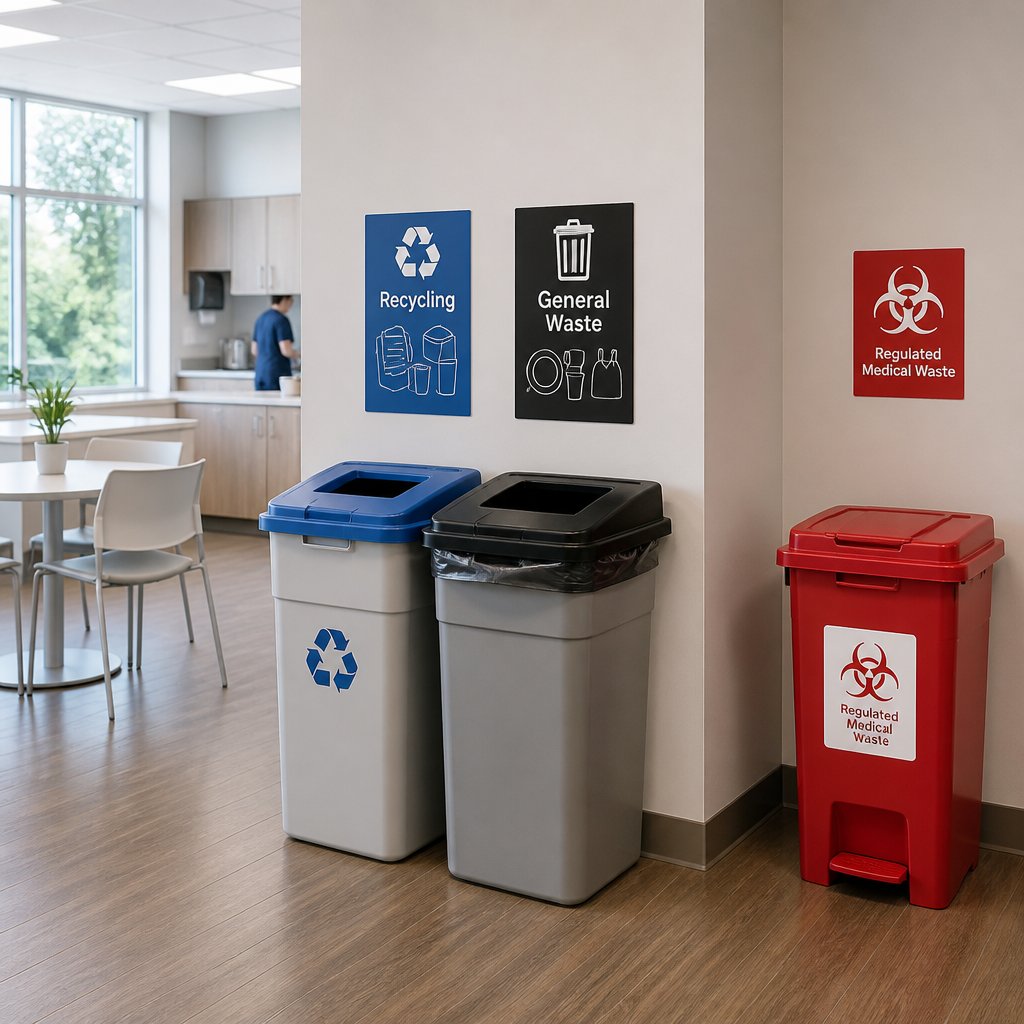
A medical office generates two very different categories of waste, and mixing them isn’t just a compliance risk — it’s a genuine safety hazard for staff, custodial workers, and anyone else who might handle trash downstream. Medical office waste disposal compliance starts with a clear separation: regulated medical waste goes through a licensed medical waste hauler, while general office waste — paper, packaging, break room trash — can go through standard commercial dumpster service like any other business.
Illinois classifies most medical waste as Potentially Infectious Medical Waste, or PIMW, a term specific to Illinois regulations covering waste generated in connection with diagnosis, treatment, or immunization of humans or animals.[1] This is a distinct regulatory category from general trash, with its own handling, packaging, and disposal requirements administered by the Illinois EPA.
Practices ranging from small independent clinics to larger multi-provider offices all fall under the same basic framework, though the volume of regulated waste generated varies enormously depending on the type of care provided. A dermatology office doing minor procedures generates a very different regulated waste profile than a practice drawing blood daily, and understanding your own practice’s actual waste composition is the first step toward setting up an appropriately sized disposal system for both waste streams.
Zap Dumpsters Peoria works as a sourcing partner for the general waste side of a medical office’s disposal needs, helping connect practices with the right dumpster for non-regulated office trash, separate from any regulated medical waste service.
What Counts as Regulated Medical Waste
| Category | Examples | Disposal Path |
|---|---|---|
| Sharps | Needles, syringes, lancets, scalpels | Puncture-resistant containers, licensed PIMW hauler |
| Blood-contaminated materials | Gauze, dressings, PPE with visible blood | Regulated waste containers per OSHA standard |
| Pathological waste | Tissue, specimens | Licensed PIMW hauler |
| General office trash | Paper, packaging, break room waste | Standard commercial dumpster |
Sharps and Regulated Waste
Used sharps and materials contaminated with blood or other potentially infectious materials fall under both Illinois PIMW rules and OSHA’s Bloodborne Pathogens Standard. These items must be placed in rigid, leak-resistant, puncture-resistant containers and can only be transported by a licensed PIMW hauler to a permitted treatment facility.[1] Container placement matters as much as the container type itself — sharps containers positioned at the actual point of use, rather than across the room, meaningfully reduce the temptation to set a used needle down “just for a second” before proper disposal.
General Office Waste
Paper, packaging, break room trash, and other non-contaminated waste generated in a medical office setting is not PIMW and can go through the same commercial dumpster service any other business would use. Keeping this distinction clear prevents unnecessarily routing ordinary trash through expensive regulated medical waste handling, which is a surprisingly common and avoidable cost for practices that default to over-caution rather than understanding the actual regulatory line.
OSHA Requirements for Handling Regulated Waste
OSHA’s Bloodborne Pathogens Standard requires regulated waste to be contained in a manner that prevents leakage during handling, storage, and transport, using labeled or color-coded containers that alert anyone who might come into contact with them.[2] This standard exists specifically to protect employees, including custodial staff who might otherwise unknowingly encounter contaminated materials in a general trash container.
Illinois law reinforces this at the disposal end: untreated PIMW is banned from all landfills in the state, meaning it must be properly treated to eliminate its infectious potential before it can go anywhere near a standard municipal waste stream.[1]
Quick Reference: Sorting Medical Office Waste
| Item | Correct Disposal Path |
|---|---|
| Used needles/syringes | Sharps container, licensed PIMW hauler |
| Blood-soaked gauze/dressings | Regulated waste container, licensed PIMW hauler |
| Used gloves (non-visibly contaminated) | Check office policy; often general trash |
| Paper records, packaging | Standard commercial dumpster |
| Break room waste | Standard commercial dumpster |
Why Getting This Wrong Carries Real Consequences
Improper medical waste disposal isn’t a minor paperwork issue. Custodial staff, waste haulers, and landfill workers can all be exposed to bloodborne pathogens if regulated waste ends up mixed into general trash, and that exposure risk is exactly what both Illinois PIMW rules and OSHA’s Bloodborne Pathogens Standard exist to prevent. Beyond the direct safety concern, a practice found improperly disposing of regulated medical waste can face fines, and in more serious cases, scrutiny that affects its ability to operate.
The financial side matters too, though in the opposite direction from what many practices assume. Some offices, out of an abundance of caution, route far more waste through expensive regulated medical waste service than actually requires it, treating anything that touched a patient as automatically regulated. This drives up disposal costs unnecessarily. Understanding the actual boundary between regulated and general waste — rather than defaulting to routing everything through the most expensive, most cautious path — often reveals meaningful savings without compromising compliance.
Setting Up a Reliable Sorting System
The offices that stay compliant consistently are the ones that make correct sorting the path of least resistance — clearly labeled sharps containers and regulated waste bins placed exactly where they’re needed, rather than tucked away somewhere staff have to remember to walk to. Regular staff training on what qualifies as regulated waste, refreshed periodically rather than covered once during onboarding and never again, keeps the system working as intended.
Auditing Your Waste Streams Periodically
Occasionally spot-checking general trash for anything that should have gone into the regulated stream catches sorting mistakes before they become a pattern. This doesn’t need to be a formal process — a quick visual check during a slower part of the week is often enough to catch and correct any drift in staff habits. Documenting these informal checks, even briefly, also creates a useful record showing the practice takes waste sorting seriously, which can matter if compliance ever comes into question.
Medical Office Waste Disposal Compliance Near You
Medical office waste disposal compliance comes down to a simple but strictly enforced principle: regulated medical waste and general trash never mix. Getting the sorting system right from day one protects staff, keeps your practice compliant, and avoids the cost of routing ordinary office waste through expensive regulated handling. A little upfront effort setting up clear labeling and training pays for itself many times over compared to correcting a compliance problem after the fact. If you’re also weighing pickup frequency and container size for your practice’s general waste, our guide on choosing the right commercial dumpster service covers how to match service to your actual volume.
For the general office waste side of your practice’s disposal needs, Zap Dumpsters Peoria works as your sourcing partner for commercial dumpster service, helping connect your medical office with the right container size near you.
Medical Office Waste Disposal Compliance FAQs
What is PIMW in Illinois?
PIMW, or Potentially Infectious Medical Waste, is the Illinois EPA’s regulatory category for waste generated in connection with diagnosis, treatment, or immunization of humans or animals, requiring special handling and disposal.
Can a medical office use a regular dumpster?
Yes, for general office waste like paper, packaging, and break room trash, but regulated medical waste such as sharps and contaminated materials must go through a licensed PIMW hauler instead.
What does medical office waste disposal compliance require for sharps?
Sharps must be placed in rigid, puncture-resistant containers and transported only by a licensed PIMW hauler to a permitted treatment facility under Illinois regulations.
Does OSHA regulate medical waste disposal?
Yes, OSHA’s Bloodborne Pathogens Standard governs how regulated waste must be contained, labeled, and handled to protect employees from exposure.
What happens if regulated medical waste ends up in general trash?
This creates both a safety hazard for anyone handling the trash and a compliance violation, since untreated PIMW is banned from Illinois landfills and must go through proper regulated channels.
Medical Office Waste Disposal Compliance Citations
- Illinois EPA, Potentially Infectious Medical Waste (PIMW) — epa.illinois.gov
- OSHA, 29 CFR 1910.1030 — Bloodborne Pathogens — osha.gov