
- Concrete and asphalt together make up the largest share of construction and demolition (C&D) debris generated in the U.S. each year — and both can be fully recycled on or near your job site.
- Recycled Concrete Aggregate (RCA) and Reclaimed Asphalt Pavement (RAP) are proven, cost-effective alternatives to virgin materials for road base, fill, and new pavement production.
- The EPA ranks source reduction — preserving what exists — as the highest priority in the C&D waste management hierarchy, followed by salvage, recycling, and disposal.
- Roll-off containers sized for your project make on-site separation of concrete, asphalt, and mixed debris significantly easier — and keep you compliant with Illinois waste regulations.
- Peoria-area contractors who plan material segregation before demolition starts save money on disposal, landfill tonnage fees, and virgin aggregate costs.
Recycling concrete and asphalt during demolition is one of the most practical ways contractors in Peoria, IL can cut project costs and reduce their environmental footprint at the same time. These aren’t niche materials — concrete and asphalt together represent the overwhelming majority of C&D debris generated at job sites across Central Illinois and the rest of the country. Knowing how to handle them correctly, from site setup through final haul-out, separates contractors who manage waste efficiently from those who pay landfill fees they didn’t have to.
Need a Roll-Off Container for Your Demolition Project in Peoria?
Zap Dumpsters Peoria sources the right-sized roll-off containers for concrete, asphalt, and C&D waste across Central Illinois. One call. No hassle.
Why Recycling Concrete and Asphalt Matters for Sustainable Demolition
The U.S. generated roughly 600 million tons of C&D debris in 2018 — more than twice the amount of municipal solid waste produced that same year, according to the EPA.[1] Demolition alone accounted for more than 90 percent of that total. Concrete and asphalt pavement are the two dominant material types, and both are highly recyclable. That combination makes sustainable demolition less of an environmental ideal and more of a practical business decision.
When concrete is crushed and screened, it becomes Recycled Concrete Aggregate (RCA) — a material that works as road subbase, fill, drainage layer, or even as aggregate in new concrete mixes. Illinois has used RCA in pavement construction as far back as the 1940s, when old Route 66 concrete was crushed and reused as aggregate during the highway’s expansion from two to four lanes.[2] That history matters for Peoria contractors: RCA isn’t experimental. It’s a proven, specification-accepted material that IDOT and local road agencies work with regularly.
Asphalt has an even more striking recycling story. According to the National Asphalt Pavement Association, more than 99 percent of reclaimed asphalt pavement is put back to use — making asphalt the most recycled material in the United States.[3] In 2022 alone, asphalt producers used 98.1 million tons of RAP in new mixes, conserving nearly 27 million barrels of asphalt binder and replacing more than 93 million tons of virgin aggregate.[4]
For contractors managing construction and demolition waste in Peoria, IL, these numbers translate directly into options. Segregated concrete and clean asphalt can often be directed to local aggregate processors or accepted at transfer facilities at lower cost than mixed C&D debris destined for a landfill.
How Recycling Concrete and Asphalt Works on a Demolition Job Site
Recycled Concrete Aggregate: From Slab to Subbase
Concrete recycling starts with demolition and ends at a crusher, either on-site or at a fixed facility. Slabs, foundations, curbs, and structural concrete are broken up and loaded into containers or trucks. Once at the crusher, reinforcing steel is removed magnetically and the concrete is processed through a jaw crusher, then screened to size. The result is graded RCA that functions as a subbase for roads and parking lots, as fill for retaining walls and embankments, as drainage aggregate, or in some cases as a partial replacement for virgin aggregate in new concrete production.
On large demolition projects in the Peoria area — commercial teardowns, bridge sections, old parking structures — it can make sense to bring in a mobile crushing unit and process material directly on the job site. This eliminates round-trip hauling costs for heavy material and reduces the disposal volume that needs to be containerized and moved. For smaller jobs, your best path is typically clean separation of concrete into a dedicated roll-off container, then directing it to an area aggregate processor who accepts concrete and issues the appropriate recycling documentation.
Reclaimed Asphalt Pavement: Milling, Stockpiling, and Reuse
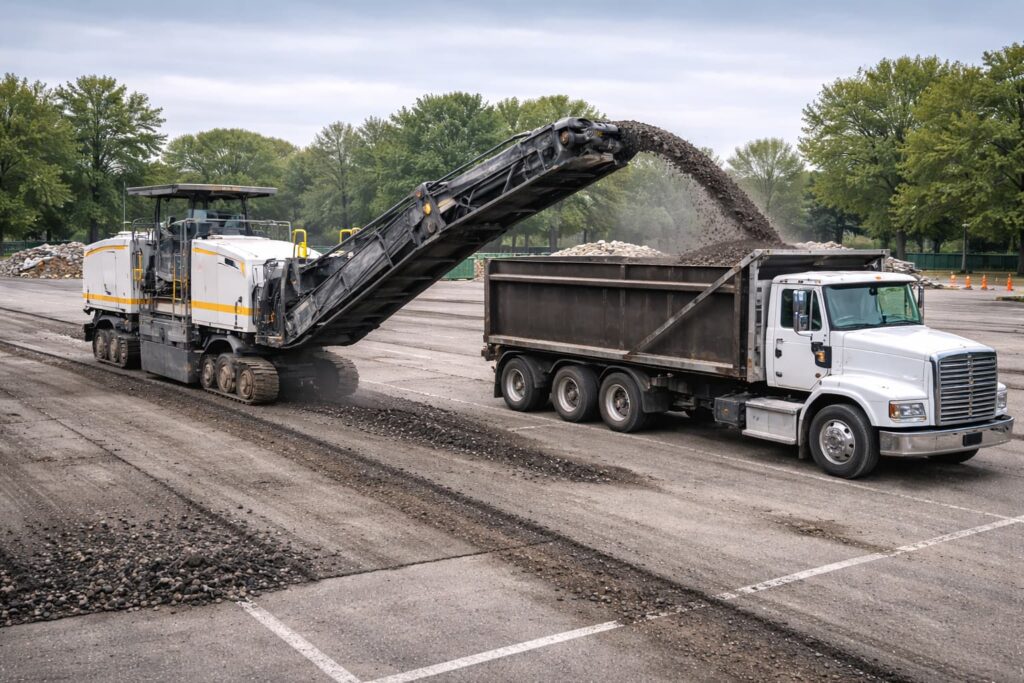
Asphalt recycling typically begins with cold milling — a specialized machine that grinds the surface of an asphalt road or parking lot down to a specified depth, producing RAP chips. These chips are then stockpiled for reuse in hot-mix asphalt production, where they replace a portion of the virgin aggregate and liquid asphalt binder. The EPA confirms that asphalt, along with concrete, is one of the primary C&D materials that can be diverted from disposal and managed into new productive use through aggregate applications.[1]
For demolition contractors who are removing asphalt driveways, parking lots, or access roads, the key step is keeping the asphalt separate from concrete, soil, and other debris. Mixed loads reduce or eliminate the recycling value because processors can’t efficiently sort materials after the fact. Clean asphalt milling or asphalt chunks broken off in manageable pieces — kept out of the dirt — can often be accepted by local asphalt plants at low or no cost.
Material Segregation: The Step Most Contractors Skip
The single biggest mistake on demolition jobs is treating concrete and asphalt as the same material. They go to different processors, they’re priced differently at disposal, and they command different value when recycled. Mixing them on-site — in the same container, on the same debris pile — forfeits the ability to direct them to the most cost-effective destination.
Practical segregation means planning for separate containers for concrete, asphalt, and mixed C&D debris from the start of the project. If you’re working with a sourcing partner to get containers on-site for a demolition project in Peoria, telling them upfront that you’re planning material-specific containers rather than one mixed roll-off changes both the container sizing and the pickup scheduling. For more on how integrated site planning reduces overall project risk, take a look at the strategies covered in our article on partnering with site services providers for Peoria contractors.
| Factor | Concrete (RCA) | Asphalt (RAP) |
|---|---|---|
| Primary Recycling Method | Crushing & screening to aggregate | Milling or chunk removal; stockpiled for plant reuse |
| Common End Use | Road subbase, fill, drainage, new concrete | Hot-mix asphalt, driveway millings, subbase |
| Recycling Rate (U.S.) | High — used in 41+ states for pavement applications | 99%+ — highest recycling rate of any material in the U.S. |
| On-Site Processing? | Yes — mobile crushers available for large jobs | Less common — usually hauled to asphalt plant |
| Key Separation Rule | Remove rebar; keep clean of soil and organic material | Keep separate from concrete, dirt, and mixed debris |
What the EPA’s Sustainable Materials Management Framework Means for Demolition Contractors
The EPA’s Sustainable Materials Management (SMM) approach identifies C&D materials — including concrete, asphalt, metals, wood, and drywall — as commodities rather than waste. The goal is to find a productive next use for each material rather than defaulting to landfill disposal.[1]
The SMM framework puts source reduction at the top of the priority hierarchy. That means designing for disassembly, preserving usable structures, and minimizing waste before it’s generated. Below that: salvage and reuse, recycling and composting, and finally, disposal. For a demolition contractor, source reduction might look like deconstruction — carefully taking apart a building to salvage usable beams, doors, hardware, and fixtures — rather than a full mechanical knockdown. Deconstruction generates employment, preserves reusable materials, and significantly cuts the volume of material that needs to be processed or disposed of.
In 2012, C&D material recycling supported roughly 175,000 U.S. jobs, according to the EPA’s own Recycling Economic Information study.[1] That figure reflects processing facilities, haulers, and the supply chain around recycled aggregate and reclaimed pavement — all economic activity generated by diverting material from landfills. For contractors in the Peoria region, that means local aggregate processors, asphalt plants, and site services providers are all part of an interconnected system that benefits when demolition debris is managed with recycling in mind.
> “Reducing the amount of C&D materials disposed of in landfills can create employment and economic activities in recycling industries and provide increased business opportunities within the local community, especially when deconstruction and selective demolition methods are used.”
>
— U.S. Environmental Protection Agency, Sustainable Management of Construction and Demolition Materials[1]
Recycling Concrete and Asphalt: Practical Cost Considerations for Peoria Projects
Disposal Costs vs. Recycling Value
Sending mixed C&D debris to a landfill costs money at every step — container rental, haul fees, and tonnage charges at disposal. Clean concrete and clean asphalt, by contrast, often move through the waste stream at a lower cost and sometimes at no cost at all, because processors and asphalt plants want the material. The spread between mixed-load disposal and clean-material recycling can be significant on larger demolition projects, particularly those generating hundreds of tons of pavement or structural concrete.
For projects in the Peoria, IL area, it pays to get quotes from local aggregate processors before the job starts. Know what they accept, what they pay or charge for clean RCA and RAP, and what condition the material needs to be in. That information shapes how you set up containers, how you schedule equipment, and whether on-site processing makes financial sense given the job volume.
Container Sizing for Segregated Demolition Debris
Concrete is dense. A 10-yard roll-off loaded with concrete can hit weight limits faster than a 40-yard container full of light framing debris. This is one of the most common mistakes when planning containers for demolition jobs: choosing container size based on visual volume without accounting for material weight. Concrete and asphalt should always be planned with weight limits in mind. A 10- or 20-yard container is often more appropriate for heavy demo materials than a larger roll-off that could overload the truck or incur overage fees.
Working with a roll-off sourcing partner who understands the weight characteristics of concrete and asphalt — and who can match container size to material type — saves you from surprises at pickup. That’s the practical value of planning container logistics as part of your demolition scope rather than as an afterthought.
| Decision Point | Mixed C&D to Landfill | Segregated RCA / RAP Recycling |
|---|---|---|
| Disposal Cost | Tonnage fees + haul; full market rate | Often lower; some processors accept at no charge |
| Landfill Space | Consumed; non-biodegradable material remains indefinitely | Preserved; material goes back into productive use |
| Environmental Impact | Higher — consumes virgin aggregate for replacement material | Lower — reduces quarrying, transport, and landfill burden |
| Planning Required | Minimal — one container, one destination | More upfront — multiple containers, processor contacts needed |
| Documentation | Basic weight ticket | Recycling certificates available; supports LEED or green bids |
Illinois Regulations and Recycling Concrete and Asphalt During Demolition
Illinois does not require contractors to recycle C&D materials on most standard demolition projects, but it does set rules around how waste is classified, transported, and disposed of. The Illinois EPA’s solid waste regulations govern the movement of construction debris, and contractors need to be aware of when a material qualifies as a beneficial reuse versus a waste requiring proper disposal documentation.
Clean, uncontaminated concrete and asphalt used as fill or aggregate base typically qualify for regulatory exemptions in Illinois, but this is material- and context-specific. Contaminated concrete — for example, slabs from properties with underground storage tanks or hazardous material exposure — requires evaluation before recycling. The same applies to asphalt that may contain historically higher tar-pitch binders from older pavement construction.
If your demolition project involves any regulated materials — asbestos-containing fireproofing, lead paint on structural elements, or contaminated soil underlying demolition debris — these must be managed under separate protocols and kept entirely out of the C&D recycling stream. Illinois asbestos notification requirements call for a 10 working days notice to the Illinois EPA before regulated asbestos abatement begins. For questions on the regulatory side of C&D recycling in Illinois, the EPA’s sustainable C&D materials guidance is a practical starting point, and the Illinois EPA’s solid waste program covers state-specific rules.[1]
Setting Up Your Peoria Demolition Job Site for Sustainable Waste Management
The most effective time to plan concrete and asphalt recycling is before the first piece of equipment touches the structure. Pre-demolition planning includes a material audit — a walkthrough that estimates volumes of concrete, asphalt, wood, metal, drywall, and other materials — so you can size containers appropriately and identify which materials have recycling value in your area.
From there, container placement matters. On a job site in Peoria, you may be working with tight access, neighboring properties, and street placement requirements. The city’s permit requirements for roll-offs on public streets include a $20/month permit fee, a minimum 10-foot clearance from fire hydrants, and 50-foot clearance from intersections. Planning container placement as part of site setup — rather than improvising on the day of delivery — keeps the project running smoothly from start to finish.
A Peoria contractor running a small commercial teardown near the riverfront found that pre-sorting concrete into its own 20-yard container — rather than mixing everything into a 40-yard roll-off — saved them nearly $400 in disposal costs on a two-day job. The concrete went to a local processor at reduced cost; the mixed debris went to Indian Creek Landfill in Hopedale at standard tonnage rates. The upfront planning took less than an hour and paid for itself immediately.
Plan Your Demo Right — Get the Containers Sized for the Job
Zap Dumpsters Peoria helps contractors across Central Illinois source roll-off containers for concrete, asphalt, and mixed C&D waste. We match the container to the material — so you’re not paying overweight fees or sorting headaches later.
Recycling Concrete and Asphalt Sustainable Demolition: What This Means for You Near You
Whether you’re tearing out an old parking lot in Morton, demoing a commercial slab in East Peoria, or clearing a mixed-use structure in Peoria itself, the principles of recycling concrete and asphalt sustainable demolition apply the same way every time: separate early, plan containers by material type, know your local processors, and build the waste management plan before the job starts.
The environmental benefits are real — less landfill strain, lower greenhouse gas emissions from virgin material extraction, and preserved natural aggregate resources. But for most contractors in Central Illinois, the driving motivation is simpler: recycling your concrete and asphalt costs less than landfilling it, and the planning required to make it work isn’t complicated. You just have to start before the first concrete starts breaking.
Zap Dumpsters Peoria works as a sourcing partner for contractors across the Peoria area, helping connect job sites with the right roll-off containers for construction and demolition waste, material-specific debris streams, and site cleanup. If you’re setting up a demolition project in Peoria, Pekin, Washington, Chillicothe, or the surrounding communities, get the container conversation started early — it changes how the whole project flows.
Recycling Concrete Asphalt Sustainable Demolition FAQs
What is recycling concrete and asphalt sustainable demolition?
Recycling concrete and asphalt sustainable demolition refers to the practice of separating concrete and asphalt pavement during a demolition project so each material can be processed into reusable aggregate — Recycled Concrete Aggregate (RCA) and Reclaimed Asphalt Pavement (RAP) — rather than being sent to a landfill. This approach reduces disposal costs, conserves natural resources, and aligns with EPA sustainable materials management guidelines.
Can recycling concrete and asphalt sustainable demolition really save money on a job in Peoria?
Yes — recycling concrete and asphalt sustainable demolition saves money when clean materials are separated and directed to processors who accept them at lower rates than mixed C&D going to a landfill. On larger Peoria-area jobs with significant concrete or asphalt volume, the savings in tonnage fees can be meaningful, especially compared to paying standard disposal rates for heavy materials that have clear recycling value.
What is Reclaimed Asphalt Pavement (RAP) and how is it reused?
RAP is the material produced when old asphalt pavement is milled or broken up during demolition or resurfacing. It’s stockpiled and fed back into hot-mix asphalt production, where it replaces a portion of the virgin aggregate and liquid binder. According to NAPA, over 99 percent of reclaimed asphalt is put back to use — making it the most recycled material in the United States.
How do I keep concrete and asphalt separate on a demo site in Peoria, IL?
Plan for separate roll-off containers from day one — one for concrete, one for clean asphalt, and a third for mixed C&D if needed. Brief your crew on the separation plan before work starts, and don’t mix soil, organics, or other debris into the concrete or asphalt containers, as contamination reduces or eliminates recycling value at the processor.
Does Illinois have rules about recycling C&D materials like concrete and asphalt?
Illinois does not mandate recycling of standard C&D materials, but it does regulate how construction debris is classified, transported, and disposed of under Illinois EPA solid waste rules. Clean, uncontaminated concrete and asphalt used as fill or aggregate base often qualify for beneficial reuse exemptions, but contaminated materials — including anything from sites with hazardous material history — must be evaluated and managed separately.
Recycling Concrete Asphalt Sustainable Demolition Citations
- U.S. Environmental Protection Agency — Sustainable Management of Construction and Demolition Materials
- National CP Tech Center / Iowa State University — Recycled Concrete Aggregate Usage in the US Summary Report (2018)
- National Asphalt Pavement Association (NAPA) — Recycling
- NAPA — 2022 Asphalt Pavement Industry Survey on Recycled Materials and Warm-Mix Asphalt Usage