
- Storm cleanup moves fast — having a roll-off container sourced before roads fully clear saves you days of waiting.
- Debris sorting is not optional. Illinois EPA rules require that hazardous waste, electronics, and certain materials be separated from general storm debris before disposal.[1]
- Document everything before you toss it. Photos and video of all damage protect your insurance claim.
- Road and site conditions affect delivery timing — saturated ground or downed power lines can delay even the fastest service.
- Not all debris is equal. Flood-soaked materials, household hazardous waste, and electronics each have their own disposal rules in Illinois.
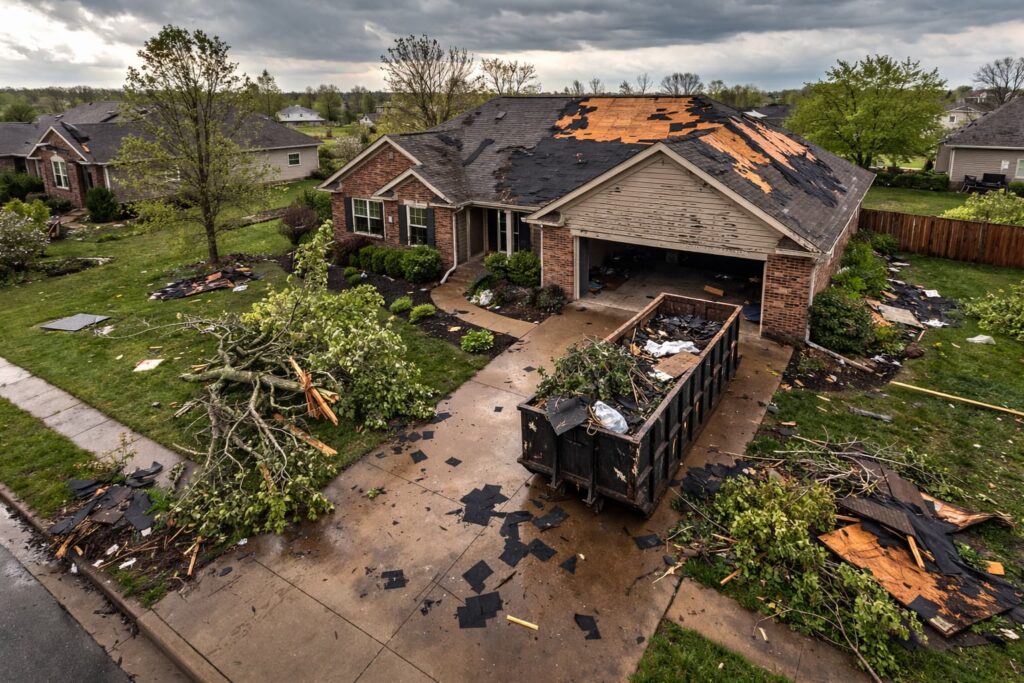
Emergency dumpster delivery after storms gives Peoria homeowners a controlled, legal way to clear fallen trees, damaged roofing, waterlogged furniture, and construction debris — all in one container, on your timeline. The faster you can get a roll-off container on-site, the sooner your property stops being a hazard and starts being a home again.
Storm hit your Peoria property? Don’t wait.
Zap Dumpsters Peoria helps source the right roll-off container for your storm cleanup — fast.
Why Emergency Dumpster Delivery After a Storm Is Different From a Regular Rental
A standard dumpster rental is planned. You pick a date, choose a size, and schedule delivery in advance. Emergency dumpster delivery after a storm is a completely different situation. You’re dealing with debris you didn’t expect, a timeline you can’t fully control, and conditions on your property that may make placement tricky. Understanding what makes storm rentals unique helps you set realistic expectations and get the job done right.
Peoria sits in a region that sees a wide mix of severe weather — from spring tornadoes and summer derechos to ice storms and flash flooding.[2] Each type of storm generates a different mix of debris. A windstorm might leave you with branches and roofing. A flood brings waterlogged furniture, contaminated materials, and sediment. A hailstorm can strip siding and crack roofing panels all at once. The debris type matters because it affects which container size you need and what you’re allowed to put in it.
What “Emergency” Actually Means for Delivery Timing
When people hear “emergency dumpster delivery,” they often expect a container to appear within the hour. Reality is a bit different. The time between your call and a container arriving on your driveway depends on a few things: availability of containers in the region, road conditions in Peoria after the storm, and whether your placement area is safe for a heavy truck to access. If roads are flooded or power lines are still down, no responsible hauler will send a driver out — and that’s actually a good thing for your property and theirs.
That said, when conditions are safe, roll-off containers sourced for emergency storm cleanup can often be arranged within a business day in many cases. The key is calling early. The longer you wait after a storm passes, the more homeowners in the area are competing for the same limited number of containers. Calling as soon as the storm clears — even before you’ve fully assessed your debris — puts you at the front of the line.
Ground Conditions and Property Protection
One thing the AI overview above gets right: saturated ground is a real problem. A roll-off container can weigh several tons even before you add a single piece of debris. If your driveway is already cracked or your yard is soft from rain, the delivery truck’s weight can cause serious damage. Asking the driver to place the container on plywood boards or scrap lumber is a simple step that protects both your surface and the container’s stability. This is especially important for Peoria properties with asphalt driveways, which are more vulnerable to cracking than concrete.
| Storm Type | Typical Debris | Recommended Container Size | Key Watch-Out |
|---|---|---|---|
| Thunderstorm / Derecho | Branches, roof shingles, siding | 15–20 yard | Volume adds up fast with limb debris |
| Tornado | Mixed structural, wood, mixed debris | 30–40 yard | Debris mix may require sorting |
| Flash Flood | Furniture, flooring, drywall, sediment | 20–30 yard | Contaminated sand/sediment has special disposal rules[1] |
| Ice Storm | Broken limbs, gutters, damaged fencing | 10–20 yard | Ice-heavy limbs weigh more than dry wood |
| Hailstorm | Roofing, siding, gutters | 15–20 yard | Shingles are heavier than they look |
What Goes in the Dumpster — and What Doesn’t
This is where a lot of Peoria homeowners run into trouble after a storm. They rent a container, start filling it up, and then find out at pickup that something they tossed in wasn’t allowed — leading to extra fees or a rejected load. Knowing what’s accepted before anything goes in the bin saves time, money, and headaches.
The Illinois EPA publishes specific guidance for storm and flood debris disposal.[1] In general, your roll-off container can handle lumber, carpet, furniture, roofing shingles, insulation, fencing, siding, and most household goods that were damaged in the storm. Tree limbs and branches can also go in, though some facilities may handle vegetative debris separately. Always confirm what your sourced container’s hauler accepts.
Materials That Need Special Handling in Illinois
Several categories of storm-damaged materials cannot simply go into a roll-off container. The Illinois EPA is clear that most electronics — including televisions, computers, printers, and cell phones — are banned from landfills in the state.[1] If the storm damaged these items, they need to go to a registered e-waste collection site, not a dumpster. Similarly, household hazardous waste — things like paint, chemicals, propane tanks, and fuel containers — must be handled separately through designated HHW collection programs.
Flood-contacted sand and sediment is another category that surprises homeowners. Floodwater sediment can carry fertilizers, pesticides, oil residue, and biological contaminants. The Illinois EPA states that contaminated sediment that is removed from the property must be disposed of in a permitted landfill — it cannot simply be spread on your yard or tossed in a general dumpster.[1] If you’re not sure whether your sand or soil contacted floodwater, the state says it’s generally safer to treat it as contaminated.
Vegetative Debris: Branches, Stumps, and Yard Waste
After a major storm, trees and branches often make up the biggest share of debris by volume. Most roll-off containers will accept this material, but there’s a nuance worth knowing: some landscape compost facilities in the Peoria area may accept tree debris separately — as long as it isn’t mixed with other storm waste materials.[1] If you have a large volume of pure vegetative debris, keeping it separate from your roofing or construction materials could open up recycling options and possibly reduce your disposal costs. Ask when you’re sourcing your container.
FEMA’s debris removal guidelines define eligible vegetative debris as tree limbs, branches, and stumps that pose a threat to life, health, or improved property.[3] Knowing this language matters if you’re filing an insurance claim or applying for any municipal debris assistance program after a major storm event in Peoria.
| Debris Type | Roll-Off Dumpster OK? | Special Rule |
|---|---|---|
| Roofing shingles, siding, lumber | ✅ Yes | Watch weight limits |
| Flood-damaged carpet, furniture | ✅ Yes | Wet materials add significant weight |
| Tree limbs and branches | ✅ Usually yes | Some facilities compost separately |
| Electronics (TV, laptop, phone) | 🚫 No — banned in IL landfills | Use registered e-waste sites[1] |
| Paint, chemicals, propane tanks | 🚫 No | HHW disposal program required[1] |
| Flood-contacted sediment | ⚠️ Only in permitted landfill | Cannot be spread on property[1] |
| Sealed drums / propane tanks | 🚫 No | Call IL EMA: 800-782-7860[1] |
How Emergency Dumpster Delivery After a Storm Fits Into Your Insurance Claim
Most homeowners don’t realize how closely debris removal and insurance documentation are connected. If you start tossing storm damage without a record, you could be throwing away money that your policy would have covered. The sequence matters.
Before you load a single item into a roll-off container, walk every area of your property and take detailed photos and video of all damage. Document the position of fallen trees, the condition of your roof, the extent of water intrusion, and the state of any outbuildings or fencing. Your insurance adjuster will use this documentation to assess the value of your claim. Once debris is gone, that evidence is gone with it.
What FEMA and Illinois Emergency Programs Cover — and What They Don’t
After a presidentially declared disaster, FEMA’s Public Assistance program may make grants available to state and local governments for eligible debris removal in the public interest.[3] However, debris removal from private residential property is generally the responsibility of the property owner, assisted by insurance settlements and — in some cases — volunteer agencies.[4] The State of Illinois Ready program outlines the path to federal assistance after major disasters, including FEMA’s Individual Assistance program and the Small Business Administration loan program for homeowners.[2]
Private property debris removal is your responsibility — but your insurance policy and a well-documented cleanup process are your biggest tools for recovering costs. Having a sourced roll-off container on-site shows insurers and adjusters that you took the cleanup seriously and handled it in an organized way. Keep any receipts or records tied to your emergency container rental as part of your claim file.
Debris Sorting for Your Insurance File
Some insurance adjusters want to see debris organized by type — structural materials separate from personal property, for example. If your adjuster has specific requests, ask before you start loading. It takes very little time to set up a basic sorting system at the start of a cleanup, but it can be nearly impossible to undo once everything is in the bin. A case in point: a Peoria homeowner dealing with both roof and flood damage on the same property may find it helpful to load roofing materials in one area of the container and water-damaged interior items in another — making the damage categories easier to photograph and present to an adjuster.
“Documentation is the single most important thing you can do before touching any storm debris. Once materials are in a dumpster or hauled away, the physical evidence for your claim disappears. Photograph everything — every room, every angle — before cleanup begins.”
— FEMA Public Assistance Debris Removal Guidance, Category A[3]
Practical Steps for Emergency Dumpster Delivery After a Storm in Peoria
Knowing what to do — and in what order — can shave days off your cleanup and prevent costly mistakes. Here’s how experienced Peoria property owners handle storm cleanup from the moment the skies clear.
Step 1: Assess Safety Before Anything Else
Before you walk your property after a major storm, check for downed power lines, gas leaks, and structural damage that could make a building unsafe to enter. The Illinois Ready program advises residents to report fallen trees, downed utility lines, and structural hazards to the appropriate city departments before starting any cleanup.[2] If you see a downed electrical transformer, contact local officials immediately — some older transformers contain PCBs, which are toxic if they leak into soil or groundwater.[1] Safety comes before debris, every time.
Step 2: Document Damage Before You Touch Anything
Walk every part of your property with your phone or camera. Photograph the roof, exterior walls, gutters, fencing, outbuildings, every room inside, and any personal property that was damaged. Video walkthroughs are especially useful. Save everything to a cloud account so it can’t be lost if your device is damaged. This step protects your insurance claim and gives you a clear baseline for your cleanup work. If you need help estimating the total volume of what you’re looking at, our guide on how to estimate the amount of debris from a storm can help you size your container correctly before you call.
Step 3: Source Your Roll-Off Container Early
Once safety is confirmed and documentation is underway, it’s time to get a container sourced. For residential storm debris removal in Peoria, having the right size container on your driveway before you start heavy cleanup saves multiple trips and keeps your property organized. Zap Dumpsters Peoria helps homeowners and property managers source roll-off containers suited to their specific storm situation — whether that’s a 15-yard bin for branch and shingle cleanup or a 30-yard container for a major wind or flood event.
Step 4: Load Smart and Stay Under the Fill Line
When loading a roll-off container, heavy items go in first — roofing materials, concrete blocks, appliances. Lighter debris like branches and insulation fills in around them. Never load above the container’s top rail. Overfilled containers can’t be legally transported, which means your pickup gets delayed until materials are removed — and you may face an overage charge. If rain is expected during your rental period, covering the container with a tarp prevents water from adding hundreds of pounds in extra weight to your load.
Step 5: Check for Local Cleanup Programs Before You Call for Pickup
After a severe storm, the City of Peoria or Peoria County may activate curbside debris collection for certain types of vegetative or storm waste. Checking with local government before your final pickup call could save you money — some material might be eligible for free municipal collection.[2] That said, municipal pickup programs often have strict guidelines about what can be placed at the curb and usually operate on a fixed schedule that doesn’t align with your personal cleanup timeline. A sourced roll-off container gives you control over the pace of your own recovery.
Emergency Dumpster Delivery After a Storm: Finding the Right Help Near You
After a storm, Peoria homeowners need fast answers and a reliable path forward. The most important thing you can do in those first hours after a storm passes is take action — document, assess, and start the process of getting cleanup resources lined up. Waiting even a day can put you behind other property owners who acted quickly, and in a major storm event, container availability can tighten fast.
Zap Dumpsters Peoria is a local, family-owned dumpster sourcing service. We help residential and commercial property owners source the right roll-off containers for their specific storm cleanup situation — no guessing on size, no surprise billing headaches. We understand Peoria’s neighborhoods, its weather patterns, and the kinds of debris that different storms leave behind. That local knowledge makes a real difference when you need help fast.
Ready to get your storm cleanup moving?
Zap Dumpsters Peoria sources roll-off containers for residential and commercial storm debris removal across the Peoria area. Call now to get started.
Wrapping Up: Take Control of Your Storm Cleanup Near You
Emergency dumpster delivery after a storm isn’t complicated once you know what to expect. The key things to hold onto: call early, document everything before you start loading, know what Illinois allows in your container and what requires special handling, and protect your property and your insurance claim throughout the process. The storms Peoria sees each year — from spring derechos to fall ice events — leave behind real debris and real stress. Having a roll-off container sourced and on your property gives you back a sense of control over a situation that often feels out of control. Zap Dumpsters Peoria is here to help source the right container for your cleanup, right when you need it. Give us a call at (309) 650-8954 and let’s get your property cleared.
Emergency Dumpster Delivery After Storm FAQs
What can I expect from emergency dumpster delivery after a storm in Peoria?
Emergency dumpster delivery after a storm in Peoria typically involves sourcing a roll-off container as quickly as road and site conditions allow after the storm passes. You can expect to work through a sourcing service that assesses your debris volume and matches you with the right container size — timing depends on road access and local container availability at the time of your call.
How fast is emergency dumpster delivery after a storm?
Emergency dumpster delivery after a storm can often be arranged within a business day once roads are clear and your property is safely accessible. Calling as soon as the storm passes gives you the best chance of getting ahead of demand, since container availability in the Peoria area can tighten quickly after a widespread weather event.
What debris cannot go into a storm cleanup dumpster in Illinois?
Illinois prohibits electronics, household hazardous waste, propane tanks, and flood-contaminated sediment from standard roll-off containers.[1] These materials require separate disposal through registered collection programs or permitted landfills — ask when sourcing your container so there are no surprises at pickup.
Does FEMA cover emergency dumpster rental costs after a storm?
FEMA’s Public Assistance program may cover debris removal costs for local governments after a presidential disaster declaration, but private residential property debris removal is generally the homeowner’s responsibility.[3] Your homeowner’s insurance policy is the primary resource for covering storm cleanup and debris disposal costs on private property.
Should I sort my storm debris before putting it in a roll-off container?
Sorting storm debris by type — vegetative waste, construction materials, household goods — before loading can simplify your insurance documentation and may open up recycling options that reduce your disposal costs.[1] It also prevents rejected loads at pickup caused by prohibited items mixed into the container.