
- Illinois does not issue a statewide general contractor license. Most licensing is handled at the city or county level.
- Only roofing and plumbing contractors are licensed at the state level, through the IDFPR and IDPH respectively.
- Waste disposal on job sites is regulated separately — Illinois EPA rules govern how construction and demolition debris must be sorted, certified, and disposed of.
- In Peoria, contractors placing a dumpster in a public right-of-way need a city-issued Dumpster/Portable Storage Contractor License and a $10,000 surety bond.
- Getting these requirements wrong can result in fines, permit denials, or rejected debris loads — all of which cost time and money.
Contractor licensing (Illinois) works differently from most states. There is no single state-issued license for general contractors. Instead, you must comply with local rules set by the city or county where the work takes place — and separately, with Illinois EPA regulations that govern how job site waste is managed and disposed of.
How Contractor Licensing in Illinois Actually Works
If you are a general contractor in Illinois, there is no state agency that will hand you a statewide license for building, renovation, or demolition work. Illinois does not mandate a state-level general contractor license. That responsibility falls to individual cities and counties.[1] So whether you are working in Peoria, Bloomington, or anywhere else in Central Illinois, you need to check local requirements before you break ground.
The one exception most contractors know about is roofing. The Illinois Department of Financial and Professional Regulation (IDFPR) licenses roofing contractors at the state level. You must hold either a Limited Roofing Contractor License for residential projects of eight units or fewer, or an Unlimited License for all property types.[2] You will also need to carry liability insurance and post a $10,000 surety bond to apply. Roofing licenses expire on December 31 of odd-numbered years and must be renewed at a cost of $62.50.[2]
Plumbing is also regulated at the state level through the Illinois Department of Public Health (IDPH). Every other trade — electrical, HVAC, general construction, demolition — is regulated locally.
What This Means for Contractors in Peoria
In Peoria specifically, the city issues its own contractor business licenses for several types of work. These licenses are valid for one calendar year and expire on December 31st annually, so they require consistent renewal.[3] One license that often catches contractors off guard is the Dumpster/Portable Storage Contractor License. Any contractor who plans to place a dumpster or portable storage unit in a public right-of-way in Peoria must hold this license. The annual fee is $25, but applicants must also post a $10,000 surety bond, renewed each year.[3] That bond requirement is important for job site planning — particularly on tight urban sites where the street or sidewalk is the only staging option.
East Peoria has its own registration process too. All contractors doing work within the City of East Peoria must be registered before permits will be issued, and they must provide proof of insurance and a copy of any applicable state license with their application.[4]
Illinois Contractor License Quick Reference
| Trade / Activity | Licensing Authority | Key Requirement |
|---|---|---|
| General Contractor | City / County (e.g., Peoria, Chicago) | Local license or registration required |
| Roofing Contractor | IDFPR (state level) | Limited or Unlimited license; $10,000 bond; liability insurance |
| Plumbing Contractor | IDPH (state level) | State plumbing license required |
| Dumpster / Portable Storage (Peoria) | City of Peoria | $25 annual license fee; $10,000 surety bond |
| Sidewalk / Driveway Contractor (Peoria) | City of Peoria | $25 annual fee; $10,000 surety bond |
| Sewer Connector (Peoria) | City of Peoria | $60 annual fee; $10,000 surety bond |
Contractor Licensing in Illinois and Waste Disposal: A Critical Connection
Here is the piece most licensing guides leave out. Being licensed to perform construction or demolition work is only half the compliance picture. The other half is knowing how to legally manage, sort, and dispose of the waste your project generates. In Illinois, that is regulated by the Illinois EPA — and the rules are more specific than many contractors realize.
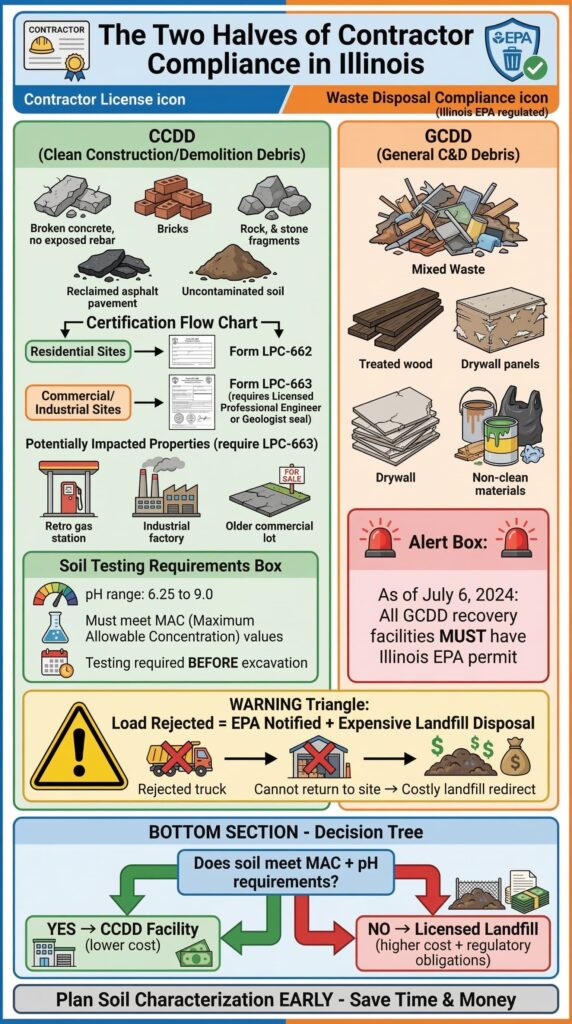
Illinois EPA rules draw a firm line between two waste categories that affect every demolition and site excavation job: Clean Construction or Demolition Debris (CCDD) and General Construction or Demolition Debris (GCDD).
What Is CCDD and Why Does It Matter to Contractors?
CCDD stands for Clean Construction or Demolition Debris. Under Illinois law, it includes uncontaminated broken concrete without protruding metal bars, bricks, rock, stone, and reclaimed asphalt pavement generated from construction or demolition activities.[5] Soil mixed with any of these materials is also considered CCDD, as long as that soil is uncontaminated.
Here is where it gets important for licensed contractors on job sites. If your project generates soil that will be moved off-site as fill material, that soil must be certified before a licensed CCDD fill facility will accept it. For residential source sites, the certification form is the LPC-662. For commercial and industrial properties — the kind of projects most licensed contractors work on — the form required is the LPC-663, completed and sealed by a Licensed Professional Engineer or Licensed Professional Geologist.[5]
If you send uncertified soil to a CCDD facility and the load is rejected, you cannot simply return it to the site. The Illinois EPA is notified, and you will need to arrange licensed landfill disposal at a considerably higher cost.[5] That is an expensive surprise on any job.
The LPC-663 Form: What Contractors Working in Peoria Need to Know
The LPC-663 is the uncontaminated soil certification form used when soil comes from a commercial or industrial property — or from any site considered a “potentially impacted property.”[6] A potentially impacted property is one where past or current land use, or contamination from a nearby site, raises the possibility of soil contamination. Gas stations, industrial parcels, older commercial lots — these all typically require LPC-663 review.
Before a licensed professional can complete the LPC-663, soil samples need to be collected and analyzed against the IEPA’s Maximum Allowable Concentration (MAC) table for chemical constituents.[7] All soil brought to fill operations for disposal must also fall within a pH range of 6.25 to 9.0.[7] If the soil does not meet MAC values, it cannot go to a CCDD facility — it becomes a landfill waste stream, which carries both higher costs and additional regulatory obligations.
Getting ahead of this process early in a project saves contractors from delays and unexpected costs. Soil characterization should happen at the planning stage, not after excavation has started.
General C&D Debris: Recycling Facilities Need Permits Too
GCDD covers everything that does not qualify as clean debris — mixed construction waste, treated wood, drywall, and similar materials. Since July 6, 2024, no person can own or operate a general construction or demolition debris recovery facility in Illinois without a permit issued by the Illinois EPA.[8] This matters for contractors because it affects which recycling and processing facilities can legally accept your waste. Before signing off with any C&D recycler, confirm they hold current authorization under the Illinois EPA’s construction and demolition debris disposal rules.
For contractors managing construction and demolition waste on job sites in the Peoria area, working with an experienced sourcing partner for construction and demolition waste container rentals helps ensure you have the right equipment in place from the start of your project.
CCDD vs. GCDD: Key Differences for Illinois Contractors
| Factor | CCDD (Clean C&D Debris) | GCDD (General C&D Debris) |
|---|---|---|
| What it includes | Uncontaminated concrete, brick, rock, stone, reclaimed asphalt, clean soil | Mixed debris: drywall, treated wood, general construction waste |
| Disposal option | CCDD fill sites (with IEPA permit) | GCDD recovery facility (IEPA permit required since July 2024) |
| Soil certification needed? | Yes — LPC-662 (residential) or LPC-663 (commercial/industrial) | No soil certification; waste characterization may be needed |
| Professional sign-off? | LPC-663 requires Licensed PE or Professional Geologist | Not required for standard GCDD |
| Rejection risk | High if pH or MAC values out of range — rejected load cannot return to site | Lower if facility is properly permitted; facility-specific rules apply |
Common Compliance Mistakes Contractors Make with Waste Disposal in Illinois
Even experienced contractors get caught out by Illinois waste disposal rules. Here are the mistakes that come up most often on job sites around Central Illinois.
Not Checking if a Disposal Facility Is Permitted
Since the July 2024 GCDD permit requirement took effect, any contractor using a C&D recovery facility should verify that it holds current IEPA authorization.[8] Using an unpermitted facility can create liability for the contractor, not just the facility operator. The IEPA Bureau of Land’s Waste Reduction and Compliance Section can be reached at 217-785-8604 to confirm a facility’s status before you commit to a disposal arrangement.[9]
Skipping Soil Characterization on Commercial Sites
Many contractors assume that because a site looks clean, soil can move freely as CCDD fill. But the Illinois EPA does not work on appearances. For commercial and industrial properties, soil testing and LPC-663 certification are required regardless of visible condition.[6] Skipping this step is one of the most common causes of load rejections at CCDD facilities — and rejected loads trigger automatic IEPA follow-up and reporting.[5]
Assuming the Hauler Is Responsible for Disposal Compliance
This is a costly assumption. In Illinois, the contractor — not the hauler — bears responsibility for ensuring that waste is properly characterized and directed to an appropriate facility. Even when a third-party waste hauler is used, you remain liable if debris ends up at an unpermitted or inappropriate site.[10]
Proper waste planning is not just good practice — it is the contractor’s legal responsibility in Illinois. Separating debris by type from the start of a project, using correctly sized containers, and verifying the receiving facility’s permit status are all part of doing the job right. Knowing how to calculate your construction and demolition waste volumes upfront helps ensure you have the right disposal capacity in place before work begins — our guide on how to calculate construction and demolition waste walks through the formulas contractors rely on for accurate job site planning.
Contractor Licensing in Illinois: What Peoria Area Contractors Should Do First
Navigating contractor licensing in Illinois and waste disposal compliance at the same time can feel like a lot. Here is a practical starting checklist for contractors working in the Peoria area.
Step 1: Confirm Your Local License Status
Check with the City of Peoria’s Building Safety Division and the Peoria County permits office for any trade-specific registration requirements before starting work. All Peoria contractor business licenses expire annually on December 31st and must be renewed on time — a lapsed license can halt permit approvals and delay your project.[3] If your work extends into East Peoria, complete the separate contractor registration before pulling any permits there.[4]
Step 2: Know Your Waste Before You Start Digging
Before excavation begins, identify whether your site is potentially impacted. If there is any history of commercial or industrial use on the property, engage a Licensed Professional Engineer or Licensed Professional Geologist early to assess whether LPC-663 certification will be needed for soil removal. This one step, taken before work begins, prevents the most common and most expensive compliance failure on job sites.[6]
Step 3: Plan Your Debris Disposal Path
Identify permitted facilities for each debris type your project will generate. Separate streams for CCDD, GCDD, and any hazardous materials (which follow federal RCRA Subtitle C rules and require separate handling entirely). Set up appropriately sized containers early, so materials can be sorted from day one. Contractors managing C&D debris on job sites across Peoria and Central Illinois can simplify this process by working with a sourcing partner for construction and demolition waste container rentals — ensuring the right equipment is in place from day one.
Conclusion: Get Contractor Licensing Illinois Right — Find Help Near You
Contractor licensing in Illinois is decentralized by design. There is no one office to call, no single statewide credential that covers every trade. What that means practically is that the responsibility is on you — to know the local rules in every municipality you work in, to hold the right licenses, and to manage job site waste in line with Illinois EPA requirements.
The good news is that once you understand the framework — local licenses for general and trade work, state-level IDFPR licensing for roofing, IEPA certification requirements for soil and debris disposal — it becomes a manageable checklist rather than an overwhelming maze. Contractors who get ahead of waste characterization, sort their debris from day one, and use the right disposal facilities protect their projects, their clients, and their licenses.
If you are a licensed contractor working on construction or demolition projects in the Peoria area and you need help sourcing the right waste containers for your job site, Zap Dumpsters Peoria is here to help find the right roll-off solution near you.
Need Waste Containers for Your Peoria Job Site?
Zap Dumpsters Peoria helps licensed contractors source the right roll-off containers for construction and demolition projects across Central Illinois. One call and we get to work finding the right fit for your project.
Contractor Licensing Illinois FAQs
Does Illinois require a statewide contractor licensing credential for general contractors?
Contractor licensing in Illinois for general contractors is handled at the local level, not the state. Each city and county sets its own requirements. You will need to check with the specific municipality where your project is located — such as the City of Peoria or Peoria County — before beginning any construction or demolition work.
What is contractor licensing in Illinois for roofing contractors specifically?
Contractor licensing in Illinois for roofing is one of the few trades regulated at the state level. The IDFPR issues two types: Limited (residential, up to 8 units) and Unlimited (all property types). Both require a $10,000 surety bond and proof of liability insurance, and licenses expire December 31st of odd-numbered years.
How does contractor licensing in Illinois connect to waste disposal compliance?
Being licensed to do construction or demolition work does not automatically cover waste disposal. Illinois EPA rules require separate compliance for how job site debris is categorized and disposed of — particularly for soil from commercial sites, which requires LPC-663 certification from a licensed engineer or geologist before it can be accepted at a CCDD fill facility.
Can a contractor in Peoria place a dumpster on the street without a special license?
No. The City of Peoria requires a Dumpster/Portable Storage Contractor License for any contractor placing a dumpster or storage unit in the public right-of-way. The annual fee is $25 and a $10,000 surety bond is required, renewed each year.
Who is responsible if construction waste is sent to an unpermitted facility in Illinois?
The contractor bears responsibility for proper waste disposal, even when a third-party hauler is used. Sending debris to an unpermitted GCDD recovery facility or non-compliant CCDD fill site can expose the contractor — not just the hauler — to regulatory penalties and liability under Illinois EPA rules.
Contractor Licensing Illinois Citations
- General Contractor License Illinois — Contractors Liability
- Illinois Contractor License Requirements — Contractor Licensing Inc.
- Contractor Business Licenses — City of Peoria, IL
- Contractor Registration — City of East Peoria, IL
- EPA Compliance Assistance — Clean Soils Consulting
- Waste Profiling (CCDD – LPC-663) — ETS Environmental
- Clean Construction or Demolition Debris (CCDD) — Illinois EPA
- General Construction or Demolition Debris (GCDD) — Illinois EPA
- CCDD Forms — Illinois EPA Bureau of Land
- How to Get an Illinois Contractor License — Procore