
Key Takeaways:
- Use the walk-in door to avoid lifting heavy items over high walls, reducing back strain and injury risk
- Load heavy items first at the bottom to create a stable foundation and prevent top-heavy containers
- Distribute weight evenly across the dumpster floor to prevent tipping during transport
- Never exceed the fill line—overfilled dumpsters create serious safety and legal hazards
- Wear proper PPE including steel-toe boots, heavy-duty gloves, and safety glasses on every load
- Maintain proper lifting technique: bend at the knees, keep loads close to your body, and avoid twisting
Article Summary:
Loading a 30-yard dumpster safely requires strategic weight distribution, proper lifting techniques, and consistent use of personal protective equipment to prevent musculoskeletal injuries and transport hazards. Contractors can reduce injury risk by up to 60% by following proven safety protocols including using walk-in doors, maintaining even weight distribution, and respecting fill line limits as key in how to load a 30 yard dumpster safely.
Why 30-Yard Dumpster Loading Safety Matters for Contractors
Loading a 30-yard dumpster might seem straightforward, but improper techniques send over 50,000 construction workers to emergency rooms each year with back injuries, strains, and crush injuries.[1] For contractors managing large cleanouts in Peoria, these injuries translate to lost workdays, workers’ compensation claims, and project delays that can devastate your bottom line.
A 30-yard container holds approximately 170-180 standard trash bags and can legally carry 3-5 tons of material depending on debris type.[2] With dimensions of roughly 22 feet long, 8 feet wide, and 6 feet tall, these dumpsters create unique safety challenges. The high sidewalls—while great for capacity—require proper technique to avoid injuries when loading heavy materials.
Musculoskeletal disorders from improper lifting cost the construction industry $13.8 billion annually in direct workers’ compensation costs.[3] The good news? Most of these injuries are completely preventable when you follow proven safety protocols.
When you need reliable 30-yard dumpster solutions for large construction projects, Zap Dumpsters coordinates with trusted local haulers who prioritize safety and proper equipment placement. We work with contractors across Peoria, Woodford, Tazewell, and Fulton counties to source dumpsters that arrive on time and positioned correctly for safe loading.
Essential Pre-Loading Safety Steps
Clear Your Loading Zone
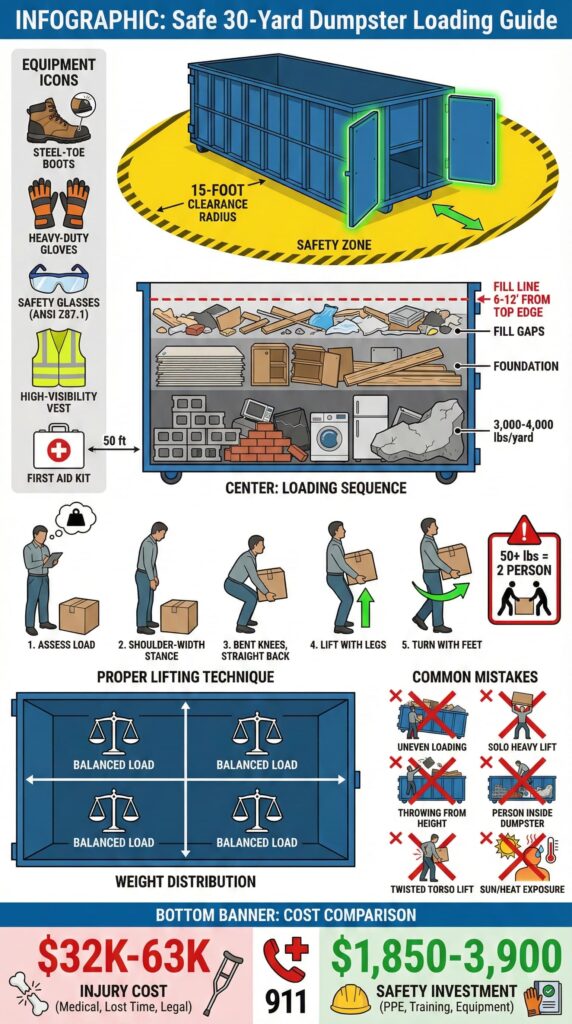
Before throwing a single piece of debris, establish a 15-foot clear perimeter around the dumpster. This safety zone prevents tripping hazards and gives your crew room to maneuver heavy items without obstruction. Remove tools, materials, cords, hoses, and any equipment that could create stumbling risks.
Your loading zone should have level, stable ground. Check for soft soil, gravel that shifts underfoot, or uneven surfaces that could cause workers to lose balance while carrying heavy loads. If necessary, place plywood sheets to create stable pathways to the dumpster.
Conduct a Team Safety Briefing
Start every cleanout project with a 5-minute safety briefing that covers:
- Which items require two-person team lifts (anything over 50 pounds)
- Designated roles for each crew member
- Hand signals for communication in noisy environments
- Location of first aid supplies and emergency contact information
- Prohibited items that cannot go in the dumpster
Establish a “one person inside, one outside” rule if anyone needs to briefly step inside to arrange items. Never allow workers to climb in alone or work inside while others continue throwing debris over the walls.
Verify Proper Personal Protective Equipment
Every worker approaching the dumpster must wear:
- Steel-toe or composite-toe safety boots – Protects feet from dropped materials and puncture injuries from nails or sharp debris
- Heavy-duty work gloves – Prevents cuts, splinters, and abrasions while gripping rough materials
- ANSI Z87.1 rated safety glasses – Guards against flying debris and dust
- High-visibility vest – Ensures all crew members can see each other in busy work zones
For projects involving demolition debris with potential sharp edges, consider cut-resistant gloves rated ANSI A3 or higher and long-sleeve shirts to protect forearms.
The Strategic Loading Method: Heavy to Light, Bottom to Top
Phase 1: Foundation Layer (Heavy, Flat Items)
Your first loads establish the foundation for everything that follows. Start with the heaviest, flattest items and place them evenly across the dumpster floor. This creates a stable base that prevents shifting during transport.
Ideal foundation items include:
- Concrete chunks and broken pavement
- Brick and masonry materials
- Large appliances (after removing refrigerant legally)
- Heavy machinery or equipment
- Thick lumber and dimensional wood
Spread these items evenly—don’t stack all heavy materials on one end. According to ergonomics research from the National Institute for Occupational Safety and Health, proper load distribution reduces back strain and prevents the container from becoming unbalanced during pickup.
Phase 2: Middle Layer (Medium-Density Materials)
Once your foundation is set, add medium-weight items that fill the footprint without creating excessive height. This layer acts as a buffer between your heavy base and lighter materials on top.
Effective middle layer materials:
- Drywall sheets and gypsum board
- Doors, cabinets, and countertops
- Rolled carpeting and padding
- Bagged construction debris
- Medium-sized furniture pieces
Break down larger items whenever possible. A couch takes up 3-4 times less space when disassembled than when thrown in whole. Use reciprocating saws to cut bulky items like vanities, shelving units, and large furniture into manageable pieces.
Phase 3: Top Layer and Gap Filling
Your final loading phase involves filling air pockets and maximizing every cubic yard of space while staying below the fill line. Small, lightweight debris is perfect for this stage.
Space-filling materials:
- Loose trash bags
- Scrap wood pieces and trim
- Insulation materials
- Cardboard boxes (flattened)
- Packaging materials and foam
Pay special attention to corners and gaps between larger items. Think of it as a 3D puzzle—every air pocket is wasted money. However, never compress or pack down debris so tightly that it exceeds the weight limit or fill line.
Master the Walk-In Door Technique
Most 30-yard dumpsters feature a double-door at one end that swings open for ground-level access. This design feature is your greatest safety tool, yet many contractors ignore it and struggle lifting items over the 6-foot high walls.
Proper Walk-In Door Usage
For items weighing 30-75 pounds: Open both doors fully and secure them to prevent sudden closure. Walk the item inside, place it according to your loading strategy, then back out carefully watching your footing on the ramp.
For awkward or bulky items: Large pieces like mattresses, doors, or long beams are nearly impossible to safely lift over the walls. Use the walk-in door to slide these items inside at a low angle, reducing the risk of the item falling back on you or striking other workers.
For team lifts: Two workers can safely carry items up to 150 pounds through the walk-in door using coordinated steps and clear communication. The lead person walks backward into the dumpster, guiding placement while the second person provides lifting support from outside.
When to Secure the Door
Lock the walk-in door once the dumpster reaches about 75% capacity. At this point, continued access creates fall hazards as workers might trip on debris near the entrance. Switch to carefully placing remaining items over the side walls (while maintaining proper lifting form) or use the door only for small, final items.
Always ensure the door is completely closed and latched before the hauler arrives for pickup. An unsecured door can swing open during transport, creating serious road hazards and potential legal liability.
Proper Lifting Mechanics to Prevent Back Injuries
Back injuries represent 20% of all workplace injuries in construction, with improper lifting being the leading cause.[4] Even experienced contractors can develop chronic back problems from years of poor lifting technique. Protect your crew—and your career—by following these proven ergonomic principles.
The Five-Point Lifting Method
1. Plan the Lift: Before touching the object, assess its weight, shape, and intended destination. Test-lift one edge to gauge the load. If it seems too heavy, get help—there’s no such thing as being “tough enough” to lift something unsafe.
2. Position Your Feet: Stand with feet shoulder-width apart, one foot slightly ahead of the other for stability. Position yourself as close to the object as possible. The further an object is from your spine, the more force your back muscles must generate to control it.
3. Bend at the Knees: Squat down using your leg muscles, keeping your back straight. Your powerful leg muscles—quadriceps and hamstrings—should do the lifting work, not your back. Think “push with legs” not “pull with back.”
4. Grip Firmly and Lift Smoothly: Get a secure grip with both hands. Tighten your core muscles to stabilize your spine. Lift by straightening your legs in one smooth motion—no jerking or twisting. Keep the load close to your body throughout the lift.
5. Turn with Your Feet: Never twist your torso while holding a load. Your spine is extremely vulnerable to injury during twisting motions under load. Instead, pivot your entire body by moving your feet, keeping your shoulders and hips aligned.
Team Lift Protocols
For any item over 50 pounds or awkwardly shaped objects, use a two-person team lift. Establish clear communication before the lift:
- Designate a lead: One person calls “ready, lift, step, place”
- Match heights: Both lifters should grip at roughly the same height to prevent uneven stress
- Synchronize movement: Move in unison, taking small, deliberate steps
- Maintain communication: If either person feels strain, immediately call “down” and set the item down safely
For extremely heavy items (over 100 pounds), consider using mechanical aids like hand trucks, appliance dollies, or pallet jacks to transport materials to the dumpster edge before the final placement.
Weight Distribution: The Critical Factor for Safe Transport
Even if you load every item safely, an improperly balanced dumpster creates serious hazards during pickup and transport. Uneven weight distribution can cause the container to tip on the truck, damage the hauler’s equipment, or even make the dumpster impossible to lift safely.
The Even Distribution Rule
Imagine your dumpster divided into four quadrants. Each section should contain roughly equal weight. This doesn’t mean identical materials in each area, but rather balanced total weight across the entire footprint.
Common distribution mistakes to avoid:
- Piling all concrete or masonry on one end
- Loading one full side while leaving the other side mostly empty
- Stacking heavy materials only in the center, leaving the ends empty
- Creating a “pyramid” with all heavy items in the middle
As you load, periodically step back and visually assess the container. Does one side look significantly heavier? If so, balance it out before continuing to add more material.
Understanding Weight Limits
A 30-yard dumpster in Peoria typically has a weight allowance of 3-5 tons (6,000-10,000 pounds) depending on the debris type and hauler specifications.[5] Different materials have dramatically different weights per cubic yard:
| Material Type | Weight per Cubic Yard | 30-Yard Capacity |
|---|---|---|
| Mixed construction debris | 400-600 lbs | 6-9 tons |
| Wood and lumber | 300-500 lbs | 4.5-7.5 tons |
| Drywall and gypsum | 500-700 lbs | 7.5-10.5 tons |
| Concrete and brick | 3,000-4,000 lbs | 45-60 tons |
| Household trash | 200-400 lbs | 3-6 tons |
Notice how concrete weighs 10-15 times more than typical construction debris. This is why you should never fill a 30-yard container completely with concrete—you’ll exceed the weight limit long before reaching the fill line. For heavy debris like concrete, brick, or dirt, consider a 10-yard or 20-yard dumpster instead, or coordinate with Zap Dumpsters to source a container specifically rated for heavy materials.
The Fill Line: Your Non-Negotiable Safety Boundary
Every rental dumpster has a maximum fill line marked on the interior walls. This isn’t a suggestion—it’s a critical safety requirement enforced by state and federal transportation regulations.
Why the Fill Line Exists
Illinois Department of Transportation regulations require all waste loads to be covered with tarps during highway transport.[6] Debris extending above the dumpster walls makes tarping impossible and creates these hazards:
- Projectile debris: Items can blow off during transport, striking other vehicles or pedestrians
- Bridge clearance issues: Overloaded dumpsters may not clear standard bridge heights
- Unstable load shifts: Top-heavy containers can shift during braking or turning
- Legal violations: Haulers can be cited and fined, with costs passed to you
Most 30-yard dumpsters have the fill line marked 6-12 inches below the top edge. Some haulers use a “waterline” rule: debris should not be visible above the walls when viewed from the side.
What Happens If You Overfill
If your dumpster exceeds the fill line when the hauler arrives, you face several consequences:
- The driver may refuse to pick up the container until you remove excess debris
- You’ll be charged overage fees, typically $75-150 per cubic yard over capacity
- Your project timeline gets delayed while you arrange alternative disposal
- In severe cases, the hauler may charge a trip fee for the refused pickup
Plan your loading to finish with about 6 inches of clearance below the fill line. This buffer accounts for debris settling and shifting, ensuring compliance even after the materials compress slightly.
Specialized Safety Concerns for Common Debris Types
Roofing Materials and Shingles
Asphalt shingles are deceptively heavy and can quickly exceed weight limits. A typical residential roof tearoff generates 2-4 tons of shingle debris. When loading roofing materials:
- Distribute shingle bundles evenly across the entire dumpster floor
- Never stack shingles only on one end—this creates extreme imbalance
- Watch for protruding nails that can puncture gloves and tires
- Use a magnetic sweeper around the dumpster daily to collect fallen nails
Drywall and Gypsum Board
Drywall dust creates respiratory hazards and the sheets are heavier than they appear. Safety measures include:
- Wear N95 respirators when breaking or loading drywall
- Break large sheets into smaller pieces to reduce lifting strain
- Keep drywall covered if rain is expected—wet drywall triples in weight
- Load drywall flat rather than on edge to prevent tipping and shifting
Appliances and Metal Items
Large appliances require special handling:
- Refrigerators and AC units must have refrigerant legally removed before disposal
- Secure or remove doors from refrigerators and freezers to prevent entrapment hazards
- Use appliance dollies to move washers, dryers, and stoves to minimize back strain
- Place appliances near the front of the dumpster where they’re easy to access for recycling separation
Site-Specific Safety Considerations
Residential Driveway Placement
When loading a dumpster on a residential driveway:
- Ensure children and pets are kept away from the loading zone
- Set up caution cones or tape to clearly mark the work area
- Avoid loading during peak traffic times when neighbors are coming and going
- Clean up dropped debris immediately to prevent tracking into the home
Street Placement Situations
Dumpsters placed on public streets require extra vigilance:
- Set up reflective warning signs or barrels at both ends of the container
- Use caution when loading near traffic—assign one person as a spotter
- Never stand in the street while loading; stage materials on the sidewalk side
- Work during daylight hours whenever possible for maximum visibility
Active Construction Sites
Multi-trade job sites need coordinated safety protocols:
- Designate specific loading times to avoid congestion
- Establish a single point person responsible for dumpster management
- Keep dumpster access clear of parked equipment and material staging
- Coordinate with other trades to prevent simultaneous loading attempts
| Loading Scenario | Primary Safety Risk | Best Practice Solution |
|---|---|---|
| Solo contractor working alone | Attempting unsafe lifts without assistance | Use mechanical aids; schedule heavy items when help is available |
| Loading during hot summer weather | Heat exhaustion and dehydration | Schedule loading for early morning; require frequent water breaks |
| Multi-story building with ground-floor dumpster | Throwing debris from height | Use chutes or carry debris down; establish exclusion zone below |
| Demolition debris with nails and sharp edges | Puncture wounds and lacerations | Require cut-resistant gloves; use magnetic sweepers daily |
Mini Case Studies: Learning from Real Incidents
Case 1 – Back Injury from Improper Technique: A 34-year-old contractor in Peoria suffered a herniated disc while loading concrete chunks into a 30-yard dumpster. He was bending at the waist and twisting to throw pieces over the wall rather than using the walk-in door. The injury required surgery and resulted in 4 months of lost work. Cost: $47,000 in medical bills and lost income.
Case 2 – Unbalanced Load Incident: A hauler arrived to pickup a dumpster that had all concrete loaded on one end and lightweight wood on the other. When the container lifted, it tilted severely, damaging the truck’s hydraulic system and nearly striking a worker. The contractor was billed $8,500 for truck repairs plus reloading costs.
Case 3 – Overfill Citation: A construction crew exceeded the fill line by approximately 18 inches with roofing shingles. The hauler refused pickup, and the general contractor had to rent an additional dumpster and pay disposal fees for both containers. Total extra cost: $950, plus 2 days of project delay.
Case 4 – Success Story: A remodeling contractor implemented a comprehensive safety protocol including mandatory team lifts, walk-in door usage, and strategic loading. Over 18 months and 23 dumpster loads, the crew recorded zero injuries and never exceeded weight limits or fill lines. The contractor reports improved crew morale and faster loading times due to organized approach.
Creating Your Crew Safety Checklist
Use this checklist at the start of each project involving a 30-yard dumpster:
Pre-Project Planning:
- Verify dumpster placement provides 15-foot clearance on all sides
- Confirm all crew members have required PPE
- Review weight limits and fill line requirements for specific debris type
- Identify items requiring team lifts or mechanical aids
- Establish communication signals for noisy environments
Daily Loading Operations:
- Conduct morning safety briefing covering day’s loading plan
- Inspect walk-in door functionality and secure latches
- Stage debris by weight category for strategic loading
- Assign spotters for street-side loading situations
- Monitor weather conditions (heat, wind, rain affect safety)
- Use magnetic sweeper for nail pickup at end of each day
End-of-Project Verification:
- Confirm debris level is below fill line by at least 6 inches
- Verify walk-in door is closed and securely latched
- Check that load appears evenly distributed across container
- Clear 15-foot perimeter of tools, materials, and trip hazards
- Document any prohibited items that need alternative disposal
Need help coordinating the right dumpster size for your next large project? Zap Dumpsters works with contractors throughout the Peoria area to source appropriately sized containers from reliable local haulers who understand construction site safety requirements.
When Accidents Happen: Immediate Response Protocol
Despite best safety practices, accidents can occur. Having a clear response protocol minimizes injury severity:
For Back Strain or Muscle Injuries
If a worker reports back pain or muscle strain during loading:
- Stop work immediately—continuing increases injury severity
- Have the worker sit or lie down in a comfortable position
- Apply ice packs if available (20 minutes on, 20 minutes off)
- Do not attempt to “stretch it out” or keep working
- Seek medical evaluation same-day for moderate to severe pain
- Document the incident, even if it seems minor
For Cuts, Punctures, or Lacerations
Sharp debris causes most dumpster loading injuries:
- Apply direct pressure with clean cloth to control bleeding
- Elevate the injured area above heart level if possible
- Clean minor cuts with soap and water, apply antibiotic ointment and bandage
- Seek immediate medical care for deep cuts, puncture wounds, or if bleeding doesn’t stop within 10 minutes
- Check tetanus vaccination status—boosters needed every 10 years
For Crush Injuries or Falling Debris
If debris falls on a worker or a crush injury occurs:
- Call 911 immediately for serious injuries
- Do not move the worker unless they’re in immediate danger
- Keep the worker calm and still until help arrives
- Cover with blanket to prevent shock if weather is cool
- Document the incident thoroughly for workers’ compensation filing
Keep a fully stocked first aid kit within 50 feet of any active dumpster loading area. Kit should include: pressure bandages, gauze pads, medical tape, antibiotic ointment, instant cold packs, latex gloves, scissors, tweezers, and emergency contact card.
Economic Impact of Safety Investment
Contractors often view safety protocols as time-consuming expenses. The reality? Safety investments deliver measurable ROI:
Cost of One Back Injury:
- Average workers’ compensation claim: $24,000-40,000
- Lost productivity during recovery: 45-90 days
- Increased insurance premiums: $3,000-8,000 annually
- Replacement worker training and overtime costs: $5,000-15,000
- Total cost of single preventable injury: $32,000-63,000
Cost of Safety Implementation:
- PPE for 5-person crew: $750-1,200 annually
- Mechanical aids (hand trucks, dollies): $400-800 one-time
- Safety training program: $500-1,500 annually
- First aid supplies and equipment: $200-400 annually
- Total annual safety investment: $1,850-3,900
A single prevented injury pays for your entire safety program 8-16 times over. Beyond direct costs, safety-focused contractors report better crew retention, improved project timelines, and enhanced reputation leading to more contract opportunities.
Need a Properly Sized Dumpster for Your Next Large Cleanout?
Zap Dumpsters coordinates with trusted Peoria-area haulers to source the right container for safe, efficient loading. We match contractors with reliable partners who deliver on time and provide properly maintained equipment.
Call us today: (309) 650-8954
Servicing Peoria, Woodford, Tazewell, and Fulton Counties
We coordinate dumpster availability—we don’t deliver, but we connect you with haulers who do.
How to Load a 30 Yard Dumpster Safely FAQs
How much weight can I safely put in a 30-yard dumpster?
Most 30-yard dumpsters have weight limits of 3-5 tons (6,000-10,000 pounds) depending on debris type and hauler specifications. Mixed construction debris typically stays within limits, but heavy materials like concrete can exceed capacity when filling the container completely. Always confirm weight allowances with your hauler before loading dense materials. Exceeding weight limits results in overage fees of $75-150 per ton and may prevent safe pickup.
What is the safest way to load heavy items into a 30-yard dumpster?
Use the walk-in door for all heavy items to avoid lifting over the high sidewalls. For items over 50 pounds, use two-person team lifts with coordinated movement and clear communication. Maintain proper lifting form by bending at the knees, keeping the load close to your body, and avoiding twisting motions. Place heavy items at the bottom of the container first to create a stable foundation. Never attempt to throw or toss heavy objects over the dumpster walls—this increases back strain and creates falling debris hazards.
Can I step inside the dumpster while loading it?
Stepping inside a partially loaded dumpster creates serious safety risks. Debris can shift unexpectedly, causing falls or trapping limbs. Sharp materials like nails, glass, and metal edges hidden beneath the surface can cause puncture wounds. If you must briefly enter to arrange large items, follow the one-in-one-out rule: only one person inside while another remains outside as a spotter. Never allow workers inside while others continue throwing debris over the walls. Once the container reaches 50% capacity, stay outside and use tools or poles to arrange materials.
What happens if I load the dumpster above the fill line?
Loading above the fill line violates transportation regulations and creates hazards. The hauler may refuse to pick up an overfilled container until you remove excess debris, delaying your project and potentially incurring trip fees. If the hauler does attempt pickup, debris extending above the walls can blow off during transport, creating road hazards and legal liability. You’ll face overage charges of $75-150 per cubic yard above capacity. Keep debris at least 6 inches below the top edge to ensure compliance and safe transport.
How should I distribute weight in how to load a 30 yard dumpster safely to prevent tipping?
Distribute weight evenly across the entire dumpster floor by dividing the container into four imaginary quadrants. Place heavy materials like concrete, brick, or appliances spread across all sections rather than concentrated on one end or side. Avoid creating a center-heavy pyramid or end-heavy configuration. As you load, periodically assess the container from the side to verify balanced appearance. Unbalanced loads can cause the dumpster to tilt during pickup, potentially damaging equipment, injuring workers, or making safe transport impossible. Proper distribution ensures stability throughout loading, pickup, and transport phases.
How to Load a 30 Yard Dumpster Safely Citations
- Bureau of Labor Statistics. (2024). “Nonfatal Occupational Injuries and Illnesses Requiring Days Away from Work, 2023.” U.S. Department of Labor. https://www.bls.gov/iif/
- National Waste & Recycling Association. (2024). “Standard Dumpster Sizes and Capacities Guide.” NWRA Industry Standards Documentation.
- National Institute for Occupational Safety and Health. (2024). “Ergonomics and Musculoskeletal Disorders: Work-Related Injuries Prevention.” Centers for Disease Control. https://www.cdc.gov/niosh/ergonomics/index.html
- Occupational Safety and Health Administration. (2024). “Back Injury Prevention in Construction.” OSHA Publication 3182. U.S. Department of Labor.
- Illinois Waste Management Association. (2024). “Dumpster Weight Limits and Disposal Guidelines for Illinois Contractors.” IWMA Technical Bulletin 2024-03.
- Illinois Department of Transportation. (2024). “Commercial Vehicle Regulations: Secured Load Requirements.” 92 Illinois Administrative Code Part 554.