
Key Takeaways:
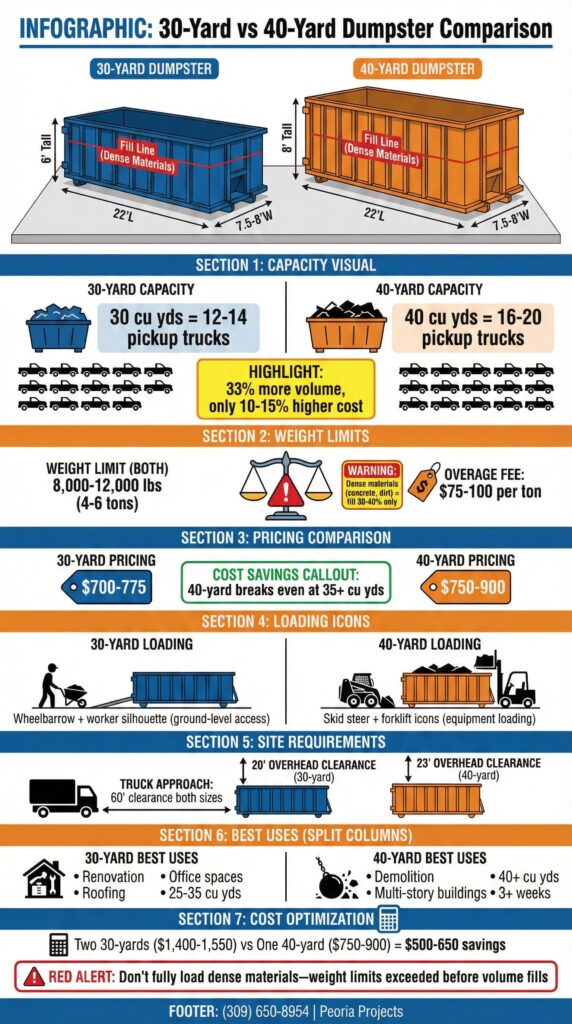
- Both sizes share nearly identical footprints (22 feet long × 7.5-8 feet wide) but differ in height — 30-yard containers stand 6 feet tall while 40-yard units reach 8 feet
- The 40-yard option provides 33% more volume for roughly $50-$150 additional cost in Peoria, making it cost-effective for high-volume commercial construction debris
- 30-yard dumpsters offer easier loading access through 6-foot sidewalls, while 40-yard containers work best with rear door loading or dock access due to 8-foot height
- Weight limits overlap significantly — both typically accommodate 8,000-12,000 pounds depending on local hauler specifications in the Peoria market
- Contractors should match container height to loading method: choose 30-yard for ground-level hand loading and 40-yard for equipment-assisted loading or elevated access
Article Summary: The choice between 30 yard vs 40 yard dumpsters for commercial construction projects in Peoria hinges on loading access and total debris volume rather than weight capacity. While both containers share similar length and width dimensions, the 40-yard’s additional 2 feet in height delivers 33% more capacity for a modest 10-15% cost increase, making it ideal for large-scale demolition and multi-story projects where dock or equipment loading is available.
Understanding Core Dimensional Differences Between 30-Yard and 40-Yard Containers
When sourcing dumpsters for major commercial construction projects in Peoria, the dimensional specifications directly impact how contractors load debris and maximize capacity. Both 30-yard and 40-yard containers maintain standardized footprints that fit most construction sites, but their height difference creates distinct operational advantages for different project types.
Standard 30-yard dumpsters measure approximately 22 feet long × 7.5-8 feet wide × 6 feet high, creating a manageable sidewall height for ground-level loading. This 6-foot wall height allows construction crews to hand-load materials, wheelbarrow debris directly over the sides, and access the container from multiple angles throughout the workday.
The 40-yard container shares the same 22-foot length and 7.5-8-foot width but extends to 8 feet in height. Those additional 2 vertical feet translate to 10 extra cubic yards of capacity — approximately 3-4 additional pickup truck loads of debris. The taller sidewalls make over-the-side loading impractical for most ground-level operations but prove advantageous when paired with equipment or dock access.
Both sizes feature rear swing doors for walk-in loading, though the 40-yard door opening sits higher from the ground. Construction sites with forklifts, skid steers, or elevated loading positions benefit from the 40-yard’s extra height, while projects relying on manual labor or wheelbarrow access find the 30-yard more efficient for daily operations.
The similar footprint means either size fits standard construction staging areas in Peoria. Contractors must ensure 60 feet of straight, level access for delivery trucks and maintain 23 feet of vertical clearance for safe placement and removal. The height difference becomes critical only when considering overhead obstructions like power lines, tree branches, or building overhangs near the placement zone.[1]
Volume Capacity and Debris Equivalents
Understanding volumetric capacity helps contractors estimate how many containers a project requires. A 30-yard container holds 30 cubic yards of material — roughly equivalent to 12-14 pickup truck loads or 170-190 contractor-grade 33-gallon trash bags. This capacity suits full-home gut renovations, multi-unit apartment turnovers, or commercial buildouts producing substantial but manageable debris volumes.
The 40-yard container accommodates 40 cubic yards — approximately 16-20 pickup truck loads or 230-250 contractor-grade 33-gallon bags. That 33% volume increase over the 30-yard size often eliminates the need for a second container on major demolition projects, complete building teardowns, or large-scale commercial renovations spanning multiple weeks.
Material type affects fill volume significantly. Bulky, lightweight construction debris like framing lumber, drywall, and insulation typically fills containers by volume before reaching weight limits. Dense materials such as concrete, brick, or roofing shingles hit weight restrictions long before filling the container’s full cubic yardage, making size selection about weight management rather than space.
Loading Method Compatibility
The 30-yard container’s 6-foot sidewall height aligns with standard human reach and wheelbarrow dump angles. Contractors can efficiently load materials throughout the day without requiring equipment assistance. Two-person crews can manage debris removal as work progresses, maintaining a clean and safe job site without specialized loading procedures.
Forty-yard containers function best when integrated with equipment-based loading systems. Skid steers, bobcats, or telehandlers can lift materials directly over the 8-foot sidewalls. Construction sites with loading docks benefit most from 40-yard containers since debris can be pushed or dumped directly from dock height. Projects without equipment access or elevated loading positions find the 8-foot walls create unnecessary inefficiency in the loading process.
Weight Capacity and Material Loading Guidelines
Weight limits govern container selection as much as volume capacity, particularly for commercial construction projects involving heavy materials. Both 30-yard and 40-yard containers feature similar weight allowances despite their volume difference — a critical consideration when selecting the right size container for dense construction debris.
Most haulers in Peoria establish weight limits between 8,000-12,000 pounds (4-6 tons) for both sizes, with specific allowances varying by company and debris type. The standardized weight limit reflects truck capacity and road safety regulations rather than container volume. Contractors loading concrete, masonry, soil, or asphalt must stay within tonnage limits regardless of which container size they choose. Proper construction waste management practices help reduce the environmental impact of demolition debris while maintaining regulatory compliance
A fully loaded 30-yard dumpster containing mixed construction debris — lumber, drywall, metal framing, and general tearout materials — typically weighs 3-5 tons, staying comfortably within standard limits. That same container filled with concrete or brick can exceed 10 tons despite occupying only 20-30% of available volume, triggering significant overage fees that often exceed the initial rental cost.[2]
| Debris Type | 30-Yard Weight Range | 40-Yard Weight Range | Loading Recommendation |
|---|---|---|---|
| Mixed Construction Debris | 6,000-10,000 lbs | 8,000-12,000 lbs | Fill to capacity |
| Drywall & Lumber | 4,000-8,000 lbs | 6,000-10,000 lbs | Fill to capacity |
| Roofing Shingles | 18,000-21,000 lbs (full) | 24,000-28,000 lbs (full) | Fill 30-40% only |
| Concrete/Masonry | 20,000-30,000 lbs (full) | 26,000-40,000 lbs (full) | Use 10-15 yard instead |
Managing Dense Material Disposal
Commercial contractors working with heavy demolition debris face a strategic choice: partially fill a large container or source multiple smaller units designed for heavy materials. Concrete, brick, block, tile, and soil weigh significantly more per cubic yard than typical construction waste, making standard 30-yard or 40-yard containers impractical for exclusive heavy material disposal.
A cubic yard of concrete weighs approximately 4,000 pounds. Just 3 cubic yards of concrete reaches the 12,000-pound weight limit, leaving 27-37 cubic yards of unused container space. Haulers charge overage fees ranging from $75-$100 per ton above included weight, potentially adding $400-$800 to a single pickup for concrete overloads.[3]
Contractors managing concrete demolition, foundation removal, or masonry tearout should source dedicated 10-yard or 15-yard low-profile containers designed for heavy debris. These specialized units feature lower sidewalls for safer loading and include higher weight allowances (10-15 tons) that accommodate dense materials without penalty. Separating heavy materials into appropriate containers prevents weight violations and reduces total disposal costs compared to partially filling large containers.
Estimating Project Weight
Accurate weight estimation prevents costly overages and helps contractors choose between 30-yard and 40-yard options. Construction professionals can calculate approximate debris weight by multiplying estimated cubic yards by material-specific weights, then comparing totals against included tonnage allowances.
For reference, common materials weigh: lumber (500 lbs/cubic yard), drywall (500-700 lbs/cubic yard), asphalt shingles (2,100-3,400 lbs/cubic yard when compacted), concrete (4,000 lbs/cubic yard), brick (3,000-3,500 lbs/cubic yard), and mixed household debris (150-300 lbs/cubic yard). Most commercial renovation debris — mixed wood, metal, drywall, fixtures, and general construction materials — averages 800-1,200 pounds per cubic yard.
When combining material types, contractors should estimate each category separately, add totals, and maintain a 10-15% buffer for moisture content and compaction. Projects generating predominantly lightweight materials benefit from larger container volumes, while jobs producing mixed or dense debris require careful weight monitoring regardless of container size.
Cost Analysis and Economic Decision Factors
Pricing differences between 30-yard and 40-yard container rentals in Peoria typically range from $50-$150, representing a 10-15% cost increase for 33% more disposal capacity. This favorable cost-to-volume ratio makes 40-yard containers economically attractive for large commercial projects that generate substantial debris volumes over extended timelines.
Current Peoria market rates for 30-yard containers range from $700-$775 for standard 7-10 day rental periods including delivery, pickup, and disposal within weight limits. Forty-yard containers cost approximately $750-$900 for comparable rental terms. The modest price difference means contractors paying for two 30-yard containers spend more than sourcing a single 40-yard unit would cost.[4]
We coordinate with local haulers to source competitive pricing for contractors managing multiple projects simultaneously. Bulk rental arrangements, extended rental periods, and repeat business relationships often reduce per-container costs by 10-20% compared to one-off rentals, making strategic size selection even more important for cost management.
| Cost Factor | 30-Yard Impact | 40-Yard Impact |
|---|---|---|
| Base Rental (7-10 days) | $700-$775 | $750-$900 |
| Weight Overage (per ton) | $75-$100 | $75-$100 |
| Extended Rental (per day) | $10-$15 | $12-$18 |
| Additional Haul Fee | $250-$350 | $275-$400 |
Hidden Cost Considerations
Beyond base rental rates, contractors must account for potential additional fees that affect total project costs. Extended rental periods add daily charges when projects run longer than initially estimated. Most Peoria haulers include 7-10 days in base pricing, after which daily fees accumulate until pickup occurs.
Weight overages represent the most common unexpected expense. Contractors who underestimate debris weight or fail to separate heavy materials face per-ton charges that can exceed $300-$500 for a single pickup. A 40-yard container loaded with mixed construction debris that exceeds included weight by 3 tons costs $225-$300 in overage fees — nearly erasing the cost advantage versus sourcing two smaller containers.
Permit requirements add $20 per 30-day period when containers must be placed in Peoria public right-of-way areas. Commercial job sites often require street placement due to limited site access or ongoing operations blocking driveway positions. Contact the Peoria Public Works Department at (309) 494-8800 for permit applications and placement approval.[5]
Additional haul fees apply when containers fill faster than anticipated, requiring early pickup and exchange. These extra service calls cost $250-$400 each, making accurate size selection critical for budget control. Contractors managing multi-phase projects should evaluate whether one large container for the project duration costs less than multiple exchanges of smaller units.
Break-Even Analysis for Size Selection
The decision between 30-yard and 40-yard containers reaches a mathematical break-even point based on debris volume and exchange frequency. Projects generating 35-45 cubic yards of debris benefit financially from sourcing a single 40-yard container rather than a 30-yard unit plus additional haul. The $50-$150 premium for the larger size costs substantially less than $250-$400 for an extra service call.
Consider a commercial renovation producing approximately 55 cubic yards of debris over a 3-week timeline. Option A sources two 30-yard containers sequentially — base cost $1,400-$1,550 plus coordination delays between exchanges. Option B sources one 40-yard container — base cost $750-$900. The single larger container saves $500-$650 while eliminating mid-project exchange scheduling and site disruption.
Conversely, projects generating 25-28 cubic yards shouldn’t pay for unused 40-yard capacity. The 30-yard container provides sufficient volume without excess, keeping costs aligned with actual needs. Contractors can refine their estimation by reviewing past project records, consulting with experienced site supervisors, and adding a 10-15% buffer for unexpected waste generation.
Project-Specific Applications for Commercial Construction
Matching container size to project type optimizes both operational efficiency and cost management for commercial contractors in Peoria. Different construction phases and building types generate predictable debris volumes that guide appropriate size selection between 30-yard and 40-yard options.
Multi-Unit Residential Construction
New apartment complex construction or major multi-family renovation generates substantial volumes of packaging materials, cut lumber, drywall scraps, and general construction waste throughout multiple build phases. Projects spanning 8-20 units typically benefit from 40-yard containers that accommodate the continuous debris flow without requiring frequent exchanges during critical construction windows.
The elevated loading height works well on multi-unit sites where contractors use skid steers, telehandlers, or crane-lifted debris buckets to move materials from upper floors. Ground-level debris chutes can direct materials into 40-yard containers positioned below, creating efficient vertical disposal systems for multi-story construction.
Demolition phases of major multi-family renovations produce even larger volumes when gutting multiple units simultaneously. A 40-yard container provides staging capacity for several days of intensive demolition work, reducing the need for daily pickups that disrupt ongoing operations and increase total costs.
Commercial Building Interior Renovations
Office building renovations, retail space reconfigurations, and restaurant buildouts generate significant debris from partition removal, ceiling tearout, flooring demolition, and fixture disposal. Projects affecting 3,000-10,000 square feet typically fill 30-yard containers appropriately, with renovation density and material types determining whether the 6-foot sidewall height proves advantageous.
Ground-level commercial spaces favor 30-yard containers for manual loading efficiency. Renovation crews can maintain clean work areas by regularly disposing of debris throughout the day without requiring equipment assistance. The accessible sidewall height supports wheelbarrow and cart-based debris removal that keeps pace with demolition and construction activities.
Projects involving extensive drywall removal or ceiling demolition may generate more volume than weight. A 10,000-square-foot office renovation typically produces 25-35 cubic yards of bulky but lightweight debris that fits comfortably in a 30-yard container while staying well within weight limits. Contractors can maximize this configuration by breaking down large items and efficiently packing the container.
Complete Building Demolition
Full structure teardowns represent the highest-volume debris generators in commercial construction. Single-story commercial building demolition often requires multiple large containers sequentially or simultaneous placement of several 40-yard units to maintain demolition momentum and clear debris from the site safely.
A complete 5,000-square-foot commercial structure demolition generates approximately 100-150 cubic yards of mixed debris — equivalent to 3-4 forty-yard containers. Demolition contractors typically sequence containers to match teardown phases, positioning fresh units as each fills and coordinating pickups to maintain accessible work areas throughout the project.
The 40-yard container’s extra height becomes advantageous during mechanical demolition when excavators can lift and dump large debris sections directly into containers. The additional 2 feet of sidewall clearance reduces spillover risk when dropping substantial material loads from height, improving site safety and reducing cleanup time around container perimeters.
Roofing and Exterior Renovation
Commercial roofing projects demand careful size selection based on building square footage and shingle removal. A 10,000-square-foot commercial roof generates approximately 12-15 tons of asphalt shingle debris — enough material to dramatically exceed weight limits in any standard container size if fully loaded.
Contractors managing large commercial roofing projects should coordinate shingle disposal across multiple 30-yard containers rather than attempting to maximize 40-yard capacity. The lower sidewall height of the 30-yard unit facilitates safer ground-level loading from roof-mounted debris chutes while providing adequate volume for controlled weight management.
When projects combine roofing removal with other building demolition, separating shingles into dedicated containers prevents weight overages. Load the 30-yard container approximately 40-50% full with roofing materials to stay within 8,000-10,000 pound limits, while directing other lightweight construction debris into a separate standard container.
For comprehensive information on managing large-scale commercial project debris, contractors can reference proven strategies for maximizing container efficiency throughout the project duration.
Operational Logistics and Site Management
Beyond dimensional and cost considerations, contractors must evaluate practical site logistics that affect daily operations when choosing between 30-yard and 40-yard containers. Delivery access, placement positioning, and ongoing site workflow influence which size integrates most effectively into project timelines.
Delivery and Placement Requirements
Both container sizes require similar delivery access but differ in vertical clearance needs. Standard roll-off trucks need 60 feet of straight, level access to position containers safely. This measurement accounts for the truck’s approach, hydraulic lift operation, and rollback maneuver required to place and later retrieve loaded containers.
The critical difference appears in overhead clearance requirements. Thirty-yard containers need approximately 20 feet of vertical clearance during delivery and pickup, while 40-yard units require 23 feet to account for the additional 2 feet of container height plus hydraulic arm clearance. Commercial construction sites with overhead power lines, building overhangs, or tree canopy must verify adequate clearance before selecting 40-yard containers.
Placement surface conditions affect both sizes equally. Roll-off containers loaded with 4-6 tons of debris exert significant ground pressure through their wheel assemblies. Contractors should position containers on concrete, asphalt, or compacted gravel surfaces capable of supporting 15,000-20,000 pounds without rutting or settling. Soft soil, grass, or unprepared ground creates sinking risk that complicates pickup and may require additional equipment to extract loaded containers.
Loading Efficiency During Active Construction
Daily loading patterns influence which container height best supports project workflows. Sites where crews manually load debris throughout the workday benefit from the 30-yard container’s accessible 6-foot sidewalls. Workers can maintain continuous disposal habits — tossing materials directly into the container as demolition progresses rather than staging debris piles for later equipment-based loading.
This real-time disposal approach keeps work areas cleaner and safer while eliminating the need for secondary material handling. Construction sites constrained by limited space or strict safety protocols particularly value this operational advantage since debris accumulation creates trip hazards, blocks access routes, and complicates daily activities.
Conversely, projects using heavy equipment for primary debris removal find 40-yard containers more efficient despite requiring equipment for all loading operations. A skid steer operator can load the full container capacity in 2-3 hours of dedicated effort, compared to days of manual loading filling a 30-yard unit. This concentrated loading period reduces labor costs and maintains better site organization by designating specific debris removal sessions rather than ongoing disposal activities.
Managing Multiple Container Rotations
Extended commercial construction projects often require sequential container deliveries as debris generation continues beyond the capacity of any single unit. We coordinate pickup schedules with local haulers to minimize downtime between container exchanges, though contractors should anticipate 24-48 hours between requesting pickup and receiving replacement containers during busy construction seasons.
Choosing 40-yard containers reduces exchange frequency compared to 30-yard units when managing high-volume projects. A demolition project generating 10 cubic yards daily fills a 30-yard container in 3 days versus 4 days for a 40-yard container. That single extra day of container capacity reduces exchanges over a month-long project from approximately 10 pickup cycles to 7-8 cycles — saving $750-$1,200 in additional haul fees while reducing logistics coordination.
Contractors managing multiple simultaneous job sites can optimize costs by matching container sizes to project durations and sequencing exchanges to maintain consistent pricing leverage with haulers. We help commercial contractors develop container management strategies that align with their typical project profiles and annual waste disposal needs.
Comparing Large Container Options Side-By-Side
| Comparison Factor | 30-Yard Container | 40-Yard Container |
|---|---|---|
| Dimensions | 22′ L × 7.5-8′ W × 6′ H | 22′ L × 7.5-8′ W × 8′ H |
| Volume Capacity | 30 cubic yards (12-14 truck loads) | 40 cubic yards (16-20 truck loads) |
| Standard Weight Limit | 8,000-12,000 lbs (4-6 tons) | 8,000-12,000 lbs (4-6 tons) |
| Peoria Rental Cost | $700-$775 (7-10 days) | $750-$900 (7-10 days) |
| Best Loading Method | Manual/wheelbarrow over sides | Equipment or dock loading |
| Overhead Clearance | 20 feet minimum | 23 feet minimum |
| Ideal Project Types | Multi-room renovations, ground-level sites, manual labor crews | Complete demolitions, equipment-based projects, multi-story work |
| Cost per Cubic Yard | $23.33-$25.83/cubic yard | $18.75-$22.50/cubic yard |
When 30-Yard Containers Outperform Larger Options
Despite the cost-per-cubic-yard advantage of 40-yard containers, specific project conditions favor the 30-yard option. Ground-level construction sites without equipment access benefit from the easier manual loading enabled by 6-foot sidewalls. Smaller commercial renovations generating 25-35 cubic yards of debris avoid paying for unused capacity while maintaining manageable container footprints on space-limited sites.
Projects with strict overhead clearance restrictions due to power lines or building proximity must use 30-yard containers when 23-foot clearance isn’t available. Sites with challenging access routes where trucks must navigate tight turns or limited straightaway approach distances also favor slightly shorter containers that reduce delivery complexity.
Commercial contractors managing primarily roofing or heavy shingle removal prefer 30-yard containers for weight management reasons. The lower profile allows controlled partial fills that stay within weight limits while providing adequate volume for typical roofing project scales.
When 40-Yard Containers Deliver Maximum Value
Large commercial construction projects producing continuous high-volume debris over extended timelines achieve maximum efficiency with 40-yard containers. Complete building demolitions, multi-story renovations, and major commercial buildouts generate sufficient waste to justify the extra capacity while minimizing exchange frequency and associated service fees.
Construction sites with equipment presence throughout the project duration integrate 40-yard containers seamlessly into daily operations. The higher loading requirement poses no operational burden when skid steers, excavators, or telehandlers already operate on site for other purposes. Positioning the container near loading dock areas or elevated work platforms transforms the height disadvantage into a strategic advantage for direct high-volume disposal.
Projects requiring extended rental periods (3+ weeks) realize greater savings from 40-yard containers since the modest daily rate premium compounds less significantly than costs associated with multiple 30-yard container exchanges. A 4-week commercial renovation producing 60-75 cubic yards benefits from sourcing one 40-yard container for the duration rather than cycling through two 30-yard units sequentially.
Ready to Source the Right Container for Your Commercial Project?
We match Peoria contractors with trusted haulers offering competitive pricing on both 30-yard and 40-yard containers.
✓ Compare local availability ✓ Coordinate delivery timing ✓ Optimize container selection
Frequently Asked Questions: 30 Yard vs 40 Yard Dumpster
What’s the main difference between a 30 yard vs 40 yard dumpster?
The primary difference lies in height and capacity — 40-yard containers stand 8 feet tall compared to 6 feet for 30-yard units, providing 33% more volume (10 additional cubic yards) while maintaining the same 22-foot length and 7.5-8-foot width. Both share similar weight limits of 8,000-12,000 pounds despite the volume difference.
Is a 40-yard dumpster worth the extra cost for commercial construction?
For projects generating over 35 cubic yards of debris, the 40-yard container delivers better value. The $50-$150 premium costs substantially less than coordinating a second haul, which runs $250-$400 for additional pickup service. Commercial demolitions and multi-phase renovations typically save money by starting with larger capacity rather than requiring mid-project container exchanges.
Can I load a 40-yard dumpster from ground level?
The 8-foot sidewall height makes over-the-side manual loading impractical from ground level. Contractors need equipment assistance (skid steer, telehandler) or elevated loading positions (docks, upper floors with chutes) to efficiently fill 40-yard containers. Projects relying primarily on manual labor and wheelbarrow transport work better with accessible 30-yard container sidewalls.
Which container size works best for commercial roofing projects?
Thirty-yard containers suit commercial roofing better due to weight management concerns and accessible loading height. Asphalt shingles weigh 2,100-3,400 pounds per cubic yard when compacted — a fully loaded 30-yard or 40-yard container would dramatically exceed weight limits. Fill the 30-yard unit only 40-50% full with roofing materials, using its lower profile for safer debris chute loading from roof level.
How long does it take to fill a 30-yard vs 40-yard dumpster?
Fill time depends on crew size, project type, and disposal pace. A manual labor crew of 3-4 workers typically fills a 30-yard container in 3-5 days during active demolition, while the same project might take 4-7 days to fill a 40-yard unit. Equipment-based loading drastically reduces these timeframes — a skid steer operator can fill either size in 2-4 hours of concentrated loading effort, making the 40-yard option more efficient for equipment-supported sites.
Conclusion
Selecting between 30-yard and 40-yard dumpsters for commercial construction projects in Peoria ultimately depends on site-specific factors rather than blanket recommendations. Contractors managing ground-level renovations with manual loading workflows benefit from the 30-yard container’s accessible 6-foot sidewalls and appropriate capacity for typical project scales. The lower profile fits more sites with overhead restrictions while delivering sufficient volume for projects generating 25-35 cubic yards of mixed construction debris.
Conversely, large-scale commercial construction, complete building demolitions, and multi-story projects justify 40-yard containers despite requiring equipment-based loading. The 33% additional capacity for only 10-15% extra cost eliminates mid-project container exchanges that disrupt workflows and add $250-$400 per service call. Projects producing 40+ cubic yards of debris achieve lower per-cubic-yard costs and better operational efficiency by matching container size to actual waste generation volumes.
Both options serve commercial contractors effectively when matched appropriately to project conditions, loading methods, and total debris volumes. We help Peoria contractors evaluate these factors and coordinate with local haulers to source competitive pricing on containers that optimize project budgets and timelines. Understanding the practical differences between these similar-sized but operationally distinct containers enables more strategic waste management decisions throughout commercial construction projects.
30 Yard vs 40 Yard Dumpster Citations
- Hometown Dumpster Rental. “40 Yard Dumpster Guide: Average Costs, Best Uses, and More.” Accessed January 2026. https://www.hometowndumpsterrental.com/blog/40-yard-dumpster-guide
- Arcann Waste. “How much Does a Garbage Dumpster Weight? in 2024.” Accessed January 2026. https://blog.arcannwaste.com/how-much-does-a-garbage-dumpster-weight/
- Hometown Dumpster Rental. “30 Yard Dumpster Guide: Average Costs, Weight Limits, and More.” Accessed January 2026. https://www.hometowndumpsterrental.com/blog/30-yard-dumpster-guide
- Zters. “Dumpster Rental in Peoria, IL.” Accessed January 2026. https://www.zters.com/dumpster-rental/peoria-il
- City of Peoria. “Public Works Department Contact Information.” Accessed January 2026. Phone: (309) 494-8800.