
Key Takeaways
- 20-yard dumpster rental costs in Illinois range from $350 to $800, with Peoria averaging $326–$525
- Rental duration (typically 7–10 days), weight limits (2–4 tons), and debris type directly impact final pricing
- Contractors can control costs by choosing local sourcing services, understanding tonnage allowances, and planning rental timing strategically
- Illinois landfill tipping fees, permits, and overage charges add $40–$200 per extra ton beyond base weight limits
- Sourcing from multiple local haulers through matchmaking services provides better pricing transparency and availability
Article Summary
Renting a 20-yard dumpster in Illinois costs contractors between $350 and $800 on average, with pricing determined by location, rental period, debris type, and weight allowances. Smart contractors source through local matchmaking services to compare multiple hauler options, control tonnage costs, and secure competitive rates for construction projects across the state.
Understanding 20-Yard Dumpster Rental Pricing in Illinois
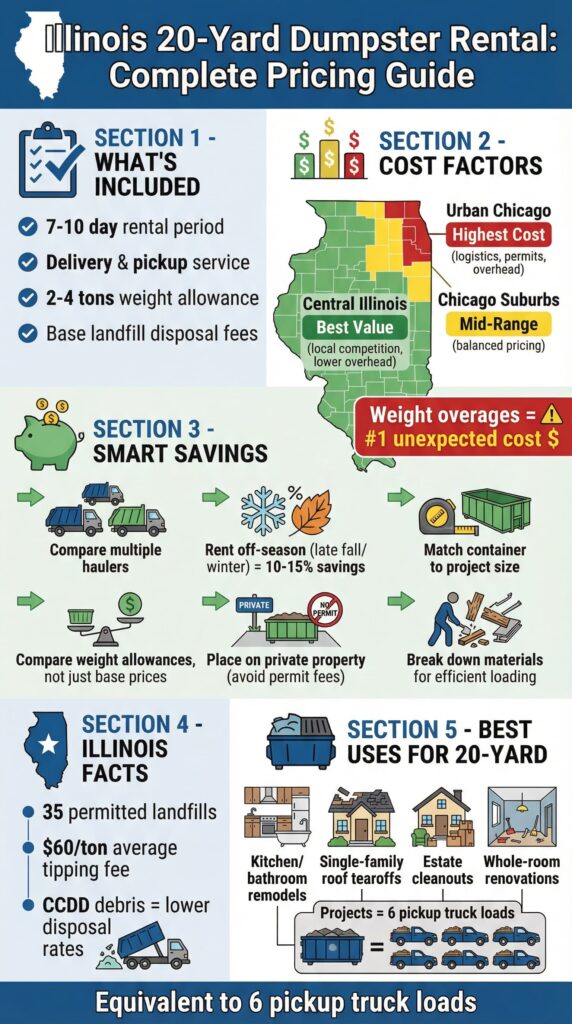
The 20-yard dumpster represents the most versatile container size for Illinois contractors managing mid-scale construction projects, whole-room renovations, and estate cleanouts. This intermediate size holds approximately 20 cubic yards of material—equivalent to six pickup truck loads or 110–130 large trash bags—making it ideal for projects that generate substantial debris without requiring the largest available containers.[1]
Illinois dumpster pricing operates within a competitive market where costs vary significantly by region, hauler, and service model. Contractors in Chicago’s metropolitan area typically pay $400–$800 for a standard 7-day rental, while Central Illinois markets like Peoria offer more competitive rates between $326–$525.[2] These regional differences reflect variations in landfill tipping fees, transportation costs, and local market competition among waste haulers.
The state’s waste management infrastructure includes 35 permitted landfills that collectively accepted more than 46 million cubic yards of solid waste during 2024.[3] This extensive disposal capacity helps keep Illinois pricing competitive compared to states with limited landfill availability, though contractors still face significant cost variations based on their specific project location and timing.
Understanding the components that make up your total rental cost empowers contractors to make informed decisions about dumpster sizing, timing, and service selection. Most Illinois haulers structure pricing around three primary elements: base rental fees (covering container delivery, placement, and pickup), weight allowances (typically 2–4 tons for 20-yard units), and disposal charges (landfill tipping fees ranging from $40–$70 per ton).[4] Additional costs may include permit fees for street placement, extension charges for rentals beyond the standard period, and overage fees when project debris exceeds included weight limits.
Regional Price Variations Across Illinois Markets
Chicago Metropolitan Area Pricing Structure
Chicago and surrounding suburbs command the state’s highest dumpster rental rates, reflecting dense urban logistics challenges, premium real estate costs, and elevated labor expenses. Contractors working in Cook County and collar counties should budget $420–$800 for a standard 20-yard rental, with pricing influenced by neighborhood accessibility, street parking restrictions, and permit requirements.[5] The Chicago market also features the most aggressive hauler competition, creating opportunities for contractors who compare multiple sourcing options.
Suburban markets surrounding Chicago—including Aurora, Naperville, Joliet, and Elgin—typically offer moderate pricing between $400–$650 for comparable services. These areas balance urban convenience with lower overhead costs, making them attractive for contractors managing projects across multiple metropolitan municipalities. The key pricing advantage in suburban locations comes from easier jobsite access and fewer permit complications that add hidden costs to downtown Chicago placements.
Central Illinois Cost Advantages
Peoria, Springfield, Bloomington-Normal, and surrounding Central Illinois markets provide contractors with significantly lower baseline costs compared to metropolitan Chicago. Peoria contractors typically secure 20-yard rentals for $326–$525, representing potential savings of $100–$300 per container compared to Chicago pricing—a meaningful margin difference for contractors managing multiple simultaneous projects.[6]
These cost advantages stem from several market factors: lower transportation costs to nearby landfills, reduced urban congestion affecting delivery logistics, and strong competition among locally-owned haulers serving the region. Contractors working in Tazewell, Woodford, and Fulton counties benefit from proximity to multiple disposal facilities, creating competitive pressure that keeps pricing reasonable even during peak construction seasons.
Central Illinois also offers contractors more flexibility in container placement and scheduling. Rural and semi-rural jobsites rarely require street permits, eliminating the $50–$200 permit fees common in urban markets—another direct cost savings that improves project budgets. The region’s less congested roadways also enable more precise delivery windows, reducing the risk of trip charges when timing conflicts arise.
Southern and Northern Illinois Market Differences
Southern Illinois markets around Carbondale, Marion, and the Metro East St. Louis area present unique pricing dynamics influenced by proximity to Missouri competition and lower population density. Contractors in these regions often see pricing between $350–$600 for 20-yard rentals, though limited hauler options in rural counties sometimes create availability challenges that push rates higher during busy seasons.[7]
Northern Illinois markets outside the Chicago metropolitan area—including Rockford, DeKalb, and the Quad Cities region—typically mirror Central Illinois pricing patterns with 20-yard costs ranging from $375–$550. These markets benefit from strong regional competition and accessibility to multiple landfills spanning Illinois and Iowa, creating pricing pressure that favors contractor budgets.
| Illinois Region | Typical 20-Yard Cost Range | Key Pricing Factors |
|---|---|---|
| Chicago Metro | $420–$800 | Urban logistics, permit costs, high demand |
| Chicago Suburbs | $400–$650 | Moderate access, suburban infrastructure |
| Central Illinois (Peoria) | $326–$525 | Strong local competition, lower overhead |
| Northern Illinois | $375–$550 | Regional competition, multi-state landfill access |
| Southern Illinois | $350–$600 | Limited haulers, rural logistics, Missouri proximity |
Cost Factors That Impact Your Final Bill
Base Rental Rates and What They Include
Most Illinois haulers advertise flat-rate pricing that bundles several service components into a single quoted price. These base rates typically include container delivery to your jobsite, a standard rental period (usually 7–10 days), and one scheduled pickup when your project concludes—providing contractors with predictable baseline costs for budgeting purposes.[8] Understanding exactly what your base rate covers prevents surprise charges that erode profit margins on competitive bids.
However, contractors must carefully review what weight allowance comes included with base pricing. Most 20-yard rentals include 2–4 tons of debris disposal, though this varies significantly between haulers and pricing tiers. A rental quoted at $450 with a 3-ton allowance offers better value than a $400 rental with only 2 tons included when your construction debris predictably exceeds lighter thresholds. Calculating your project’s estimated tonnage before sourcing containers helps identify which quoted price delivers the best actual value.
Illinois haulers also include local landfill disposal fees within base rates, though these charges vary by facility. The Illinois Environmental Protection Agency reports that landfill operators pay volume-based fees to the state, and these regulatory costs ultimately flow through to contractors via disposal charges incorporated into rental pricing.[9] Contractors working on projects generating clean construction debris often secure better rates than those disposing of mixed waste streams requiring additional sorting and processing.
Weight Limits and Tonnage Overage Charges
Weight limits represent the most common source of unexpected cost overruns for contractors unfamiliar with dumpster rental economics. Twenty-yard containers typically include 2–4 tons (4,000–8,000 pounds) of disposal capacity within base pricing, but construction materials vary dramatically in density—creating situations where a half-full container exceeds weight limits while a completely full unit stays within allowances.[10]
Illinois haulers typically charge $40–$70 per ton for weight overages beyond included limits, reflecting current landfill tipping fees that average around $60 per ton nationwide.[11] These overage charges compound quickly on heavier debris types like roofing shingles, concrete fragments, drywall, and dirt. A single-family roofing tearoff generating 4 tons of shingle waste on a rental with a 2-ton allowance creates an additional $120–$140 in unexpected costs that contractors absorb unless properly factored into project bids.
Smart contractors estimate project weight before container delivery by calculating cubic yardage and applying material-specific density factors. Asphalt shingles average 750 pounds per cubic yard, while mixed construction debris typically weighs 400–600 pounds per cubic yard.[12] By matching container size and weight allowance to actual project requirements, contractors avoid both overage penalties and the inefficiency of ordering oversized containers that tie up unnecessary capital.
Rental Duration and Extension Fees
Standard Illinois rental periods range from 7–10 days depending on hauler policies and regional market norms. Most contractors find this window sufficient for typical renovation projects, but complex jobs with phased demolition or weather delays often require extensions beyond initial rental agreements. Extension fees typically add $5–$20 per day beyond the included period, making it cost-effective to accurately estimate project timelines during the initial sourcing process.[13]
Contractors managing large commercial projects or multi-phase residential renovations should discuss extended rental options upfront rather than assuming per-day extension rates will remain economical over weeks or months. Some Illinois haulers offer monthly rental rates that provide better value for longer-term placements compared to daily extension charges. For example, a 30-day rental negotiated at $600 delivers better economics than a 7-day rental at $450 plus 23 days of $15 extensions totaling $795.
Debris Type and Material Restrictions
The type of material you’re disposing significantly impacts both base pricing and potential additional charges. Standard household junk, general construction debris, and non-heavy materials typically qualify for standard pricing tiers. However, heavy materials like concrete, brick, asphalt, soil, and roofing shingles often require specialized “low-boy” dumpsters with lower weight capacities to avoid vehicle safety issues and excessive overage fees—sometimes commanding 20–30% premium pricing over standard units.[14]
Illinois regulations prohibit certain materials from standard dumpster disposal, including hazardous waste, liquids, batteries, tires, appliances containing refrigerants, and electronic waste. Contractors who inadvertently load prohibited materials face contamination fees typically ranging from $100–$500 per violation, plus costs to properly dispose of flagged materials through appropriate channels.[15] Understanding Illinois-specific restrictions before container delivery prevents costly compliance issues that damage relationships with haulers and delay project completion.
Compare Local Hauler Options in Peoria
Zap Dumpsters sources 20-yard containers from multiple trusted haulers across Central Illinois, helping contractors find the best available pricing and scheduling for your project timeline.
Call (309) 650-8954 for same-day sourcing and transparent cost comparisons.
Coordinating availability, compare pricing, and arrange logistics—you focus on completing quality work.
Smart Sourcing Strategies for Cost-Conscious Contractors
Working with Dumpster Sourcing Services
The traditional model of calling individual haulers to compare pricing consumes valuable time that contractors could spend managing jobsites and closing new business. Dumpster sourcing services streamline this process by maintaining relationships with multiple local haulers and coordinating availability across provider networks—delivering competitive pricing without the administrative burden of evaluating numerous individual companies.[16]
Sourcing services like Zap Dumpsters in Peoria operate as matchmaking intermediaries that connect contractors with appropriate hauling partners based on project requirements, timeline, and budget constraints. This model provides several advantages: access to real-time availability across multiple fleets, competitive pricing pressure from hauler competition, and simplified logistics coordination through a single point of contact.
Contractors benefit from sourcing services particularly during high-demand periods when individual haulers may be fully booked or charging premium rates. A sourcing service with relationships across 5–10 local haulers can identify available inventory and competitive pricing that individual contractors might never discover through direct research—often securing containers for projects that would otherwise face delays waiting for hauler availability.
Timing Your Rental for Maximum Value
Illinois construction activity follows seasonal patterns that create predictable demand cycles affecting both pricing and availability. Spring and summer months generate peak demand as homeowners schedule renovations and contractors manage outdoor work before winter weather arrives. Contractors who can schedule non-urgent projects during shoulder seasons (late fall, early spring) or winter months often negotiate 10–15% better pricing compared to peak summer rates—meaningful savings on multiple container rentals across a busy year.[17]
Weather considerations also impact timing decisions in Illinois. Winter rentals avoid some peak-season premiums but introduce challenges with frozen ground, snow accumulation in containers, and potential delivery complications during severe weather. Contractors should weigh potential cost savings against operational efficiency impacts when deciding whether off-season scheduling makes sense for specific project types.
Maximizing Your Weight Allowance
Understanding how to load containers efficiently prevents weight overages while maximizing the debris volume you can dispose within base pricing limits. Break down bulky materials before loading—crushed drywall occupies less space than full sheets, and dismantled furniture loads more efficiently than whole pieces—allowing contractors to fit more material within the same cubic yardage.[18] This approach is especially valuable when working within fixed weight allowances on projects generating lighter-density waste.
For projects mixing heavy and light materials, strategic container selection prevents overage penalties. Instead of combining concrete debris with general construction waste in a single 20-yard unit, contractors can source a 10-yard container specifically for heavy materials (maximizing the lower weight limit of smaller units) and a 20-yard for lighter debris—often achieving better total economics than overage fees on a mixed-load container.
Cost Comparison: 20-Yard vs Other Container Sizes
Contractors frequently debate whether a 20-yard container offers better value than smaller 10–15-yard units or larger 30-yard alternatives. The 20-yard size typically provides the best per-cubic-yard cost efficiency, falling into a pricing sweet spot where economies of scale reduce per-volume costs compared to smaller units while avoiding the premium pricing attached to the largest available containers.[19]
A 10-yard dumpster in Peoria averages $250–$400, delivering 10 cubic yards of capacity—effectively $25–$40 per cubic yard. The 20-yard container at $326–$525 provides 20 cubic yards at $16–$26 per cubic yard. This 35–40% reduction in per-volume costs makes the 20-yard size economically attractive even when projects might physically fit in smaller containers. For contractors managing renovation work, kitchen remodels, or estate cleanouts, the additional capacity provides valuable buffer space that prevents mid-project container swaps that add $100–$200 in extra delivery and disposal charges.[20]
Conversely, 30-yard and 40-yard containers command premium pricing ($500–$800+) that makes them cost-effective only for projects genuinely requiring massive capacity—major commercial renovations, whole-house demolitions, or large-scale roofing jobs on multi-unit properties. The 20-yard size handles most contractor scenarios without the space, weight, and cost challenges of oversized equipment.
| Container Size | Peoria Price Range | Cost Per Cubic Yard | Best Use Cases |
|---|---|---|---|
| 10-Yard | $250–$400 | $25–$40 | Small cleanouts, minor repairs, heavy debris |
| 15-Yard | $300–$475 | $20–$32 | Medium cleanouts, bathroom remodels, flooring projects |
| 20-Yard | $326–$525 | $16–$26 | Kitchen remodels, estate cleanouts, roofing tearoffs |
| 30-Yard | $500–$700 | $17–$23 | Whole-home renovations, large commercial projects |
| 40-Yard | $600–$850 | $15–$21 | Major demolitions, multi-unit properties, large-scale construction |
Mini Case Study: Kitchen Remodel in East Peoria
A contractor managed a complete kitchen gut including cabinet removal, countertop demolition, and flooring tearout. Initial estimates suggested a 15-yard container might suffice, but the contractor sourced a 20-yard unit for $450—only $75 more than the quoted 15-yard price. The additional capacity prevented a mid-project second delivery that would have cost $400, saving $325 in total project costs.
Mini Case Study: Multi-Property Roofing Project
A roofing contractor bid on three adjacent townhomes requiring shingle replacement. By coordinating projects and sourcing a single strategically-placed 20-yard container for $475 instead of three separate 10-yard units at $350 each ($1,050 total), the contractor saved $575 while maintaining efficient workflow across all three properties.
Hidden Fees and How to Avoid Them
Even contractors experienced with dumpster rentals occasionally encounter unexpected charges that inflate final bills beyond initial quotes. Understanding common fee triggers helps you negotiate clear agreements upfront and avoid costly surprises during project execution. The most frequent hidden charges involve trip fees when delivery access is blocked, contamination penalties for prohibited materials, and administrative fees some haulers add without clear disclosure during initial quoting.[21]
Trip fees typically range from $75–$150 and apply when haulers cannot complete scheduled deliveries or pickups due to site conditions. Common triggers include vehicles blocking access paths, insufficient overhead clearance that prevents safe container placement, or locked gates preventing entry on scheduled service days. Contractors can eliminate trip fees by conducting pre-delivery site inspections, ensuring 60 feet of straight-line access for delivery trucks, and providing accurate placement instructions when coordinating logistics.
Permit fees represent another commonly overlooked cost that varies dramatically by Illinois municipality. Chicago charges $50–$100 for right-of-way permits when dumpsters must occupy street parking, while many suburban and rural areas waive permit requirements for containers placed entirely on private property.[22] Contractors should verify local permit requirements before finalizing placement plans and factor permit costs into project budgets rather than treating them as unexpected expenses.
For more details on container capacity and selecting appropriate sizes, contractors should review guidance on typical projects requiring 20-yard dumpsters to ensure optimal sizing for specific work scopes.
Illinois-Specific Regulatory Considerations
Illinois contractors must navigate state-level waste management regulations that affect both dumpster costs and disposal procedures. The Illinois Environmental Protection Agency maintains comprehensive oversight of the state’s 35 permitted municipal waste landfills through volume-based fee structures and quarterly reporting requirements that landfill operators must satisfy.[23] These regulatory compliance costs ultimately flow through to contractors via disposal fees incorporated into rental pricing.
The state’s solid waste tipping fee system requires landfill operators to pay fees based on waste volume received, with rates varying by facility size and waste quantities. Facilities receiving more than 150,000 cubic yards annually can measure waste by volume or weight when calculating fee obligations—a flexibility that creates slight pricing variations between disposal sites across different Illinois regions.[24] Contractors benefit from understanding these regulatory structures because they explain why disposal costs differ between Central Illinois and Chicago-area facilities even when base operational expenses appear similar.
Illinois also maintains specific regulations regarding construction and demolition debris that contractors must follow when sourcing containers. Clean construction and demolition debris (CCDD)—consisting of uncontaminated concrete, brick, stone, and similar materials—qualifies for different handling and potentially lower disposal costs compared to mixed construction waste containing wood, metals, and plastics.[25] Contractors who separate clean CCDD from mixed debris can sometimes negotiate better disposal rates by directing materials to specialized facilities rather than general municipal landfills.
Conclusion
Illinois contractors managing mid-scale construction projects find excellent value in 20-yard dumpster rentals when they understand regional pricing variations, weight limit economics, and sourcing strategies that deliver competitive rates. With costs ranging from $326 in Central Illinois markets like Peoria to $800 in premium Chicago locations, knowing how to evaluate quotes and maximize included allowances directly impacts project profitability across your annual work volume.
Smart contractors source through matchmaking services that coordinate availability across multiple local haulers, compare pricing transparently, and handle logistics coordination—freeing valuable time for managing jobsites and growing business relationships. By understanding tonnage economics, timing rentals strategically, and avoiding common fee triggers, you control one of construction’s most predictable yet frequently mismanaged expense categories.
Whether you’re managing kitchen renovations, roofing tearoffs, or estate cleanouts across Illinois communities, the 20-yard container delivers the capacity and cost efficiency that makes projects profitable without sacrificing operational flexibility.
Source Your Next 20-Yard Container Through Zap Dumpsters
We coordinate with trusted haulers across Peoria, Woodford County, Tazewell County, and Fulton County to find competitive pricing and available inventory for your project timeline.
Call (309) 650-8954 for transparent pricing comparisons and same-day coordination.
Local sourcing service—we match you with the right hauler without markup or commission fees.
20 Yard Dumpster Rental Cost Illinois FAQs
What’s the average cost to rent a 20-yard dumpster in Illinois?
Twenty-yard dumpster rentals in Illinois typically cost between $350 and $800, with significant regional variation. Chicago metropolitan area pricing runs $420–$800 for standard 7-day rentals, while Central Illinois markets like Peoria offer more competitive rates between $326–$525. Your final cost depends on location, rental duration, debris type, and weight allowances included in base pricing. Most Illinois haulers include delivery, pickup, and 2–4 tons of disposal within quoted rates.
How long can I keep a 20-yard dumpster in Illinois?
Standard rental periods in Illinois range from 7 to 10 days depending on hauler policies and regional market norms. Most contractors find this window sufficient for typical renovation projects, bathroom remodels, and roofing tearoffs. Extension fees typically add $5–$20 per day beyond the included period when projects require additional time. Contractors managing complex jobs should discuss extended rental options upfront, as some haulers offer monthly rates that provide better economics than daily extension charges.
Do I need a permit for a 20-yard dumpster in Illinois?
Permit requirements vary by municipality throughout Illinois. Contractors can place dumpsters on private property without permits in most jurisdictions, provided the placement complies with local setback requirements and homeowner association rules. Street placement typically requires right-of-way permits ranging from $50–$100 in urban areas like Chicago, while many suburban and rural communities waive permit fees entirely. Contact your local public works department to verify specific requirements before container delivery to avoid citation fees.
What materials can I put in a 20-yard dumpster in Illinois?
Twenty-yard dumpsters accept most standard construction debris including lumber, drywall, flooring materials, cabinets, fixtures, roofing shingles, concrete, brick, and general household junk from cleanouts. Illinois regulations prohibit hazardous waste, liquids, batteries, tires, appliances containing refrigerants, electronic waste, and certain other materials from standard dumpster disposal. Contractors who load prohibited materials face contamination fees typically ranging from $100–$500 per violation plus proper disposal costs through appropriate channels.
How much weight can a 20-yard dumpster hold in Illinois?
Most 20-yard dumpster rentals in Illinois include 2–4 tons (4,000–8,000 pounds) of debris disposal within base pricing, though exact allowances vary between haulers and pricing tiers. Construction materials vary dramatically in density—asphalt shingles average 750 pounds per cubic yard while mixed debris typically weighs 400–600 pounds per cubic yard. Illinois haulers charge $40–$70 per ton for weight overages beyond included limits, making it critical to estimate project tonnage accurately before container delivery to avoid unexpected charges.
20 Yard Dumpster Rental Cost Illinois Citations
[1] Republic Services, “Residential Dumpster Rental,” accessed December 2024, https://www.republicservices.com/residents/dumpster-rental
[2] Dumpsters.com, “Rent a Dumpster in Peoria, IL,” accessed December 2024, https://www.dumpsters.com/service-area/peoria-il
[3] Illinois Environmental Protection Agency, “2024 Landfill Capacity Report,” accessed December 2024, https://epa.illinois.gov/topics/waste-management/landfills/landfill-capacity/2024.html
[4] HomeGuide, “2025 Dumpster Rental Prices,” accessed December 2024, https://homeguide.com/costs/dumpster-rental-prices
[5] Brackenbox, “20 Yard Dumpster Rental in Chicago, IL,” accessed December 2024, https://brackenbox.com/20-yard-dumpster-rental
[6] ZTERS, “Dumpster Rental in Peoria, IL,” accessed December 2024, https://www.zters.com/dumpster-rental/peoria-il
[7] Budget Dumpster, “Roll Off Dumpster Rentals in Illinois,” accessed December 2024, https://www.budgetdumpster.com/illinois-dumpster-rental.php
[8] Bin There Dump That, “20 Yard Dumpster Rental,” accessed December 2024, https://chicagoland.bintheredumpthatusa.com/20-yard-dumpster-chicagoland
[9] Illinois Environmental Protection Agency, “Landfill Tipping Fees,” accessed December 2024, https://epa.illinois.gov/topics/forms/fees/landill-tipping.html
[10] Trash Daddy Dumpsters, “Dumpster Rental Peoria, IL,” accessed December 2024, https://trashdaddydumpsters.com/dumpster-rentals-illinois/peoria/
[11] Waste Optima, “2024 Landfill Tipping Fees,” accessed December 2024, https://www.wasteoptima.com/blog/eref-2024-landfill-tipping-fees
[12] Budget Dumpster, “20 Yard Dumpster Sizes,” accessed December 2024, https://www.budgetdumpster.com/budget-dumpster-sizes/twenty-yard-dumpster.php
[13] DDT Dumpster, “20-Yard Dumpster Rental in Illinois,” accessed December 2024, https://ddtdumpster.com/our-dumpsters/20-yard-dumpster-rental/
[14] SBC Waste Solutions, “Dumpster Rental Prices Near Me,” accessed December 2024, https://www.sbcwastesolutions.com/what-is-the-price-of-a-dumpster-rental-near-me/
[15] Homewood Disposal Service, “Dumpster Rental For Home,” accessed December 2024, https://mydisposal.com/residential/dumpsters/
[16] Discount Dumpster, “20 Yard Dumpster Rental in Chicago,” accessed December 2024, https://discountdumpsterco.com/locations/chicago/20-yard-dumpster-rental-in-chicago/
[17] Tri-State Disposal, “20-Yard Roll-Off Dumpster Rentals,” accessed December 2024, https://tri-statedisposal.com/dumpster-rental/20-yard/
[18] Waste Management, “Dumpster Rental in Peoria, IL,” accessed December 2024, https://www.wm.com/us/en/location/il/peoria/dumpster-rental-peoria-il
[19] Dumpsters.com, “Dumpster Rental Prices in Chicago, IL,” accessed December 2024, https://www.dumpsters.com/service-area/chicago-il
[20] Heartland Recycling Services, “Dumpster Rental – Peoria, Illinois,” accessed December 2024, https://www.heartlandrecyclingservices.com/peoria-il-dumpster-rental-illinois/
[21] BigRentz, “Roll Off Dumpster Rentals – Peoria, IL,” accessed December 2024, https://www.bigrentz.com/rental-locations/illinois/peoria/dumpsters
[22] Budget Dumpster, “Roll Off Dumpster Rentals in Peoria, IL,” accessed December 2024, https://www.budgetdumpster.com/peoria-il-dumpster-rental-illinois.php
[23] Illinois Environmental Protection Agency, “Non Hazardous Waste,” accessed December 2024, https://epa.illinois.gov/topics/waste-management/waste-disposal/non-hazardous-waste.html
[24] Illinois Environmental Protection Agency, “Instructions for Payment of the Solid Waste Management Fee,” accessed December 2024, https://epa.illinois.gov/content/dam/soi/en/web/epa/documents/epa-forms/land/waste-management/swm-fee-instructions.pdf
[25] Illinois Environmental Protection Agency, “Waste Disposal,” accessed December 2024, https://epa.illinois.gov/topics/waste-management/waste-disposal.html