
Key Takeaways
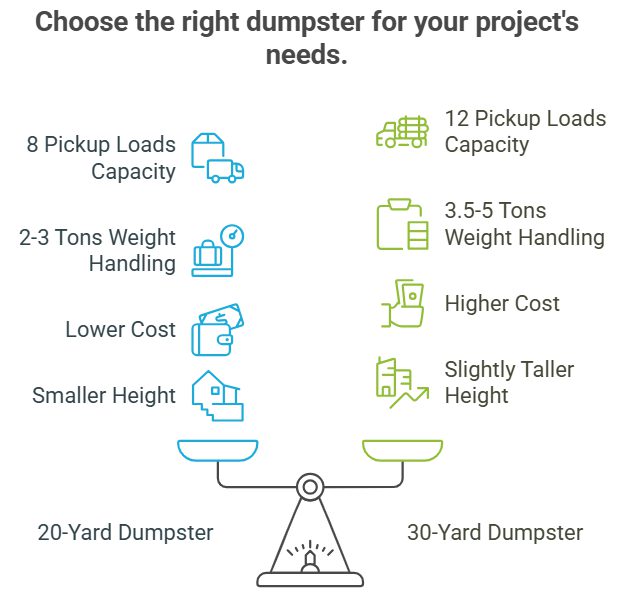
- 20-yard dumpsters hold 8 pickup loads and handle 2-3 tons, ideal for medium residential projects like single-room remodels and roof replacements
- 30-yard dumpsters hold 12 pickup loads and handle 3.5-5 tons, designed for large-scale renovations, new construction, and commercial cleanouts
- Cost difference averages $100-$200 more for 30-yard units, but prevents costly multiple hauls or overage fees on big jobs
- Space requirements differ by only 1.5 feet in height—both need 22 feet length and 60 feet approach clearance
- Weight limits matter more than volume for heavy debris like concrete, drywall, or roofing materials
Article Summary
Choosing between a 20-yard and 30-yard dumpster depends on your project scale, debris type, and available space. A 20-yard works best for medium residential jobs generating moderate waste, while a 30-yard handles large renovations or commercial projects with heavy debris volumes. Understanding capacity, weight limits, placement needs, and cost differences helps contractors avoid mid-project delays and expensive overage fees.
Understanding Dumpster Size Differences
The choice between a 20-yard and 30-yard dumpster impacts project efficiency, budget, and timeline. Contractors working in Peoria need to match container size to debris volume and type, not just estimate space needs.
A 20-yard dumpster measures approximately 22 feet long, 7.5 feet wide, and 4.5 feet high. This translates to about 8 pickup truck loads or 120 large trash bags. The typical weight capacity ranges from 2-3 tons (4,000-6,000 pounds), making it the most popular choice for residential contractors handling kitchen remodels, bathroom upgrades, or roof tear-offs.
A 30-yard dumpster maintains similar length and width at 22 feet by 7.5-8 feet but stands 6 feet tall. That extra 1.5 feet of height adds substantial capacity—roughly 12 pickup loads or 170-190 trash bags. Weight limits increase to 3.5-5 tons (7,000-10,000 pounds), accommodating heavier construction debris without triggering overage fees.
The volume difference matters for bulky materials. While both sizes share the same footprint length, the 30-yard’s additional height means you can stack demolished cabinets, bathtubs, or large drywall sections without reaching the fill line. This prevents the need for careful Tetris-style loading that smaller containers require.
Volume Capacity and Real-World Applications
Volume capacity determines how much physical space your debris occupies, separate from weight considerations. A 20-yard container holds 20 cubic yards—enough for most single-room renovations or moderate garage cleanouts. Contractors removing old kitchen cabinets, countertops, and flooring from a 200-square-foot space typically fill a 20-yard dumpster to about 70-80% capacity.
The 30-yard container’s 30 cubic yards accommodates full-home remodels or multi-room demolition projects. When gutting a 1,200-square-foot ranch home down to studs, contractors generate approximately 25-28 cubic yards of debris including drywall, flooring, trim, and fixtures. A 30-yard dumpster handles this volume in one haul, while a 20-yard would require an empty-and-return service or second rental.
For roofing projects, the calculation changes based on layers. A standard 2,000-square-foot roof with single-layer asphalt shingles generates roughly 3-4 tons and fits comfortably in a 20-yard dumpster. If you’re tearing off two layers from the same roof, you’re looking at 6-8 tons—now you need a 30-yard to stay within weight limits and avoid overflow.
Weight Limits vs Volume Capacity
Weight restrictions create the most confusion for first-time renters. A dumpster might have plenty of empty space but still exceed its weight limit if filled with dense materials. This distinction between volume capacity and weight capacity determines whether you face surprise overage fees.
Heavy materials like concrete, brick, tile, or dirt quickly max out weight limits before filling volume. A 20-yard dumpster loaded with broken concrete from a patio demolition might only be 30% full by volume but already at its 3-ton weight limit. In these scenarios, contractors should request multiple smaller 10-yard dumpsters designated for heavy debris rather than one undersized 20-yard.
Light materials like wooden framing, cardboard, or furniture create the opposite problem. You’ll fill a 20-yard dumpster to capacity by volume while staying well under weight limits. This makes 20-yard containers cost-effective for remodeling projects with lots of bulk but lighter debris.
Understanding this balance helps contractors avoid two common mistakes: renting too small and paying overage fees, or renting too large and wasting money on unused capacity.
20-Yard Dumpster: Detailed Pros and Cons
The 20-yard dumpster serves as the industry workhorse for residential contractors. It balances size, capacity, and cost for most medium-scale projects without requiring excessive driveway space or special placement permits.
Advantages of 20-Yard Containers
Cost efficiency drives most contractors toward 20-yard rentals for standard jobs. In Peoria, Illinois, 20-yard dumpster rentals typically range from $400-$600 for a 7-10 day rental period, depending on debris type and included weight allowance. This price point fits comfortably within most residential project budgets while providing adequate capacity for single-room remodels.
Versatility across project types makes 20-yard dumpsters the go-to choice for general contractors. Kitchen renovations generate 12-18 cubic yards of debris when removing cabinets, countertops, appliances, and flooring. Bathroom remodels produce 8-12 cubic yards including tile, vanities, and fixtures. Both scenarios fit well within a 20-yard capacity with room for unexpected additions.
Placement flexibility becomes critical in residential neighborhoods with tight driveways or street parking restrictions. The 22-foot length and 4.5-foot height fit most standard driveways without blocking garage access or extending into the street. This often eliminates permit requirements that larger containers trigger when occupying public right-of-way.
Accessibility for manual loading makes the 4.5-foot height manageable for contractors working without equipment. Tossing debris over the side remains physically reasonable for healthy workers, unlike the 6-foot walls of larger containers that require step stools or ramps for efficient loading.
Many Peoria-area services that help you source and compare local dumpster providers, like <a href=”https://zapdumpsterspeoria.com/roll-off-rentals/20-yard/”>20-yard dumpster coordination services</a>, can match you with haulers offering competitive rates and flexible terms for residential projects.
Limitations of 20-Yard Containers
Insufficient capacity for large projects creates the primary drawback. Whole-home renovations, complete roof replacements with multiple layers, or full basement cleanouts generate 25-35 cubic yards of debris—requiring either an empty-and-return service or a second rental. The added coordination and pickup fees often exceed the cost difference of choosing a 30-yard initially.
Weight limit concerns with heavy materials cause frequent problems for contractors unfamiliar with debris density. A 20-yard dumpster filled halfway with asphalt shingles can already reach its 3-ton weight limit. Concrete, brick, and tile create even worse scenarios. The result? Either remove material before pickup (wasting labor time) or pay $75-$100 per ton in overage fees.
Potential for inefficient use on borderline projects happens when contractors underestimate volume. A home with moderate hoarding conditions might appear to need only a 20-yard, but actual cleanout reveals 22-24 cubic yards of debris. Now you’re loading carefully, crushing items to maximize space, and still ending up with overflow piles. The time spent managing space often costs more than upgrading to a 30-yard from the start.
Limited accommodation for bulky items forces creative loading. Large items like sectional sofas, king-sized mattresses, or commercial refrigerators consume significant volume without breaking down. While they fit in a 20-yard dumpster, you’re left with less space for the remaining debris. Contractors dealing with multiple bulky items fare better with a 30-yard’s additional height.
Ready to Compare Local Options?
Whether you need a 20-yard or 30-yard dumpster, we help match you with trusted local haulers serving Peoria contractors. Get competitive quotes, flexible scheduling, and expert guidance on the right size for your project.
Call now: (309) 650-8954
Serving Peoria, IL and surrounding areas • 7-day rental periods • Competitive pricing
30-Yard Dumpster: Detailed Pros and Cons
The 30-yard dumpster serves contractors handling large-scale residential projects, new construction, or commercial renovations. This size eliminates the mid-project rental extension or second container that often derails timelines.
Advantages of 30-Yard Containers
High volume capacity eliminates the guesswork on borderline projects. When demolishing a full home interior including walls, flooring, cabinetry, and fixtures, debris volumes easily reach 28-32 cubic yards. A 30-yard dumpster handles this in one haul, keeping your job site clean and avoiding the logistics of coordinating multiple pickups.
Increased weight allowance provides critical breathing room for heavy debris. The 3.5-5 ton capacity (7,000-10,000 pounds) accommodates mixed loads of drywall, tile, and framing lumber without constant weight monitoring. For contractors doing combination projects—like a kitchen demo that includes removing a tile floor, plaster walls, and granite countertops—this extra tonnage prevents expensive overage fees.
Efficiency for time-sensitive projects becomes a major advantage on commercial jobs with strict timelines. Restaurant remodels, retail buildouts, or office renovations generate debris constantly over 2-4 weeks. Having a 30-yard container on-site means workers can maintain productivity without waiting for emptied returns or worrying about overflow. Time saved on debris management often exceeds the marginal cost increase over a 20-yard.
Better accommodation of bulky materials makes loading simpler. Large items like commercial HVAC units, multiple bathroom vanities, or sectioned countertops fit without careful Tetris-style arrangement. The 6-foot height allows you to load efficiently and keep moving rather than spending time breaking down items to make them fit.
Limitations of 30-Yard Containers
Higher upfront cost impacts budget-conscious projects. In Peoria, 30-yard dumpster rentals typically range from $550-$750 for a 7-10 day period—roughly $100-$200 more than comparable 20-yard rentals. For smaller contractors working on tight margins, this difference matters when the project only generates 15-18 cubic yards of debris. You’re paying for capacity you won’t use.
Space requirements create placement challenges in residential neighborhoods. While the 22-foot length matches a 20-yard, the 6-foot height demands more vertical clearance. Low-hanging utility lines, tree branches, or residential garage door heights (typically 7 feet) can block placement in preferred locations. Some contractors end up putting 30-yard dumpsters in the street, triggering permit requirements and associated fees.
Risk of underutilization on smaller projects wastes money. A standard single-room remodel might only generate 12-16 cubic yards of debris, leaving a 30-yard container less than 60% full. The cost premium for unused capacity cuts into project profits. Contractors should honestly assess debris volume before defaulting to “bigger is safer.”
Potential for heavier loads exceeding road limits becomes relevant on demolition jobs with dense materials. A 30-yard dumpster filled completely with broken concrete weighs 15-20 tons—well beyond the 5-ton weight limit and potentially exceeding truck hauling capacity. While overage fees apply to reasonable overages, extreme weight situations can delay pickup while haulers arrange specialized equipment.
Understanding these trade-offs helps contractors select the right size based on project specifics rather than defaulting to one size for all jobs.
Direct Comparison: When to Choose Each Size
| Feature | 20-Yard Dumpster | 30-Yard Dumpster |
|---|---|---|
| Dimensions | 22′ L × 7.5′ W × 4.5′ H | 22′ L × 7.5-8′ W × 6′ H |
| Volume Capacity | ~8 pickup loads (120 trash bags) | ~12 pickup loads (180 trash bags) |
| Weight Limit | 2-3 tons (4,000-6,000 lbs) | 3.5-5 tons (7,000-10,000 lbs) |
| Peoria Rental Cost | $400-$600 (7-10 days) | $550-$750 (7-10 days) |
| Best For | Single-room remodels, roof replacements, medium cleanouts | Whole-home renovations, new construction, commercial projects |
| Placement Flexibility | Fits most driveways, rarely needs permits | May require street placement, check clearance |
| Loading Height | 4.5′ (easier manual loading) | 6′ (may need step stool for smaller workers) |
| Ideal Project Size | 200-400 sq ft demo area | 600-1,200 sq ft demo area |
Project-Specific Recommendations
Kitchen remodels typically generate 12-16 cubic yards when removing cabinets, countertops, appliances, flooring, and backsplash. A 20-yard dumpster handles standard kitchen renovations (200-300 square feet) comfortably. If you’re also removing walls, adding new framing, or replacing subflooring, upgrade to a 30-yard to avoid mid-project capacity issues.
Bathroom renovations produce 8-12 cubic yards including tile, vanity, bathtub, toilet, and flooring. A single bathroom remodel fits easily in a 20-yard dumpster with room to spare. Master bathroom remodels with separate shower, soaking tub, and double vanity might push toward 14-16 cubic yards—still manageable in a 20-yard but with less margin for unexpected debris.
Roofing projects depend entirely on square footage and layer count. A 2,000-square-foot single-layer asphalt shingle roof generates approximately 3-4 tons fitting in a 20-yard dumpster. Double-layer tear-offs from the same roof produce 6-8 tons requiring a 30-yard to stay within weight limits. Many Peoria roofing contractors default to 30-yard containers to avoid guessing wrong and facing overage fees.
Whole-home renovations always demand 30-yard containers. Gutting a 1,200-square-foot home down to studs generates 25-32 cubic yards of mixed debris. Even staged renovations (doing kitchen first, then bathrooms, then bedrooms) benefit from a 30-yard’s capacity to handle accumulating debris without constant pickup coordination.
Commercial cleanouts vary widely based on business type. Retail store fixtures and inventory generate substantial volume but lighter weight—fitting well in 30-yard containers. Restaurant equipment, tile, and commercial-grade materials weigh considerably more, sometimes requiring multiple 20-yard containers designated for heavy debris instead of one 30-yard.
New construction sites generate debris differently than remodels. Framing waste consists of lumber cutoffs, packaging materials, and drywall scraps—bulky but relatively light. A 30-yard dumpster serves most single-family home builds through rough framing, with a second container needed for finish work debris.
For contractors looking to understand debris capacity better, check out this <a href=”https://zapdumpsterspeoria.com/20-yard-dumpster-debris-capacity-guide-how-much-can-they-hold/”>guide to 20-yard dumpster debris capacity</a> which breaks down specific material volumes.
Cost Analysis and Budget Planning
The $100-$200 price difference between 20-yard and 30-yard rentals seems straightforward, but total project costs involve additional factors. Understanding these helps contractors make financially sound decisions.
Base rental costs in Peoria for 20-yard dumpsters average $400-$600 depending on included weight allowance and rental duration. Most providers include 2-3 tons in this base price with 7-10 day rental periods. The 30-yard base cost runs $550-$750 with 3.5-5 tons included for the same rental period.
Overage fees quickly erase any savings from choosing a smaller container. Peoria-area haulers typically charge $75-$100 per ton above the included weight limit. If you rent a 20-yard with 3 tons included but generate 4.5 tons of debris, you’ll pay $112-$150 in overage fees. That extra $100-$150 might have covered most of the upgrade to a 30-yard with higher base capacity.
Empty-and-return services cost $150-$250 per additional trip in the Peoria market. Contractors who underestimate volume and fill a 20-yard dumpster halfway through a project face this fee plus coordination delays. Two rounds with a 20-yard (base rental plus empty-and-return) often exceed the single-trip cost of a 30-yard.
Permit fees affect cost when street placement becomes necessary. Peoria requires right-of-way permits for dumpsters blocking sidewalks or occupying street parking. Permit costs range from $20-$75 depending on placement duration. The 30-yard’s additional height sometimes forces street placement where a 20-yard would have fit on the driveway, adding this permit expense.
Time costs matter more than many contractors calculate. A 20-yard dumpster requiring careful loading to maximize space costs 30-45 minutes daily in extra labor compared to a 30-yard where workers simply toss debris without space concerns. Over a 10-day project, that’s 5-7.5 hours of labor—easily worth $150-$300 in crew time at standard contractor rates.
The math works like this: If your project is genuinely borderline (18-22 cubic yards), spending an extra $150 for a 30-yard saves potential overage fees ($112-$150), empty-and-return fees ($150-$250), and lost labor time ($150-$300). The larger container becomes a $150 investment preventing $400-$700 in potential costs.
Practical Loading and Placement Considerations
Efficient loading and proper placement directly impact project workflow, safety, and total costs. Contractors who understand these factors avoid common problems that delay timelines.
Loading Techniques for Maximum Efficiency
Break down bulky items before loading whenever practical. Couches, mattresses, and cabinets consume 2-3 times more space intact versus dismantled. A sectional sofa broken into individual pieces and stacked flat takes up 60% less volume than throwing it in whole. This practice matters more with 20-yard containers where every cubic foot counts.
Load heavy items first at the bottom to create a stable base and prevent shifting during transport. Concrete chunks, tile pieces, and dense materials belong at the dumpster bottom. Lighter materials like cardboard, insulation, and packaging go on top. This distribution keeps loads stable and prevents avalanches when the hauler tilts the container for dumping.
Fill gaps strategically by using smaller debris to pack spaces between larger items. Loose insulation, broken drywall pieces, and packaging materials compress into voids around furniture or fixtures. This technique increases effective capacity by 15-20% compared to haphazard loading.
Respect the fill line marked on container sides. Material piled above this line creates unsafe transport conditions and may result in refused pickup or additional fees. The fill line exists about 6 inches below the top edge—contractors should stop loading when debris reaches this point regardless of remaining volume.
Distribute weight evenly across the container rather than concentrating heavy materials in one area. A dumpster loaded with all concrete at one end and all insulation at the other creates unbalanced weight distribution that complicates hauling. Spread heavy debris throughout the container length for safe transport.
Site Preparation and Placement
Provide adequate clearance for delivery trucks requiring 60 feet of straight-line approach and 23-25 feet of overhead height. Measure from the street to your intended placement spot, checking for low-hanging utility lines, tree branches, or building overhangs. Trucks equipped with hydraulic arms need clear vertical space to safely place and retrieve containers.
Choose firm, level surfaces that support combined dumpster and debris weight (typically 8,000-15,000 pounds fully loaded). Concrete driveways, asphalt parking lots, and compacted gravel work well. Soft ground, grass, or uncompacted dirt can create ruts or allow containers to sink, complicating pickup.
Protect surfaces prone to damage using plywood sheets (¾-inch thickness minimum) under dumpster feet. While most modern dumpsters use rubber feet to minimize damage, the weight can still crack older concrete or damage decorative pavers. Plywood distributes weight more evenly and provides extra protection.
Consider seasonal factors in Illinois weather. Winter placements require checking that snow and ice won’t block truck access or hide ground irregularities. Summer storms can fill open-top dumpsters with rainwater, dramatically increasing weight and potentially triggering overage fees. Cover dumpsters with tarps during predicted rainfall to prevent water accumulation.
Maintain access throughout the rental period by keeping the path to the dumpster clear. Parked vehicles, equipment, or materials blocking access cause pickup delays and potential trip fees when drivers can’t reach the container. This becomes especially critical on tight residential lots or busy commercial sites.
Check local regulations before placement. Peoria requires permits for dumpsters in street right-of-way or blocking sidewalks. HOA communities often have additional restrictions on dumpster placement timing and location. Contractors should verify requirements before delivery to avoid citations or forced repositioning.
Real-World Contractor Scenarios
Actual project examples demonstrate how size selection impacts outcomes, costs, and efficiency for different job types.
Scenario 1: Kitchen Remodel Gone Wrong
A contractor estimated 14 cubic yards for a standard kitchen renovation including cabinet removal, countertop demo, and floor replacement. He rented a 20-yard dumpster figuring he’d have plenty of room. Midway through the project, the homeowner decided to remove a partial wall and expand into an adjacent dining area. Final debris totaled 23 cubic yards. The contractor paid $200 for an empty-and-return service and lost half a day coordinating the second pickup. A 30-yard dumpster would have cost $125 more upfront but eliminated the service call and delay.
Scenario 2: Roofing Project Success
A Peoria roofing crew scheduled a 2,400-square-foot double-layer shingle tear-off. Based on experience with weight limits, they ordered a 30-yard dumpster despite the project appearing to need only 18-20 cubic yards. The actual debris measured 19 cubic yards but weighed 7.2 tons due to old asphalt shingles being denser than expected. The 30-yard’s 5-ton weight allowance triggered $220 in overage fees ($100 per ton for 2.2 tons over), but a 20-yard with 3-ton capacity would have incurred $420 in overages. The larger container saved $200 and avoided potential pickup refusal from weight limits.
Scenario 3: Commercial Cleanout Efficiency
A contractor clearing out a 3,000-square-foot retail space after a tenant departure faced mixed debris—shelving units, display fixtures, old inventory, and minor drywall repairs. Volume appeared manageable for a 20-yard, but bulky metal shelving consumed space inefficiently. The contractor ended up renting two 20-yard dumpsters over three weeks for $1,100 total. A single 30-yard dumpster at $650 for an extended 14-day rental would have served the project better while keeping the site cleaner with one container instead of coordinating two separate deliveries and pickups.
Scenario 4: Bathroom Remodel Budget Win
A small contractor doing a standard bathroom renovation (150 square feet, tub-to-shower conversion, new vanity, tile floor) accurately estimated 9 cubic yards of debris. He rented a 20-yard dumpster at $425 for a 7-day period, finishing the project in 6 days with the container only 45% full. Final weight came in at 1.8 tons, well below the 3-ton limit. A 30-yard would have cost $550—unnecessary expense for a properly sized project. This scenario shows that bigger isn’t always better when volume and weight are accurately predicted.
These examples highlight a pattern: projects with clear scopes and predictable materials benefit from accurately sized 20-yard containers, while projects with uncertainty, heavy materials, or expansion potential justify 30-yard investments to avoid mid-project complications.
Making Your Decision: A Practical Framework
Use this decision framework to select the right size systematically rather than guessing based on rough estimates.
Step 1: Calculate Volume
Measure your demolition area in square feet and multiply by average depth of debris (typically 2-3 feet for floor-to-ceiling demolition). Divide by 27 to convert cubic feet to cubic yards. Add 20% buffer for unexpected items or inefficient loading.
Step 2: Estimate Weight
Categorize your debris by material type and use industry averages: drywall (500 lbs/cubic yard), wood (400 lbs/cubic yard), asphalt shingles (900 lbs/cubic yard), concrete (2,400 lbs/cubic yard). Calculate total estimated weight and compare to container limits.
Step 3: Assess Project Uncertainty
Rate your project on a scale of 1-5 for potential scope changes, hidden conditions, or material unknowns. Projects rating 3 or higher benefit from oversizing by one container level as insurance against mid-project complications.
Step 4: Consider Timeline Pressure
Time-sensitive projects with hard completion deadlines should favor larger containers to prevent delays from coordinating additional pickups or empty-and-return services. Budget-flexible projects with relaxed timelines can optimize costs more aggressively.
Step 5: Calculate Total Cost Scenarios
Price out both options including base rental, estimated overage fees, potential empty-and-return costs, and labor time for careful loading. Compare total costs rather than just base rental prices.
The result of this framework typically shows: standard single-room remodels need 20-yard containers; multi-room projects, commercial work, or heavy debris situations require 30-yard containers; and borderline projects (18-22 cubic yards estimated) benefit from choosing 30-yard to avoid costly mid-project adjustments.
Conclusion
Selecting between 20-yard and 30-yard dumpsters requires matching container capacity to project scope, debris type, and placement constraints. Contractors benefit from 20-yard containers on well-defined single-room remodels, roof replacements, and medium cleanouts where debris volumes stay under 18 cubic yards and weights remain below 2.5 tons. The 30-yard choice serves large-scale renovations, new construction, and commercial projects generating 22+ cubic yards or involving heavy materials likely to approach weight limits.
The $100-$200 price difference between sizes becomes negligible when measured against potential overage fees ($75-$100 per ton), empty-and-return services ($150-$250), and lost labor time from careful space management. Contractors working in competitive Peoria markets protect profit margins by sizing containers correctly the first time, preventing mid-project delays that damage client relationships and timeline commitments.
Understanding volume versus weight, respecting fill lines, and planning placement logistics transform dumpster rental from a simple commodity purchase into a strategic project decision. The right container keeps job sites clean, workers productive, and projects on schedule—goals worth the extra attention to detail when comparing options.
Get Expert Guidance on the Right Container Size
Not sure whether a 20-yard or 30-yard dumpster fits your project? We help connect Peoria contractors with experienced local haulers who can assess your specific needs, provide accurate quotes, and coordinate delivery that works with your timeline. No guesswork—just professional service from start to finish.
Call now for a free consultation: (309) 650-8954
Serving residential and commercial contractors throughout Peoria, IL and surrounding areas
20 Yard vs 30 Yard Dumpster FAQs
Can I switch from a 20-yard to a 30-yard dumpster mid-project?
Yes, most haulers offer empty-and-return services where they pick up your full 20-yard container and deliver a 30-yard as a replacement. This service typically costs $150-$250 plus the price difference between container sizes. You’ll avoid this extra expense by accurately estimating volume before the initial delivery. Contact providers sourcing dumpsters in your area to understand their specific swap policies and fees before starting your project.
How do I know if my debris will exceed weight limits?
Heavy materials like concrete, asphalt, tile, and brick weigh 1,500-2,400 pounds per cubic yard—meaning a 20-yard container filled with these materials could weigh 15-24 tons, far exceeding typical 2-3 ton limits. Light materials like furniture, cardboard, and wood weigh 200-500 pounds per cubic yard, rarely approaching weight limits even when filling containers completely. Mixed loads require calculating each material type separately and adding totals. Industry forums like those found at external contractor resources provide real-world weight examples from experienced professionals dealing with similar projects.
What happens if I fill a 20-yard dumpster above the fill line?
Haulers may refuse to pick up overfilled dumpsters due to DOT road safety regulations prohibiting unsecured loads. You’ll need to remove excess debris bringing the load below the fill line before they’ll transport the container. This costs labor time and creates disposal challenges for the removed material. Some haulers charge trip fees ($75-$125) when they arrive to find non-compliant loads. Keep debris level with or below the painted fill line (typically 6 inches from the top edge) to avoid these problems.
Do 30-yard dumpsters always require street permits in residential areas?
Not always—permit requirements depend on placement location rather than container size. Dumpsters placed entirely on private property like driveways or job sites rarely need permits. If a 30-yard container must occupy street parking, block sidewalks, or extend into public right-of-way due to space constraints, Peoria requires permits costing $20-$75 depending on duration. The 30-yard’s additional height sometimes prevents driveway placement where overhead clearance is limited, forcing street placement that triggers permit requirements.
Is it more economical to rent two 20-yard dumpsters or one 30-yard for a large project?
One 30-yard dumpster typically costs less and provides more efficiency than two 20-yard containers. Two 20-yard rentals at $425 each total $850 versus a single 30-yard at $650—a $200 savings. Beyond cost, managing one container simplifies logistics, reduces delivery coordination, keeps more site space available, and prevents the workflow disruption of switching between containers. The only scenario favoring multiple smaller containers is when separating material types (like keeping clean concrete separate from mixed construction debris) for specialized disposal or recycling purposes.
20 Yard vs 30 Yard Dumpster Citations
[1] Hometown Dumpster Rental. “How Much Weight Can a 20 Yard Dumpster Hold?” 2024. https://www.hometowndumpsterrental.com/blog/how-much-weight-can-a-20-yard-dumpster-hold
[2] Ultimate Dumpsters. “Understanding the Weight Capacity of a 20-Yard Dumpster: How Many Pounds Can it Hold?” July 24, 2024. https://ultimatedumpsters.com/how-many-pounds-does-a-20-yard-dumpster-hold/
[3] Dumpsters.com. “Rent a 20 Yard Dumpster.” https://www.dumpsters.com/sizes/20-yard-dumpster
[4] Fusion Waste. “20 Yard Dumpsters – Dimension, Size, and Rental Costs.” March 12, 2025. https://fusionwaste.com/dumpsters/20-yard/
[5] Dumpsters.com. “30 Yard Dumpster Rental.” https://www.dumpsters.com/sizes/30-yard-dumpster
[6] Fusion Waste. “30 Yard Dumpsters – Dimension, Size, and Rental Costs.” March 12, 2025. https://fusionwaste.com/dumpsters/30-yard/
[7] Hometown Dumpster Rental. “30 Yard Dumpster Guide: Average Costs, Weight Limits, and More.” https://www.hometowndumpsterrental.com/blog/30-yard-dumpster-guide
[8] Ultimate Dumpsters. “20 vs 30 Yard Dumpster: Choosing the Right Size for Your Project.” June 17, 2025. https://ultimatedumpsters.com/what-is-the-difference-between-a-20-and-30-yard-dumpster/
[9] ZTERS. “Dumpster Rental in Peoria, IL.” https://www.zters.com/dumpster-rental/peoria-il
[10] Trash Daddy Dumpster Rentals. “Dumpster Rental Peoria, IL.” September 18, 2025. https://trashdaddydumpsters.com/dumpster-rentals-illinois/peoria/
[11] Dumpsters.com. “Rent a Dumpster in Peoria, IL.” June 5, 2023. https://www.dumpsters.com/service-area/peoria-il
[12] Garage Journal Forums. “Dumpster Rental Tips or Tricks.” https://www.garagejournal.com/forum/threads/dumpster-rental-tips-or-tricks.112350/