
Key Takeaways:
- A 30-yard dumpster holds 9–15 pickup truck loads and works best for whole-house cleanouts, major renovations, and large demolition projects
- Weight limits (2–4 tons typically) matter more than volume—dense materials like concrete trigger overage fees quickly
- Smart loading strategy includes placing heavy items first, breaking down bulky furniture, and never stacking above the top rail
- Peoria contractors should verify permit requirements for street placement ($20 per 30 days) and plan for 60+ feet of access clearance
- Proper planning prevents common mistakes: covering debris during rain, sorting prohibited items, and coordinating pickup timing with project milestones
Article Summary:
A 30-yard dumpster is the ideal choice for contractors managing large residential cleanouts, multi-room renovations, and garage demolitions in Peoria. Strategic loading, weight management, and proper site preparation maximize value and prevent costly overage fees while keeping projects on schedule.
Understanding 30-Yard Dumpster Capacity and Limitations
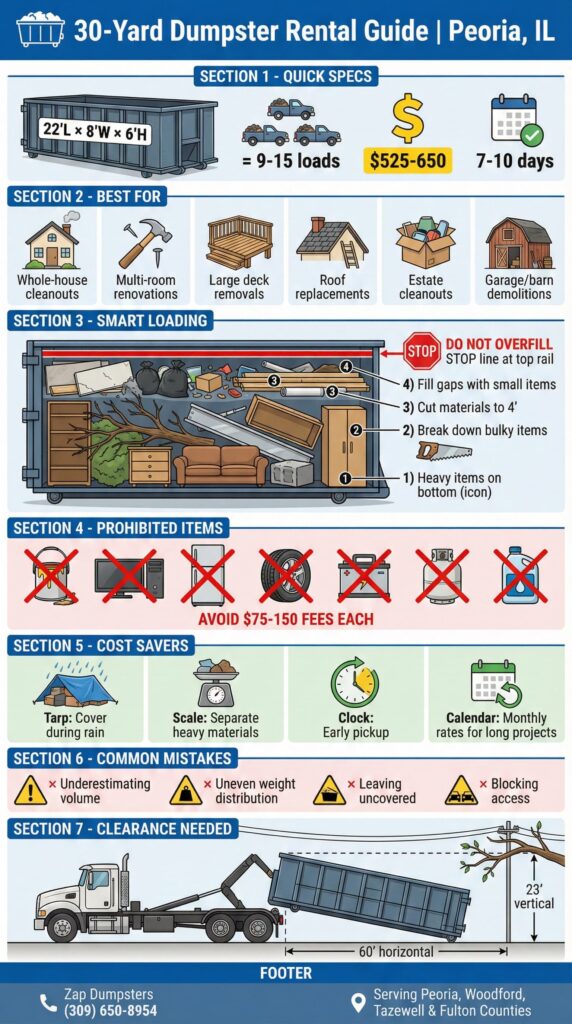
A 30-yard dumpster measures approximately 22 feet long, 8 feet wide, and 6 feet high, providing 30 cubic yards of total volume for waste disposal.[1] This size holds the equivalent of 9–15 standard pickup truck loads depending on debris density and how efficiently you pack the container.[2]
For Peoria contractors working on residential projects, the 30-yard size handles whole-house cleanouts, complete kitchen and bathroom gut jobs, large deck removals, and extensive siding replacements without requiring multiple containers.[3] The capacity accommodates roughly 3,000–5,000 square feet of asphalt shingles from roofing tear-offs, making it the standard choice for residential re-roofing projects.[4]
However, capacity is only half the story. Weight limits drive most overage charges, not volume. Most 30-yard rentals in the Peoria area include 2–4 tons in the base price, with additional tonnage costing $50–$75 per ton beyond the included weight.[5] Dense materials—concrete, brick, dirt, roof shingles—accumulate weight rapidly and can push a half-empty dumpster past its weight threshold.
When you coordinate a 30-yard container in Peoria, clarify the included weight allowance upfront and estimate your debris weight based on material types. This single step prevents surprise charges and helps you select the right size for both volume and weight constraints.
What Fits in a 30-Yard Dumpster
Typical contents for a 30-yard rental include:
- Household cleanout debris: Furniture, mattresses, appliances (without Freon), boxes, and general household junk
- Renovation materials: Drywall, wood framing, cabinets, flooring, carpeting, doors, and trim
- Roofing materials: Asphalt shingles, underlayment, flashing (up to weight limits)
- Light demolition waste: Shed teardowns, deck removals, fence materials, and non-structural demolition debris
Materials that quickly exceed weight limits include concrete slabs, brick pavers, ceramic tile, dirt, and wet drywall. For concrete-heavy projects, contractors in Peoria typically coordinate a 20-yard container to stay within safe weight parameters and avoid transport restrictions.[6]
When a 30-Yard Container Makes Sense
Choose a 30-yard dumpster when your project involves:
- Full-home cleanouts with multiple rooms of furniture and belongings
- Multi-room renovations affecting kitchens, bathrooms, and living spaces simultaneously
- Large garage or barn cleanouts with accumulated equipment and materials
- Residential additions where framing, siding, and roofing debris accumulate quickly
- Estate cleanouts requiring disposal of entire household contents
Smaller projects—single bathroom remodels, basement cleanouts, small deck removals—typically work better with 10-yard or 20-yard containers that cost less and prevent you from paying for unused capacity.[7]
Critical Planning Steps Before Your Rental Arrives
Contractors who plan placement, access, and site preparation before the delivery truck arrives avoid delays and prevent property damage. Here’s what to verify 48 hours before your scheduled drop-off.
Site Access and Clearance Requirements
A roll-off truck delivering a 30-yard container needs at least 60 feet of straight clearance to maneuver the hydraulic bed and roll the dumpster into position.[8] The truck itself measures approximately 35–40 feet long, and the operator needs additional space to angle the chassis and extend the tilting mechanism.
Verify these clearances before delivery:
- Vertical clearance: Minimum 23 feet to clear power lines, tree branches, and building overhangs
- Horizontal clearance: 60+ feet of straight access from the street to the placement spot
- Turn radius: Wide streets or driveways without tight corners that restrict truck movement
- Ground stability: Firm, level surface capable of supporting 10+ tons (loaded dumpster plus truck weight)
For Peoria projects with limited access—narrow residential streets, tight driveways, or overhead obstacles—discuss placement options with your sourcing service before scheduling delivery. Alternative locations like adjacent vacant lots or street placement with permits may provide better solutions than forcing a difficult placement.
Surface Protection and Property Preservation
A loaded 30-yard dumpster weighs 8,000–12,000 pounds depending on debris type. This weight concentrates on small roller points that can crack asphalt driveways, sink into soft ground, or damage decorative pavers.[9]
Protect surfaces by placing materials under the dumpster’s contact points:
- Asphalt driveways: Use ¾-inch plywood sheets (4×8 feet minimum) under each roller to distribute weight
- Concrete driveways: 2×8 or 2×10 lumber boards work well for newer concrete in good condition
- Grass or dirt: Lay plywood or heavy-duty plastic sheeting to prevent deep ruts and soil compaction
- Decorative pavers: Remove and store pavers temporarily, placing the dumpster on compacted soil or gravel base
Position protection materials before the delivery truck arrives. Once the dumpster is in place, you cannot reposition it without scheduling an additional trip charge.
Permit Requirements in Peoria, IL
If your 30-yard dumpster placement requires use of the public right-of-way—streets, sidewalks, or alleys—you must obtain a permit from the City of Peoria Public Works Department before delivery.[10] The permit costs $20 per 30-day period and requires advance application with placement details and duration.
Placement fully on private property (driveways, yards, parking areas) does not require a permit. However, verify that the dumpster does not block sidewalks, fire hydrants, or obstruct traffic sight lines, as these violations can result in citations even on private property.
Contact Peoria Public Works at (309) 494-8800 for permit applications and specific placement restrictions in your work area. Allow 3–5 business days for permit processing to avoid delivery delays.
Smart Loading Strategies for Maximum Capacity
How you load a 30-yard dumpster directly impacts how much debris fits and whether you exceed weight limits. Contractors who follow strategic loading practices fit more material, reduce costs, and avoid pickup delays caused by unsafe loads.
Load Heavy Items First and Distribute Weight Evenly
Start by placing the heaviest, densest items on the bottom of the dumpster, distributed evenly from front to back.[11] This loading pattern creates a stable base, prevents the container from becoming nose-heavy or tail-heavy, and allows lighter materials to fill gaps and airspace above.
Heavy items to load first include:
- Furniture frames (couches, dressers, bed frames)
- Appliances (ranges, dishwashers, washing machines)
- Bundled roofing shingles or drywall stacks
- Cabinetry and solid wood components
Avoid concentrating weight at one end of the container. Unbalanced loads create transport hazards and may result in the hauler refusing pickup until you redistribute the debris—costing you time and potentially triggering rebalancing fees.
Break Down and Flatten Everything Possible
Bulky items create “air pockets” that waste capacity without adding significant weight. Disassemble and flatten materials before loading to maximize the usable volume in your 30-yard container.[12]
Disassembly practices that save space:
- Furniture: Remove legs, backs, and cushions; flatten chair frames and table bases
- Cabinets: Separate doors, remove shelving, and break down cabinet boxes into flat panels
- Cardboard and boxes: Flatten completely and layer at the bottom or sides of the container
- Long materials: Cut lumber, trim, and branches to 4-foot lengths or shorter to prevent bridging across the top
Tools that speed disassembly include reciprocating saws, pry bars, and sledgehammers. Spending 15 minutes breaking down a couch or cabinet set can create space equivalent to 1–2 additional pickup truck loads.
Never Stack Above the Fill Line
Every 30-yard dumpster has a clearly marked fill line—typically the top rail of the container walls. Do not stack debris above this line.[13] Overfilled containers create safety hazards during transport, prevent proper tarping, and may result in refused pickup or mandatory offload fees.
If you approach the fill line before your project is complete, contact your sourcing service to coordinate either an early pickup and container swap, or schedule a second container for the remaining debris. Attempting to “heap” the load or stack materials above the rails always costs more in fees and delays than coordinating proper capacity from the start.
Cost Management and Avoiding Overage Fees
Base rental prices for 30-yard dumpsters in Peoria typically range from $525–$650 depending on rental duration and included weight allowance.[14] However, overage fees, extended rental charges, and prohibited item penalties can increase total costs by 30–50% if you don’t plan properly.
Understanding Weight Limits and Overage Charges
Most 30-yard rentals include 2–4 tons (4,000–8,000 pounds) of debris in the base price. Exceeding the included weight triggers overage fees of $50–$75 per additional ton.[15] On construction projects with dense materials, these overages accumulate quickly.
Material weight estimates per cubic yard:
| Material Type | Weight per Cubic Yard | 30-Yard Container Weight |
|---|---|---|
| Mixed household junk | 300–400 lbs | 4.5–6 tons |
| Wood framing and lumber | 400–500 lbs | 6–7.5 tons |
| Drywall (dry) | 500–600 lbs | 7.5–9 tons |
| Asphalt shingles | 700–900 lbs | 10.5–13.5 tons |
| Concrete and brick | 2,000–3,000 lbs | 30–45 tons |
As the table shows, filling a 30-yard container with concrete or brick exceeds safe transport limits by 3–4 times. For concrete removal, coordinate a 10-yard or 20-yard container specifically rated for heavy debris.
When working with mixed loads, separate heavy materials and coordinate dedicated containers for concrete, brick, or dirt. This approach prevents weight overages and allows you to recycle heavy materials at specialized facilities that charge lower disposal fees than landfills.
Preventing Weight Gain from Weather
Rain significantly increases debris weight, particularly for porous materials like drywall, carpeting, insulation, and cardboard. Wet drywall weighs 2–3 times more than dry drywall, pushing loads over weight limits without adding volume.[16]
If your rental period spans multiple days and weather forecasts show rain, cover the dumpster with a heavy-duty tarp secured with bungee cords or rope. This simple step prevents thousands of pounds of water absorption and avoids overage fees that cost far more than a $30 tarp.
Prohibited Items and Contamination Fees
Standard Illinois waste regulations prohibit certain materials from landfill disposal, and haulers assess steep per-item fees when these materials appear in your dumpster. Common prohibited items include:
- Hazardous materials: Paints, solvents, chemicals, pesticides, motor oil
- Electronics: TVs, computers, monitors (require e-waste recycling)
- Appliances with refrigerants: Refrigerators, freezers, air conditioners (Freon removal required)
- Automotive items: Tires, batteries, gas tanks, propane cylinders
- Liquids: Any containers with liquid contents
Contamination fees range from $75–$150 per prohibited item, plus potential disposal surcharges. Before loading, sort these materials and coordinate proper disposal through specialized recyclers or hazardous waste collection events.
Timing Your Rental for Project Efficiency
Standard rental periods run 7–10 days, giving contractors adequate time for demo, loading, and project completion without daily charges. However, poor timing coordination causes expensive delays and rushed work.
Coordinating Delivery with Project Milestones
Schedule your 30-yard dumpster delivery to arrive 1–2 days before you begin demolition or cleanout work, not the day demolition starts. This buffer ensures the container is positioned and ready when your crew arrives, preventing wasted labor hours waiting for delivery.
For phased projects—where demo happens in stages over multiple weeks—consider coordinating multiple containers on staggered schedules rather than paying daily overage fees for extended single-container rentals. Most Peoria haulers charge $10–$15 per day beyond the included period, making a second container more cost-effective after 10–14 days.
Scheduling Pickup at Project Completion
Call for pickup 24–48 hours before you need the container removed, not the day you finish filling it. Haulers schedule pickups based on route efficiency, and same-day service may not be available during peak construction seasons (spring and summer).
If you complete loading earlier than expected, call immediately to request early pickup. Many haulers accommodate early removal at no charge, preventing unnecessary daily rental fees while the empty-but-full container sits on site.
30-Yard vs. Alternative Sizes: Making the Right Choice
While a 30-yard container handles most large residential projects, understanding when to size up or down saves money and prevents capacity issues.
| Project Type | Recommended Size | Why This Size Works |
|---|---|---|
| Whole-house cleanout (3+ bedrooms) | 30-yard | Accommodates furniture, belongings, and accumulated items from entire home |
| Kitchen and bathroom gut (both rooms) | 30-yard | Holds cabinets, countertops, fixtures, drywall, and flooring from multiple rooms |
| Large deck removal (500+ sq ft) | 30-yard | Sufficient volume for decking, joists, and support structure materials |
| Roof replacement (2,500+ sq ft) | 30-yard | Handles shingles, underlayment, and flashing within weight limits for single-layer removal |
| Concrete slab removal | 20-yard (or smaller) | Prevents exceeding weight limits with dense concrete debris |
| Single bathroom remodel | 10-yard or 20-yard | More cost-effective than paying for unused 30-yard capacity |
| Garage cleanout (standard 2-car) | 20-yard | Adequate for typical garage contents without overpaying for excess space |
For contractors working on multiple small projects simultaneously—several bathroom remodels across different properties—coordinating separate 10-yard or 20-yard containers for each site often provides better efficiency than one large 30-yard container that requires driving debris between locations.
When to Choose a 40-Yard Container
Upgrade to a 40-yard container (the largest commonly available residential size) when your project involves:
- Complete home demolition with structural debris
- Multi-story additions generating massive volumes of framing and sheathing waste
- Commercial cleanout projects with warehouse-scale contents
- Estate cleanouts where the home contains excessive hoarding accumulation
However, 40-yard containers require more access clearance (70+ feet) and may not fit in standard residential driveways. Verify access and placement feasibility before upgrading size.
Common Mistakes Contractors Make with 30-Yard Rentals
Underestimating project debris volume. Contractors frequently assume a 30-yard container will be “more than enough,” only to run out of space with 15–20% of debris remaining. When estimating, add 20% buffer capacity to your calculations to account for unexpected materials and poor packing efficiency.
Loading prohibited items without checking regulations. Throwing a single refrigerator or paint cans into the dumpster can trigger $100+ contamination fees. Always verify allowed materials before loading, and coordinate specialized disposal for questionable items.
Blocking dumpster access during the rental period. Parking vehicles, storing materials, or placing equipment around the dumpster prevents your crew from efficiently loading debris and blocks the hauler from accessing the container for pickup. Maintain clear access on all sides throughout the rental period.
Failing to cover the load during multi-day projects. Leaving the dumpster uncovered invites weather damage (rain adding weight), unauthorized dumping by neighbors, and pest infestations. Cover the top between work sessions and overnight to maintain control of the container contents.
Not communicating project changes to the sourcing service. If your timeline extends, debris type changes, or you need early pickup, inform your sourcing service immediately. Last-minute changes cost more than proactive coordination, and early communication often allows service adjustments at no charge.
Ready to Source Your 30-Yard Dumpster in Peoria?
Zap Dumpsters Peoria coordinates 30-yard container availability from trusted local haulers, comparing options to match your project timeline, weight requirements, and site conditions.
Get instant quotes and availability for contractors throughout Peoria, Woodford, Tazewell, and Fulton Counties.
Project-Specific Loading Guidance for Contractors
Different project types generate different debris profiles, requiring adjusted loading strategies for optimal container use.
Whole-House Cleanout Loading
Estate cleanouts and whole-house decluttering projects generate mixed debris—furniture, personal items, clothing, kitchenware, and miscellaneous household goods. This variety makes weight estimation easier (mixed household junk averages 300–400 lbs per cubic yard), but requires systematic loading to maximize space.
Load larger furniture pieces first, positioning them along the container walls to create a framework. Fill gaps with boxes, bags of clothing, and smaller items. Break down bed frames, remove cushions from furniture, and flatten all cardboard boxes before loading.
Sort valuable items before loading. Many estates contain sellable furniture, tools, or collectibles that generate revenue instead of disposal costs. Taking 30 minutes to identify valuable items can offset $200–$500 of dumpster costs through resale.
Kitchen and Bathroom Remodel Loading
Cabinet removal, countertop demolition, and fixture replacement generate bulky, awkward debris. Cabinets—especially upper units—create significant airspace when loaded intact. Always disassemble cabinets into flat panels before loading to maximize capacity.
Ceramic tile, porcelain fixtures, and cast iron tubs add substantial weight. Distribute these heavy materials evenly across the container bottom rather than stacking them in one area. Break tile into smaller pieces rather than loading full sheets, which create voids and waste space.
Separate metal fixtures (sinks, faucets, hardware) for scrap recycling if your hauler offers credit or reduced disposal fees for separated metals. This practice reduces landfill weight charges and aligns with Illinois recycling regulations.
Roofing Project Loading
Asphalt shingle removal generates the most weight-dense debris contractors encounter in residential work. A typical 2,500-square-foot roof with one layer of shingles produces 3–4 tons of material—potentially exceeding the 30-yard container’s included weight allowance.
For roofing projects, request weight allowance clarification before ordering. Some haulers offer “shingle-specific” pricing with higher included tonnage (up to 6–8 tons) for roofing contractors who generate consistent business. If your 30-yard dumpster costs seem high compared to quoted prices, verify whether shingle surcharges or reduced tonnage applies to your project.
Load shingles systematically as they come off the roof. Avoid allowing shingles to accumulate on the ground, which requires double-handling and increases labor costs. Position the dumpster directly below the roof edge when safe access allows, enabling shingles to be tossed directly into the container.
Long-Term and Multi-Project Rental Strategies
Contractors managing multiple concurrent projects or extended renovations often benefit from flexible rental arrangements rather than standard 7–10 day periods.
Monthly Rental Pricing
Projects spanning 3–4 weeks typically cost less with monthly rental agreements than paying daily overage fees on weekly rentals. Monthly pricing averages $650–$850 for a 30-yard container in Peoria, compared to $525 base + $10–$15/day for extended weekly rentals (which reaches $675–$825 after 15–20 additional days).
Negotiate monthly terms upfront if you anticipate extended project duration. Most haulers accommodate month-to-month extensions at reduced daily rates for contractors who provide consistent business.
Multiple Container Coordination
General contractors managing several residential projects simultaneously often coordinate multiple 10-yard or 20-yard containers across different sites rather than one large 30-yard container at a central location. This approach eliminates debris transportation between sites and allows specialized debris separation (heavy materials at one site, household junk at another).
Discuss volume pricing with your sourcing service. Many Peoria haulers offer 10–15% discounts when coordinating 3+ containers monthly, making multiple smaller containers more cost-effective than serial single-container rentals.
Safety and Liability Considerations
Contractors bear responsibility for safe dumpster loading and site security during the rental period. Failure to maintain proper safety standards creates liability exposure and potential project delays.
Preventing Unauthorized Access
Open dumpsters attract unauthorized dumping from neighbors, passersby, and opportunistic waste disposal. This “contamination” fills your container with materials you didn’t generate and potentially includes prohibited items that trigger disposal fees you must pay.
Secure the dumpster between work sessions:
- Cover with a locking tarp or heavy-duty cover at night and during non-work hours
- Position the dumpster in a gated or fenced area when possible
- Post “Private Container – Authorized Use Only” signage on visible sides
- Document loading progress with photos to dispute unauthorized dumping claims
If you discover unauthorized materials in your container, photograph the items and notify your sourcing service immediately. Early documentation supports contamination fee disputes and may enable removal of prohibited materials before pickup.
Load Security During Transport
Loose materials shifting during transport create road hazards and liability exposure. Never load loose, unsecured items that can blow out during highway transport. Lightweight materials (insulation, plastic sheeting, loose papers) must be covered, weighted down, or packed inside heavier debris to prevent escape.
If your load contains lightweight materials, notify the hauler during pickup scheduling. Most provide tarp service for loose materials at no charge, preventing citations and ensuring safe transport to the disposal facility.
Environmental Considerations and Recycling Opportunities
Illinois regulations encourage construction debris recycling, and many Peoria haulers offer reduced fees for separated recyclable materials. Contractors who separate metals, wood, and cardboard reduce disposal costs while supporting environmental compliance.
Materials Worth Separating
- Scrap metal: Copper wire, aluminum siding, steel framing, and brass fixtures often generate recycling credits that offset container costs
- Clean wood: Untreated lumber and dimensional wood (not painted or treated) can be chipped for landscaping mulch at lower disposal fees
- Cardboard: Flattened cardboard boxes take minimal space and qualify for recycling credit at some facilities
- Concrete and asphalt: Clean concrete (no rebar) and asphalt qualify for crushing and reuse as aggregate, typically at 30–40% lower disposal costs than landfill fees
Discuss separation and recycling options with your sourcing service before delivery. Some haulers provide separate containers for recyclables at discounted rates when coordinated with standard waste containers.
30 Yard Dumpster Rental Tips FAQs
How do I prevent my 30-yard dumpster from exceeding weight limits during a whole-house cleanout?
Focus on volume management rather than trying to fill every cubic foot of space. Mixed household debris (furniture, clothing, kitchenware) averages 300–400 lbs per cubic yard, so a 30-yard container filled 80–90% typically stays within 3–4 ton weight limits. Avoid loading heavy concentrated materials like appliances, dense wood furniture, or wet materials in the final 20% of capacity. If you’re uncertain about weight, ask your sourcing service to schedule an interim pickup for weight verification before filling completely.
What’s the best way to handle a 30-yard dumpster rental for roofing projects in Peoria?
Request shingle-specific pricing that includes higher weight allowances (6–8 tons vs. standard 2–4 tons) to accommodate dense roofing materials. Position the container as close to the roof edge as safety permits, enabling direct disposal that eliminates ground accumulation and double-handling. For roofs exceeding 3,000 square feet or multiple-layer tear-offs, coordinate two 20-yard containers instead of one 30-yard to prevent weight overages. Always verify whether your base price includes adequate tonnage for complete roof removal before starting demolition.
Can I keep a 30-yard dumpster on my residential job site for 30 days without extra fees?
Standard rentals include 7–10 days, with daily charges ($10–$15/day) applying beyond the included period. For projects spanning 3–4 weeks, negotiate monthly rental pricing upfront ($650–$850 in Peoria) rather than accepting weekly pricing plus daily overages. Monthly agreements provide cost certainty and eliminate surprise charges for extended project timelines. Inform your sourcing service of expected project duration before delivery to secure appropriate pricing terms.
What should Peoria contractors do if a 30-yard dumpster won’t fit in a tight residential driveway?
Verify access requirements (60+ feet straight clearance, 23+ feet vertical clearance) before scheduling delivery. If site constraints prevent proper placement, consider street placement with a city permit ($20 per 30 days from Public Works), alternative placement on adjacent properties with owner permission, or coordinating a smaller 20-yard container that requires less clearance. Never force placement in inadequate space—you risk property damage, stuck trucks, and service refusal that delays your project timeline.
How much debris volume should contractors plan for when estimating 30-yard dumpster capacity for renovation projects?
Calculate debris volume conservatively, adding 20% buffer to your estimates. A 30-yard container theoretically holds 30 cubic yards, but poor packing efficiency, bulky items, and irregular shapes typically result in effective capacity of 24–27 cubic yards. For kitchen remodels, estimate 6–8 cubic yards for full cabinet and countertop removal; bathroom remodels generate 4–6 cubic yards including fixtures and tile. When debris estimates approach 25–27 cubic yards, coordinate a second container rather than attempting to overfill a single unit.
Conclusion
A 30-yard dumpster serves as the workhorse container size for Peoria contractors managing whole-house cleanouts, multi-room renovations, and large-scale residential demolition. Success requires planning beyond simple volume calculation—weight management, strategic loading, site preparation, and permit compliance all influence total project costs and efficiency.
Contractors who verify weight allowances, coordinate delivery timing with project milestones, separate prohibited materials, and protect property during placement avoid the costly mistakes that inflate dumpster expenses by 30–50%. Smart loading practices—placing heavy items first, breaking down bulky materials, and never exceeding fill lines—maximize container capacity and prevent pickup delays.
For Peoria-area residential contractors, sourcing 30-yard containers through comparison services ensures you match project requirements with appropriate hauler capabilities, weight allowances, and pricing structures. Whether you’re managing a single large cleanout or coordinating multiple containers across several job sites, proper planning and strategic coordination deliver cost-effective waste management that keeps projects on schedule and within budget.
30 Yard Dumpster Rental Tips Citations
- Curbside Waste. “How Dumpster Rental for Junk Removal Simplifies Big Cleanouts.” Accessed January 2026. https://curbsidewaste.com/how-dumpster-rental-for-junk-removal-simplifies-big-cleanouts/
- Your Docket. “Why Haulers Need 30-Yard Dumpsters for Big Jobs.” Accessed January 2026. https://www.yourdocket.com/why-haulers-need-30-yard-dumpsters-for-big-jobs/
- Dumpsters.com. “Dumpster Weight Limits.” Accessed January 2026. https://www.dumpsters.com/resources/dumpster-weight-limits
- Twin Bridges Waste and Recycling. “How to Choose the Right Dumpster Rental for Your Project.” Accessed January 2026. https://twinbridgeswasteandrecycling.com/how-to-choose-the-right-dumpster-rental-for-your-project/
- Opdenaker. “The Ultimate Guide to Renting a Roll-Off Dumpster for Your Home Clean-Out.” Accessed January 2026. https://opdenaker.com/the-ultimate-guide-to-renting-a-roll-off-dumpster-for-your-home-clean-out/
- New South Waste. “How to Choose the Right Dumpster Size for Your Project.” Accessed January 2026. https://newsouthwaste.com/how-to-choose-the-right-dumpster-size-for-your-project/
- Veit Disposal. “30 Yard Roll Off Dumpster.” Accessed January 2026. https://veitdisposal.com/dumpster/30-yard-roll-off-dumpster/
- Dumpsters.com. “How to Rent a Dumpster.” Accessed January 2026. https://www.dumpsters.com/resources/how-to-rent-a-dumpster
- Sweet Dumps. “Tips for Maximizing Space in Your 30 Yard Dumpster Rental.” Accessed January 2026. https://sweetdumps.com/tips-for-maximizing-space-in-your-30-yard-dumpster-rental/
- City of Peoria Public Works. “Right-of-Way Permits.” Accessed January 2026.
- Waste Management. “Dumpster Loading Guidelines.” Industry standard practice documentation.
- Budget Dumpster. “How to Pack a Dumpster Efficiently.” Industry best practices.
- EPA Illinois. “Disposal Methods.” Accessed January 2026. https://epa.illinois.gov/topics/waste-management/illegal-dumping/disposal-methods.html
- HomeGuide. “Dumpster Rental Costs.” Market pricing data, 2024-2025.
- Waste Dive. “Construction Debris Weight and Volume Standards.” Industry reference data.
- Construction Materials Recycling Association. “Material Weight Characteristics.” Technical specifications.