
Key Takeaways:
- You need 20 yard dumpster permit only when placing it on public right-of-way (streets, alleys, sidewalks) in Peoria, IL
- No permit is required when the dumpster sits entirely on private property like your driveway or jobsite
- Peoria charges $20 per 30-day period for right-of-way permits with specific safety requirements
- Permit applications must be submitted to the Public Works Department at least several days before delivery
- Contractors can avoid permit costs and delays by planning private property placement when possible
Quick Answer: A permit for 20-yard dumpsters in Peoria, IL is required only when the container is placed on public property such as streets or alleys. Private property placement eliminates the permit requirement, though you must still follow placement safety guidelines and HOA rules if applicable.
Understanding Permit Requirements for 20-Yard Dumpsters
Knowing whether you need a permit for 20-yard dumpsters saves contractors time and money on every job. The answer depends entirely on where you plan to place the container. Peoria regulations follow a simple location-based rule that applies to all dumpster sizes including the popular 20-yard option.[1]
The City of Peoria requires permits for any dumpster or portable storage container placed on public right-of-way. This includes streets, alleys, sidewalks, and parkways. The regulation exists to manage traffic safety, emergency vehicle access, and pedestrian flow throughout the city. Many contractors appreciate this clarity because it removes guesswork from project planning.[2]
Private property placement eliminates permit requirements completely. When your 20-yard dumpster sits entirely on a customer’s driveway, yard, or private lot without any part touching public areas, you skip the city permit process. This distinction makes placement planning a critical first step in every dumpster rental.
Location matters more than container size for permit requirements. A 10-yard dumpster on the street requires the same permit as a 40-yard unit, while a massive 30-yard container on private property needs no city approval. Understanding this principle helps contractors make smarter placement decisions for 20-yard dumpster projects across Peoria.
The permit requirement is based solely on whether any part of your dumpster occupies public right-of-way, not the size of the container.
When You Must Obtain a Permit
Public Right-of-Way Placement Scenarios
Several common situations require permits for 20-yard dumpsters in Peoria. Narrow driveways that cannot accommodate a container force placement into the street curb lane. Urban jobsites with limited private space often need street placement to keep work areas accessible. Renovation projects on homes with shared driveways or restricted access may have no choice but public placement.[1]
Street parking removal creates another permit trigger. When your dumpster takes up metered parking spaces, you need both the standard right-of-way permit and meter hood rentals to compensate the city for lost revenue. This dual requirement adds complexity and cost to projects in busy commercial districts.
Alley placement requires permits even when it seems less intrusive than street placement. Peoria treats alleys as public right-of-way subject to the same regulations as streets. Contractors working in older neighborhoods with rear-access garages frequently encounter this requirement. The city maintains this rule to preserve emergency vehicle access through alleyways.
Sidewalk and parkway encroachment demands permits regardless of how little space the dumpster occupies. Even minor overhang onto public walkways triggers the permit requirement. This strict enforcement protects pedestrian access and maintains ADA compliance throughout Peoria neighborhoods.
Specific City Requirements
Peoria enforces clear permit requirements managed by the Public Works Department. The city charges $20 for each 30-day period when your 20-yard dumpster occupies public right-of-way. This flat fee structure simplifies cost planning for contractors managing multiple projects with varying timelines.[2]
Safety requirements accompany every permit. Your dumpster must sit at least 50 feet from intersections or alleys to maintain sight distance for drivers. A 10-foot clearance from fire hydrants ensures emergency access remains unobstructed. These distance requirements sometimes eliminate certain street locations even when permits are available.[1]
Traffic safety measures are mandatory. Barricades with flashing lights must be placed at each end of your dumpster along the traffic side. Reflective strips on the container sides increase nighttime visibility. Boards placed under the dumpster protect road surfaces from damage. Contractors become responsible for repairing any pavement damage at their own expense.
The Fire Department holds veto power over any proposed dumpster location. Even with an approved permit, fire officials can deny placement if the container blocks emergency vehicle passage. This final safety check protects Peoria residents while occasionally forcing last-minute location changes on contractors.[1]
| Placement Type | Permit Required? | Cost | Key Restrictions |
|---|---|---|---|
| Street/Curb Lane | Yes | $20 per 30 days | 50 ft from intersections, 10 ft from hydrants |
| Alley | Yes | $20 per 30 days | Cannot block traffic lane or emergency access |
| Sidewalk/Parkway | Yes | $20 per 30 days | Barricades and reflective strips required |
| Private Driveway | No | $0 | Must not extend into public areas |
| Private Lot/Yard | No | $0 | Check HOA rules if applicable |
When No Permit Is Needed
Private Property Placement Benefits
Keeping your 20-yard dumpster entirely on private property delivers multiple advantages for contractors. You eliminate the $20 permit fee and the time spent completing applications. The approval process disappears along with the wait time that can delay project starts. These savings add up quickly across multiple jobs throughout the year.
Private placement offers more flexibility in container positioning. You can place the dumpster exactly where it provides the most efficient loading access for your crew. No city-mandated distance restrictions limit your options. This freedom helps contractors optimize workflow and reduce the physical labor involved in debris removal.
Safety equipment requirements decrease significantly. While you should always use boards under containers to protect surfaces, the mandatory barricades and flashing lights required for public placement become unnecessary. This reduces setup time and equipment costs on every project.
Project timeline control improves with private placement. City permits limit dumpster duration to specific periods requiring renewal fees. Private property allows flexible rental terms matching your actual project needs without administrative overhead. Contractors appreciate this freedom when managing projects with uncertain completion dates.[2]
Property Boundary Considerations
Even an inch of dumpster extending into public right-of-way triggers permit requirements. Contractors must verify exact property lines before assuming private placement is possible. Driveways often end closer to the sidewalk than property boundaries, creating confusion about where private land actually stops.
Aprons and curb cuts present particular challenges. The area between the sidewalk and street edge might look like part of the driveway but typically falls within city right-of-way. Placing any portion of your 20-yard dumpster in this zone requires a permit even when the majority sits on the driveway.
Shared driveways complicate placement decisions. When two properties share access, contractors must secure permission from all affected owners. These situations sometimes force public placement simply because private space cannot accommodate both dumpster access and ongoing property use by multiple parties.
Corner lots face additional restrictions. Property near intersections often includes public easements that extend deeper into what appears to be private land. These easements preserve sight lines and utility access while reducing available space for dumpster placement without permits.
The Permit Application Process
Required Documentation and Steps
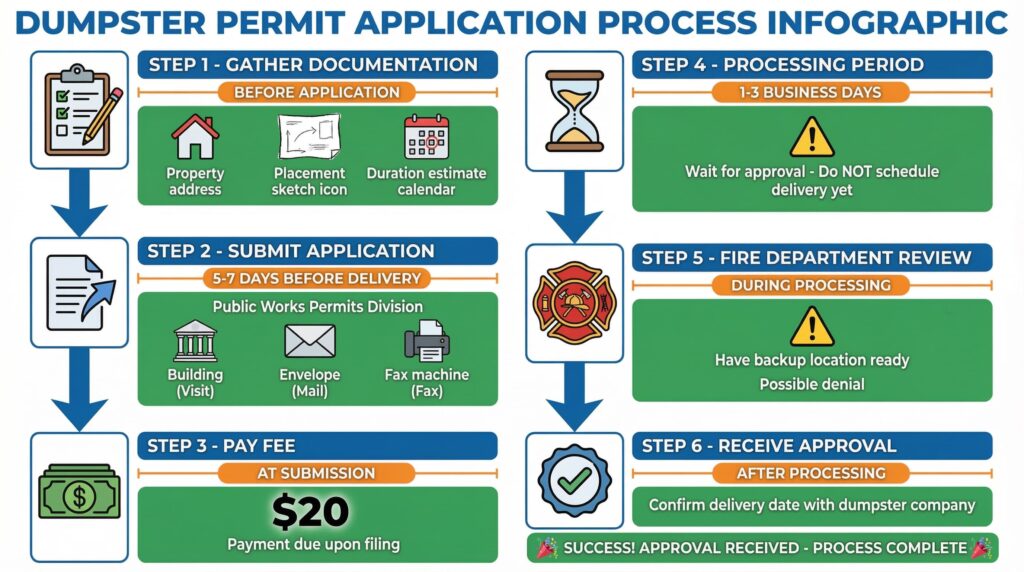
Peoria’s permit application requires basic project information. You need the exact address where the dumpster will sit, planned placement duration, and container dimensions. A simple sketch showing proposed location relative to streets, intersections, and fire hydrants helps expedite approval. The Public Works Department uses this information to evaluate safety and traffic impact.[2]
Applications can be submitted in person, by mail, or by fax to the Permits Division at 3505 N Dries Lane. The office operates during standard business hours with staff available at 309-494-8800 to answer questions. Having all required information ready before contacting the office saves time and prevents application delays.
Processing time typically runs 1-3 business days after submission. Contractors should plan accordingly and never schedule dumpster delivery before receiving permit approval. Some urgent situations may qualify for expedited processing through direct contact with the Permits Division, though approval is never guaranteed for rush requests.[3]
Payment of the $20 fee is due upon application submission. The fee covers a 30-day period and includes the administrative review and any required inspections. Extensions require additional $20 payments for each subsequent 30-day period. This straightforward fee structure helps contractors budget accurately for extended projects.[2]
Working With Your Dumpster Sourcing Service
Many dumpster sourcing firms help coordinate permit applications as part of their service. When you work with a sourcing service to compare local options and arrange availability, ask whether they assist with permit paperwork. Some services maintain relationships with haulers who handle permits directly, streamlining the entire process for contractors.
Clear communication about placement plans prevents last-minute complications. Tell your sourcing service whether you plan private or public placement when requesting quotes. This information helps them match you with haulers familiar with Peoria permit requirements and equipped to handle necessary safety measures for public placement.
Timing coordination becomes critical when permits are involved. Your sourcing service should understand that delivery cannot occur until permit approval is received. Building this buffer into your project schedule prevents costly delays and keeps your renovation or construction work on track.
Some typical 20-yard dumpster projects require more planning than others. Commercial renovations in busy areas may need early permit applications to secure approval before project start dates. Residential work with flexible timelines can afford more relaxed permit scheduling.
| Permit Application Step | Timeline | Contractor Action Required |
|---|---|---|
| Gather documentation | Before application | Prepare address, placement sketch, duration estimate |
| Submit application | 5-7 days before delivery | Visit, mail, or fax to Public Works Permits Division |
| Pay $20 fee | At submission | Payment due upon application filing |
| Processing period | 1-3 business days | Wait for approval before scheduling delivery |
| Fire Department review | During processing | Be prepared for location denial and backup plan |
| Receive approval | After processing | Confirm delivery date with dumpster source |
Additional Regulations and Considerations
HOA and Building Management Rules
Homeowners associations frequently impose restrictions beyond city requirements. Some HOAs prohibit visible dumpsters regardless of city permit status. Others limit container placement to specific areas or restrict rental duration to shorter periods than city regulations allow. Contractors must review HOA covenants before finalizing placement plans.
Multi-family properties and condominiums often require building management approval separate from city permits. Property managers may mandate specific placement locations, loading hours, or cleanup protocols. These internal requirements exist even when city permits are not needed for private property placement.
Notification requirements vary by HOA. Some associations demand advance notice to all residents when a dumpster will be placed in common areas or where it affects shared views. Contractors working in HOA communities should clarify these expectations early to avoid complaints or forced removal of containers.
Violation penalties can be severe. HOAs may impose daily fines for unauthorized dumpster placement or duration violations. These fines typically fall on property owners who then seek reimbursement from contractors. Including HOA rule verification in your pre-job checklist protects all parties from unexpected costs.
Project-Specific Permit Overlap
Construction and demolition projects may require building permits in addition to dumpster permits. When your work involves structural changes, electrical upgrades, or plumbing modifications, separate permits from Peoria’s Building Division become necessary. Your 20-yard dumpster permit does not replace or combine with these construction permits.
Some building permits include provisions for temporary structures and equipment. Occasionally, a comprehensive construction permit provides coverage for associated dumpster placement. Contractors should verify with both the Building Division and Permits Division to avoid duplicate permit costs or missed requirements.
Lane closure permits may be needed alongside dumpster permits. When your project requires blocking traffic lanes beyond the space occupied by the dumpster itself, additional right-of-way use permits come into play. These situations occur frequently in narrow street renovations or large commercial projects.[4]
Always verify whether your specific project requires multiple permit types—building permits and dumpster permits serve different regulatory purposes.
Cost Analysis for Contractors
Permit Fees and Associated Costs
The base $20 permit fee for 30 days represents just the starting point for public placement costs. Barricades with flashing lights rental can add $50-100 to project expenses. Reflective tape and protective boards under the dumpster add another $20-40 in materials. These safety requirements increase total cost significantly compared to private placement.[2]
Meter hood rentals in commercial areas create additional expenses. When your 20-yard dumpster occupies metered parking spaces, the city requires meter hoods to cover lost revenue. These rentals can cost $15-25 per meter per day, quickly exceeding the permit fee itself on longer projects in busy districts.
Extended rental situations multiply permit costs. A three-month renovation requiring street placement means three separate $20 permit renewals totaling $60 in city fees alone. Private placement eliminates this recurring cost while providing unlimited duration flexibility based solely on your hauler’s rental terms.
Road damage repair liability presents the largest potential cost. Contractors bear full responsibility for pavement repairs if their dumpster causes damage to city streets. While uncommon with proper board placement, this liability can reach hundreds or thousands of dollars. Private property placement transfers this risk to surface protection rather than pavement repair.[1]
Savings Through Strategic Placement
Private property placement saves contractors between $90-200 per project on average. The permit fee elimination combines with avoided safety equipment costs and eliminated meter hood rentals. These savings improve profit margins on competitive bids while reducing administrative overhead.
Time savings translate to money for busy contractors. The hours spent preparing permit applications, waiting for approval, and managing renewals could be invested in billable work. Private placement recovers this time while reducing the complexity of project management across multiple simultaneous jobs.
Risk reduction represents another form of savings. Eliminating road damage liability and simplifying HOA compliance reduces insurance claims and dispute resolution costs. Contractors who consistently choose private placement where possible experience fewer complications and smoother client relationships.
Comparing placement options should be standard practice. Before automatically requesting a permit, contractors should evaluate whether creative private placement is possible. Temporary driveway reconfiguration, sequential project phasing, or alternative access routes sometimes enable permit-free placement with modest additional planning.
Case Study: A Peoria remodeling contractor reduced annual permit costs by $840 by prioritizing private placement across 14 residential projects. The strategic planning added approximately 30 minutes per project but eliminated all permit fees, safety equipment rentals, and associated paperwork delays.
Common Mistakes Contractors Make
Placement Assumptions
Assuming the driveway is entirely private represents the most common mistake. Many contractors place dumpsters without verifying exact property boundaries. Even partial encroachment onto public aprons or street-side curb areas triggers permit requirements and potential violation notices.
Trusting visual assessment of property lines creates problems. Driveway pavement often extends beyond property boundaries into city right-of-way. Professional contractors either review property surveys or contact the city’s Address Assignment office to confirm exact boundaries before committing to permit-free placement.
Overlooking HOA jurisdiction happens frequently in newer developments. Contractors accustomed to working in older neighborhoods without associations may not think to check for HOA rules. This oversight leads to violations, fines, and difficult conversations with property owners who expected professional guidance.
Misunderstanding permit duration causes renewal issues. Some contractors assume the $20 fee covers the entire rental period regardless of length. When projects extend beyond 30 days without renewal applications, violation notices arrive along with potential fines that exceed the original permit cost.[2]
Communication Failures
Failing to communicate placement plans with clients causes problems. Homeowners may expect private driveway placement only to discover their contractor needed street placement due to size constraints. Early discussion of placement requirements and associated costs prevents surprises and maintains trust.
Not coordinating with dumpster sourcing services about permit status creates delivery delays. When haulers arrive without knowing permit approval is pending, they cannot legally place the container. This forces rescheduling and disrupts project timelines while permit processing completes.
Assuming all haulers handle permits the same way leads to confusion. Some companies obtain permits as part of service while others expect contractors to secure approval independently. Clarifying this responsibility during initial coordination prevents gaps where no one applies for required permits.
Neglecting neighbor notification in tight quarters generates complaints. While not legally required, informing adjacent properties about temporary dumpster placement prevents disputes and maintains community goodwill. This courtesy becomes especially important for street placement that affects neighbor parking.
Tips for Smooth Permit-Free Projects
Measuring available space before ordering prevents placement problems. A 20-yard dumpster typically measures 22 feet long by 8 feet wide. Adding clearance for safe loading and access means you need approximately 25 feet of length and 10 feet of width. Verifying these dimensions fit entirely on private property eliminates permit needs.
Communicating with property owners about driveway use expectations prevents conflicts. Some homeowners need daily vehicle access during renovation work. Discussing how dumpster placement affects their routines and finding mutually acceptable arrangements keeps projects running smoothly.
Protecting private surfaces maintains good client relationships. Using boards under dumpsters on driveways prevents damage just as effectively as city-mandated boards on streets. This professionalism demonstrates care for client property while avoiding repair costs and disputes.
Planning loading access carefully maximizes private placement efficiency. Position your dumpster where debris routes are shortest and safest for crews. Good placement reduces labor costs and injury risk while keeping containers entirely on private land.
Documenting placement with photos protects contractors. Taking time-stamped images showing the dumpster entirely on private property provides evidence if permit questions arise later. This simple step prevents disputes about whether permits should have been obtained.
Conclusion
Understanding permit requirements for 20-yard dumpsters in Peoria saves contractors time and money on every project. The location-based regulation is straightforward: public right-of-way placement requires a $20 permit while private property placement needs no city approval. Strategic planning to maximize private placement opportunities eliminates permit costs and simplifies project management.
Successful contractors verify property boundaries, coordinate with sourcing services, and communicate placement plans clearly with all stakeholders. Following Peoria’s safety requirements and respecting HOA rules prevents violations regardless of permit status. These professional practices build reputation and improve profitability across all dumpster rental projects.
Ready to Source Your Next 20-Yard Dumpster?
Zap Dumpsters Peoria helps contractors compare local options and coordinate availability across trusted hauling partners. We streamline the sourcing process whether you need permit assistance or private placement guidance.
Call (309) 650-8954 to discuss your project needs and get matched with the right dumpster solution in Peoria, IL.
20 Yard Dumpster Permit FAQs
Do I need a permit for a 20-yard dumpster if it only touches the street a little bit?
Yes, any portion of your dumpster extending into public right-of-way requires a permit regardless of how minimal the encroachment. Peoria enforces this requirement strictly because even small obstructions affect traffic flow and emergency vehicle access. The $20 permit fee applies to partial street contact just as it does to full street placement.
Can my dumpster sourcing service obtain the permit for 20-yard dumpsters on my behalf?
Some sourcing services coordinate with haulers who handle permit applications as part of their service, while others expect contractors to manage permits independently. When you contact a sourcing service to compare options and arrange availability, ask specifically whether permit assistance is included. Clarifying this responsibility during initial coordination prevents confusion and delivery delays.
How far in advance should I apply for a permit for 20-yard dumpsters in Peoria?
Submit permit applications at least 5-7 business days before your planned delivery date. Peoria’s Public Works Department typically processes applications within 1-3 business days, but the Fire Department review and potential location issues can extend approval time. Early application prevents project delays and ensures you have approval before scheduling dumpster delivery.
What happens if I place a 20-yard dumpster on the street without getting a permit?
Placing a dumpster on public right-of-way without proper permits results in violation notices and potential fines. The city may require immediate removal of the container, forcing project delays while you secure proper approval. Contractors may also face liability for any incidents occurring due to unpermitted obstruction of public areas. Always obtain required permits before delivery to avoid these complications.
Does my building permit cover my 20-yard dumpster or do I need a separate permit?
Building permits and dumpster permits serve different regulatory purposes in Peoria. Your construction or renovation permit does not automatically provide authorization for dumpster placement on public right-of-way. Contact both the Building Division and the Public Works Permits Division to verify all required permits for your specific project, as some situations may require multiple separate approvals.
20 Yard Dumpster Permit Citations
- City of Peoria Public Works Department. “Dumpster or Portable Storage Containers (PODs) on the Right-of-Way.” Peoria, IL Official Website. https://www.peoriagov.org/459/Dumpster-or-Portable-Storage-Containers-
- City of Peoria Public Works Department. “Fees – Public Works Department.” Peoria, IL Official Website. https://www.peoriagov.org/428/Fees
- Zap Dumpsters Peoria. “Do I Need a Dumpster Permit in Peoria? How Do I Get One?” https://zapdumpsterspeoria.com/how-to-get-a-dumpster-permit-in-peoria-il-2/
- City of Peoria. “Permits.” Peoria, IL Official Website. https://www.peoriagov.org/443/Permits